Cooking in Two Languages
In a multilingual kitchen, ingredients, commands and affection do not cross languages evenly. What survives translation depends on words, gestures and the people cooking together.
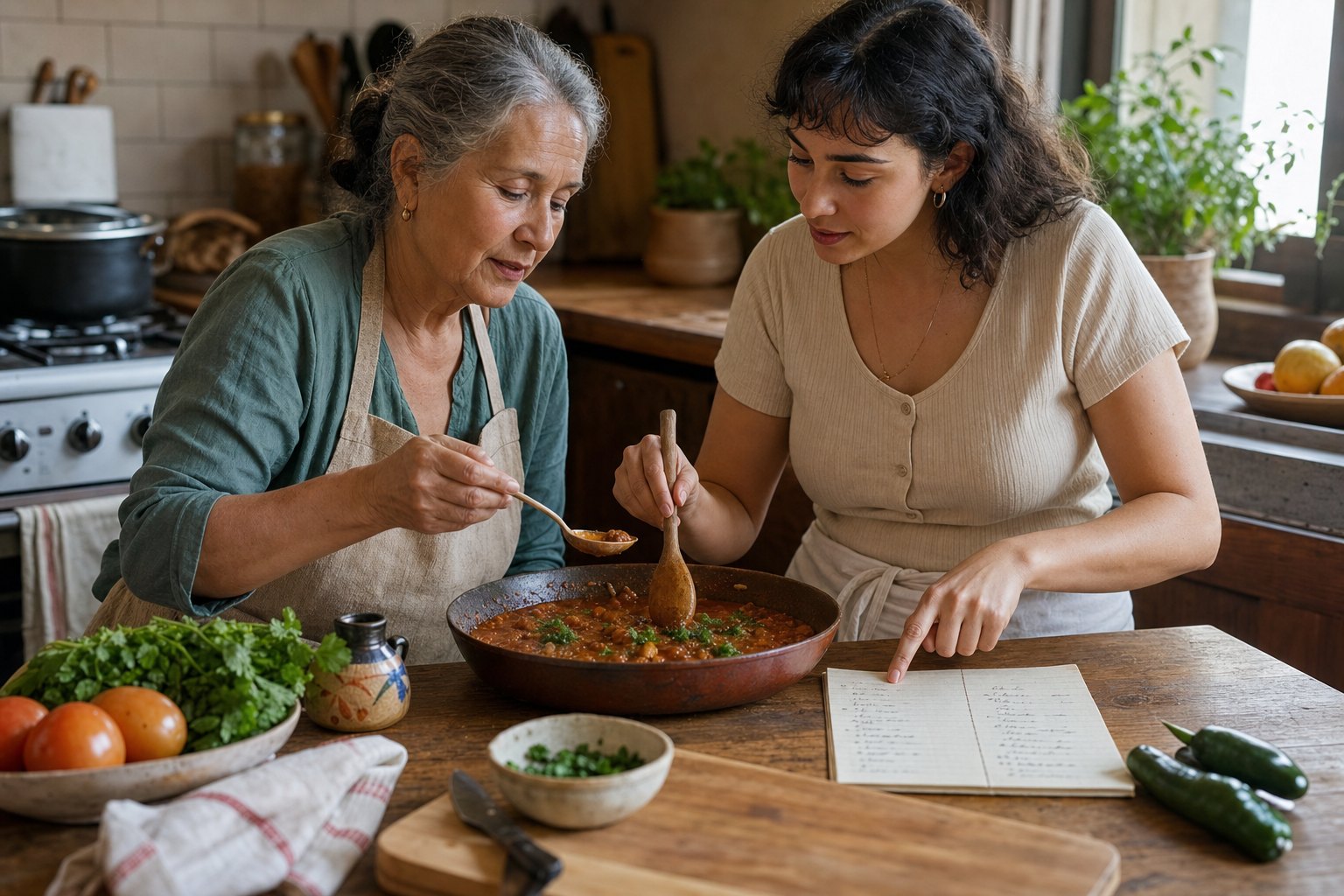
A hand reaches for the salt before the sentence is finished.
The older cook named the ingredient in one language and gave the instruction in another. The younger cook answered in the language used at work, then measured according to the packet. Now the older cook repeats a short kitchen word with no convenient equivalent—not “stir,” exactly, and not “fold,” but the movement that keeps this mixture light.
The spoon changes direction. That is enough.
Nobody announces that a translation has taken place. There is no clean border where one vocabulary stops and the other begins. A noun crosses the conversation; a command stays where it has always lived. A gesture supplies the missing precision. Then an affectionate warning—half instruction, half family joke—makes both cooks laugh.
This is what cooking in two languages often looks like. It is less like translating a printed recipe and more like keeping several kinds of knowledge moving at once. Ingredient names, temperatures, measures, memories, reprimands and endearments do not cross the border evenly. Some arrive almost unchanged. Some expand into explanation. Some shrink into a general word. Others refuse to move until a hand demonstrates what the mouth cannot quite say.
From outside, the exchange may sound unfinished. Inside this kitchen it is exact enough to cook by. The two people use every available word, object, sense and shared memory to make the food come out right.
The kitchen rarely waits for a perfect translation
A dictionary imagines that translation begins with two words placed opposite each other. A kitchen gives translation a hot pan, a noisy extractor fan and three things that need attention at once.
Under those conditions, accuracy has a practical meaning. The point is not to produce the most elegant sentence. The point is to stop the garlic from burning, recognise when the dough has had enough water and know which jar someone means when they call it by the name used in another country.
This urgency changes the shape of communication. Speakers shorten sentences. They repeat key words. They point, taste, imitate and correct. A person who is not confident enough to discuss politics in a heritage language may know exactly what to say when a sauce begins to split. Another who speaks that language easily may still reach for the local language to name an appliance that never appeared in the kitchens of their childhood.
The languages divide the work according to experience.
One may hold the names of leaves, cuts of meat and stages of ripeness. Another may be better for oven settings, supermarket labels and food-safety advice. The heritage language may return when someone wants to express impatience, tenderness or disbelief. The community language may enter when a child reads the next step from a website. Both may be present in a single sentence because a single sentence is doing several jobs.
From outside, this can sound incomplete: words borrowed, grammar interrupted, thoughts apparently switching tracks. From inside, it may be precise. The speakers know which term will be understood fastest and which carries the right texture of meaning. They are not failing to remain in one language. They are using the kitchen repertoire they have built together.
Ingredient names carry geography
Ingredients seem like the easiest part of a recipe to translate. An onion is an onion, surely, and flour remains flour.
But ingredient names rarely point only to an object. They can also identify a variety, a preparation, a season, a market category or an expected use. A word translated simply as “cheese” may imply a particular age and saltiness. “Greens” may refer to leaves that are ordinary in one place and sold only in specialist shops in another. A familiar grain may be divided into several everyday types in one language but gathered under a broad label in the other.
This is not because one language is inherently richer. Languages grow detailed where communities have needed, valued and repeated distinctions. Their everyday vocabularies record habits of buying, growing, storing and cooking. When ingredients move, the old categories meet new shelves.
Migration makes this especially visible. A family may continue using the name of an ingredient from its place of origin even when the packet carries another label. The old word can come to mean not just the plant or spice but “the version we buy for our food.” A local substitute may acquire the heritage name because it now performs the same role. The word remains stable while the object beneath it changes.
The reverse also happens. Children may know the supermarket name but not the one spoken by grandparents. They recognise the ingredient in the kitchen yet cannot find it when asked in the other language. A relative on the telephone describes it by appearance, where it sits in the shop and what should be written on the bag. The search becomes a small lesson in both language and geography.
This is why translating an ingredient list can require more than replacing terms. A useful translation may need to say what the ingredient does: adds sourness, thickens the broth, perfumes the oil, softens after long cooking. Function can travel when the exact object cannot.
And sometimes the untranslated name is the most accurate choice. Keeping it does not make the recipe inaccessible if the cook also explains how to identify, select and use the ingredient. The original word can remain as a doorway into a category the receiving language has not yet made familiar.
Cooking verbs divide movement differently
The hardest words in a recipe are often verbs.
English-language recipes distinguish among chop, dice, mince, slice, fold, whisk, beat, simmer, boil, sear, brown and toast. Those boundaries do not transfer neatly. A comparative study of Korean and English cooking verbs, for example, found few simple one-to-one matches in its teaching-material and cooking-video sample. Depending on the action, one familiar verb may arrive in the other language as several terms—or require a phrase.
Translation therefore changes not only words but the boundaries between actions.
Consider an instruction rendered as “cook until done.” The grammar is fine; the practical guidance is almost gone. What heat? Which movement? What visible change marks completion? A more specific source verb may have implied an intensity, method or expected result that disappears into the general word “cook.”
The missing detail is often restored by the cook’s body. A hand shows the angle of the knife. Fingers demonstrate how finely an ingredient should be broken. The spoon moves around the edge of the bowl rather than through the middle. A palm hovers above the pan to judge heat. The younger cook repeats the movement, and the older cook says, “Yes—like that.”
In this exchange, the gesture is not an optional illustration added to a complete verbal instruction. It is part of the instruction itself.
This matters when a recipe moves from oral teaching into writing. The writer has to notice distinctions that were previously carried by imitation. “Mix” may need to become “lift the mixture from underneath and turn it over gently.” “Fry” may need a note about the sound the oil should make. A verb that felt obvious in the first language becomes a paragraph in the second.
That expansion is not evidence that the original was vague. It shows how much context can live inside a familiar kitchen word.
“A little” belongs to a relationship
Quantities create another false impression of simplicity. Numbers appear universal, so a translated recipe with grams and minutes can look more exact than the spoken knowledge from which it came.
Yet many domestic recipes are built from relational measures: a small glass, a full spoon, a handful, enough water, the amount the flour takes. Their precision depends on repeated practice with particular ingredients, vessels and people.
When the older cook says “a little,” the younger one may already know whether that means a cautious pinch or a generous pour. Years of watching have calibrated the phrase. Too little might earn only a look; too much brings back the same teasing correction heard during earlier lessons.
Translate “a little” literally for a stranger and the relationship disappears. The words remain, but the shared scale behind them is gone.
This is where family recipe projects often slow down. The person demonstrating thinks the amount is obvious; the person holding the notebook wants a number. They pause, tip the ingredient back out and weigh it. The cook’s “handful” turns out to be remarkably consistent. It was never a careless measure. It was a measure held in the body.
Numbers can make that knowledge portable, but they also change it. They separate the instruction from the hand that once supplied the scale. This is useful for someone learning at a distance, yet it may produce a different kind of recipe—one designed to survive without the original relationship.
A generous translation preserves both forms when possible. It gives a quantity and the sensory judgement: two tablespoons, or enough to make the paste loosen from the spoon; twenty minutes, or until the surface is set but the centre still trembles. The number offers a starting point. The description teaches the cook how to stop depending on it.
Commands remember who taught whom
Kitchen language is full of imperatives: wash, cut, wait, taste, bring, turn it down.
Imperatives look neutral on a printed page. In a family kitchen they arrive with a speaker, a history and a tone. The same two-word instruction can be caring, impatient, comic or severe.
A heritage language may be the language in which a parent first taught a child to keep fingers away from a blade. Years later, the grown child may speak another language for most of the day, but the old warning still arrives unchanged. It is quicker than translation and weighted with every earlier time it was said.
Sometimes a speaker switches languages precisely to change the emotional temperature. A correction in one language may feel too sharp, so it is softened in another. Or the heritage language may be chosen because affection sounds less exposed there. An instruction that would seem formal in the community language becomes intimate when spoken in the words of childhood.
That social force is difficult to carry into a conventional bilingual recipe. “Taste it” might invite a learner to trust their judgement, set a test or issue a playful challenge. Even “move” can mean “you are in my way” and “you belong in this work” at once.
The relationship between cooks helps listeners interpret what the words alone cannot settle. Facial expression, timing and familiarity all participate. That is why a sentence overheard by a guest may sound harsher—or more tender—than it feels to the people who have spent years cooking together.
Translation is never only between languages. It is also between relationships.
Endearments season the instruction
Recipes prepared for publication usually remove the names people use for one another. The verbs survive; the endearments disappear. At home, separating them may be impossible.
A person may say “my dear” before correcting a mistake, use a childhood nickname while asking for a bowl, or attach a diminutive to an ingredient, utensil or action. These small forms can soften authority and make work sociable. They remind the learner that instruction is taking place inside a relationship, not an examination.
Endearments also resist clean translation. Their dictionary equivalents may sound too romantic, childish or theatrical in another language. A phrase used casually by an aunt may feel unnatural if rendered word for word. Families therefore leave it untranslated, shorten it, or replace it with another marker of closeness.
Humour travels just as unevenly. A kitchen joke may depend on a rhyme, a regional accent or one relative’s familiar delivery. Retold in another language, its information survives and its timing collapses. Somebody explains why it was funny; before long, the failed explanation has become part of the family story too.
Yet untranslatable does not mean unshareable. The younger cook can learn when the expression is used even without a perfect equivalent. A partner entering the family may first recognise the phrase by tone, then by situation, and only later by literal meaning. The words acquire a place in the new speaker’s life through repetition.
In this way, a kitchen can become a small archive of affectionate language. People who have forgotten much of a childhood vocabulary may retain the phrases that accompanied food: come and eat, taste this, take some more, be careful, it is hot.
These are not decorative additions to culinary knowledge. They are part of the reason the knowledge was worth receiving.
Switching languages is a practical skill
Language switching is sometimes described only as deficiency: the speaker starts in one language because they cannot finish in it, or borrows a word because the “proper” one has been forgotten. That happens. It is nowhere near the whole explanation.
Multilingual cooks also switch because one term is more exact, one phrase is faster, one person needs help, or one language fits the mood. A child reads an online recipe aloud in the community language while a grandparent comments in the heritage language. An ingredient keeps its original name, the appliance takes the local name, and the command linking them is a mixture understood by everyone present.
The switching is not random. Over time, families develop patterns.
Certain topics pull a conversation toward one language. The shopping list may belong to the language of local commerce. Stories about who first made the dish may return to the language in which those memories were formed. Technical explanations may follow whichever person has the stronger vocabulary. Jokes may switch midway to reach the best ending.
The pattern can also respond to inclusion. When a guest or younger relative cannot follow, someone translates, paraphrases or repeats. The speaker may keep the key heritage word and surround it with explanation, allowing the listener to learn it without losing the thread of the work.
A kitchen does not become inclusively bilingual by saying every sentence twice. Constant duplication would slow the work and make conversation stiff. Participants make quicker judgements: what must be translated now, what can be inferred from the task, and which word is worth learning in place.
That judgement is itself a form of knowledge. It depends on attention to other people: who understands, who is pretending to understand, who needs a demonstration, and who is ready to be trusted with the next step.
The body translates before the dictionary does
Cooking knowledge enters through the senses long before it becomes an explanation.
A learner watches how the dough resists the heel of a hand. They hear the change in sound when water leaves a pan. They notice the smell that comes just before spices scorch. They see how an experienced cook lifts the lid without letting condensation fall back onto a crisp surface.
These signs can be shared across languages because they are available to the body. But they are not automatically understood. Attention must be directed.
“Listen,” someone says.
“Smell now.”
“It should feel like this.”
The verbal cue points toward a sensory event. The learner then connects a word, a moment and a physical judgement. If the cue changes language, the sensory memory can hold the lesson together.
This is why demonstrations are so powerful in multilingual kitchens. They do not eliminate language; they give language something visible and repeatable to attach to. A cook may lack the vocabulary to define the exact texture but can create it, show it and invite another person to touch it.
Video calls can carry this teaching across distance, though never completely. A camera shows thickness and colour but cannot transmit aroma, heat or resistance. The teacher compensates: let it fall from the spoon; show me the bubbles; stir again so I can hear it. The learner lifts the bowl toward the camera and waits.
Translation becomes collaborative. One person searches for words while the other adjusts the angle, repeats the movement and offers a guess. Meaning is assembled between them.
The body does not make language unnecessary. It reveals how language and perception have always worked together.
Written recipes flatten an oral kitchen
Writing protects knowledge from some kinds of loss. It can preserve an ingredient list, record a family variation and let someone cook when the teacher is absent.
It also removes the interruptions.
On the page, nobody tastes and changes their mind. Nobody answers a question with “not that spoon, the other one.” The recipe cannot notice that today’s tomatoes contain more water, the learner is nervous or the pan is thinner than last week’s. A clean sequence replaces the back-and-forth through which domestic cooking actually happens.
Translation can flatten the recipe a second time. Regional words become standard ones. Repeated instructions are trimmed. The writer chooses one equivalent for a term that changed according to context. An endearment, aside or family warning is judged irrelevant and removed.
The result may be easier to follow and less recognisable to the people who made it.
This does not mean recipes should imitate conversation word for word. A transcript of a busy kitchen can be unreadable. The challenge is to decide which irregularities carry knowledge.
A bilingual family recipe might retain the original name of the dish and explain its pronunciation. It might place a heritage cooking verb beside a descriptive phrase instead of pretending they are exact equivalents. It could record the sensory test after the measured instruction. A note might identify who uses which variation and why.
Audio can preserve voice and rhythm. Video can preserve gesture. Photographs can show stages that are difficult to describe. None is complete alone, and none needs to be.
The aim is not to freeze the kitchen into a perfect record. It is to leave enough paths back into the practice that another person can continue it.
Migration changes the vocabulary of substitution
When recipes travel, translation happens among ingredients as well as words.
The exact bean is unavailable, so a similar one is used. A fish has a different market name and behaves differently under heat. Flour absorbs more water. A herb appears only frozen. The oven is more reliable than the one remembered from home, while the outdoor grill is impossible in an apartment.
Families develop a language for these compromises.
They distinguish between the ingredient that is “right,” the one that is “good here,” the one used only in an emergency and the one that changed the dish so successfully that it became permanent. These judgements may not appear in a formal recipe, but they organise the migrant pantry.
A substitute is not automatically an inferior copy. It may answer to climate, price, dietary need or a new neighbour’s influence. Given enough time, children know the adapted dish as the family version; encountering another rendition later, they are surprised by what it lacks—or contains.
The two languages can mark this history. The heritage name remains attached to the remembered ingredient, while the community-language name identifies what is actually purchased. Or the original term expands until it includes both. Speakers understand the distinction through context.
Explaining the substitution to someone outside the family often reveals the chain of decisions hidden inside it: what quality mattered most, what could change, what had to be protected. The process is a lesson in the recipe’s structure.
To translate a travelling recipe well, then, is not to erase substitution. It is to document the reasoning that made substitution possible.
Children may inherit a kitchen-sized language
Not everyone receives a family language evenly.
A child may understand far more than they speak. They may know greetings, warnings and the names of foods but lack the vocabulary for school, work or abstract conversation. Adults sometimes describe this as knowing “only kitchen words,” as though the knowledge were small.
But “kitchen-sized” does not mean small.
It may include plants, tools, textures, kinship terms, invitations and rules of hospitality. It teaches who is served first, how generosity is expressed, when refusal is polite and how insistence can be affectionate. It may be the language in which a child learns to ask an elder for a story without appearing to ask.
This repertoire can also be fragile. If younger speakers are mocked for pronunciation or corrected at every attempt, they may retreat into the language in which they feel competent. If adults refuse to explain because “you should know,” the kitchen becomes a test of belonging rather than a place of learning.
Gentler practices make more room. A relative repeats the word without turning pronunciation into a public test. A label carries both languages. Most importantly, the child receives a real kitchen task instead of being asked to perform vocabulary on demand. The word returns next week because the work needs it.
Competence grows around purpose. The learner remembers the term because it helps them choose the right ingredient or understand when the pan is ready.
Some people later rebuild the language outward from this culinary core. A dish name leads to a regional history. A remembered command opens a conversation about grammar. A phrase of praise recalls a voice. The kitchen vocabulary becomes not the limit of inheritance but its starting place.
Recording both languages without freezing either
Families who want to preserve multilingual recipes face a delicate choice: how much to standardise.
Too little explanation can make a record unusable. Too much can make a living practice look like a museum object. The goal is not to establish a final authorised version but to make future cooking possible.
A practical record can begin with both names for the dish and its ingredients, including local or family spellings. Where a direct translation misleads, a description is more useful than a false equivalent. Cooking verbs need particular care: what movement, heat, sound or visible change does the word imply here?
It also helps to record variation openly.
“This is the version made in winter.”
“She uses more water because her pot is wider.”
“We call both ingredients by the same name, but this is the one meant here.”
“He says this instruction in the other language because that is how his mother said it.”
Such notes do not weaken a recipe. They show the conditions under which knowledge lives.
The recording process itself can become an intergenerational meal. One person cooks, another writes, a third asks questions that once seemed unnecessary. Disagreement is useful if it reveals hidden assumptions. The family can keep multiple answers rather than forcing consensus.
Digital tools make it possible to layer the record: a concise recipe for use, an audio clip for pronunciation, a short video for the difficult motion, and a note about the people associated with the dish. Translation can remain revisable. New speakers can add the term used where they live.
Preservation then becomes less like sealing a container and more like setting another place at the table.
What survives between the words
By the time the dish is ready, the conversation has moved through both languages many times.
The younger cook now uses the heritage word for the ingredient without thinking. The older cook reads the number on the modern oven and repeats it in the other language. A verb that resisted explanation has become a movement they can both recognise. The recipe notebook remains open, but no one is looking at it.
Something has been translated, but not into one final form.
The ingredient name has travelled with an explanation. The command has kept its familiar tone. The quantity has become both a number and a judgement. The gesture has passed from one pair of hands to another. A joke has survived imperfectly and is still funny because everyone remembers when it is told.
This is the deeper work of a multilingual kitchen. It does not merely carry culinary information across a linguistic divide. It creates a shared practice in the space between languages.
Some words will be lost. Others will change pronunciation, widen in meaning or attach themselves to new ingredients. A child may answer in a different language from the one they understand. A recipe written carefully today will still be altered by the person who cooks it tomorrow.
That is not a failure of preservation. It is how living knowledge moves.
At the table, nobody needs to account for which language contributed each part of the meal. The dish is served, corrected with a final squeeze or pinch, and recognised.
The translation is complete enough to eat.