The Restaurant for Regulars and Newcomers
Regulars give a restaurant continuity, but their belonging should make the room easier—not harder—for a newcomer to enter.
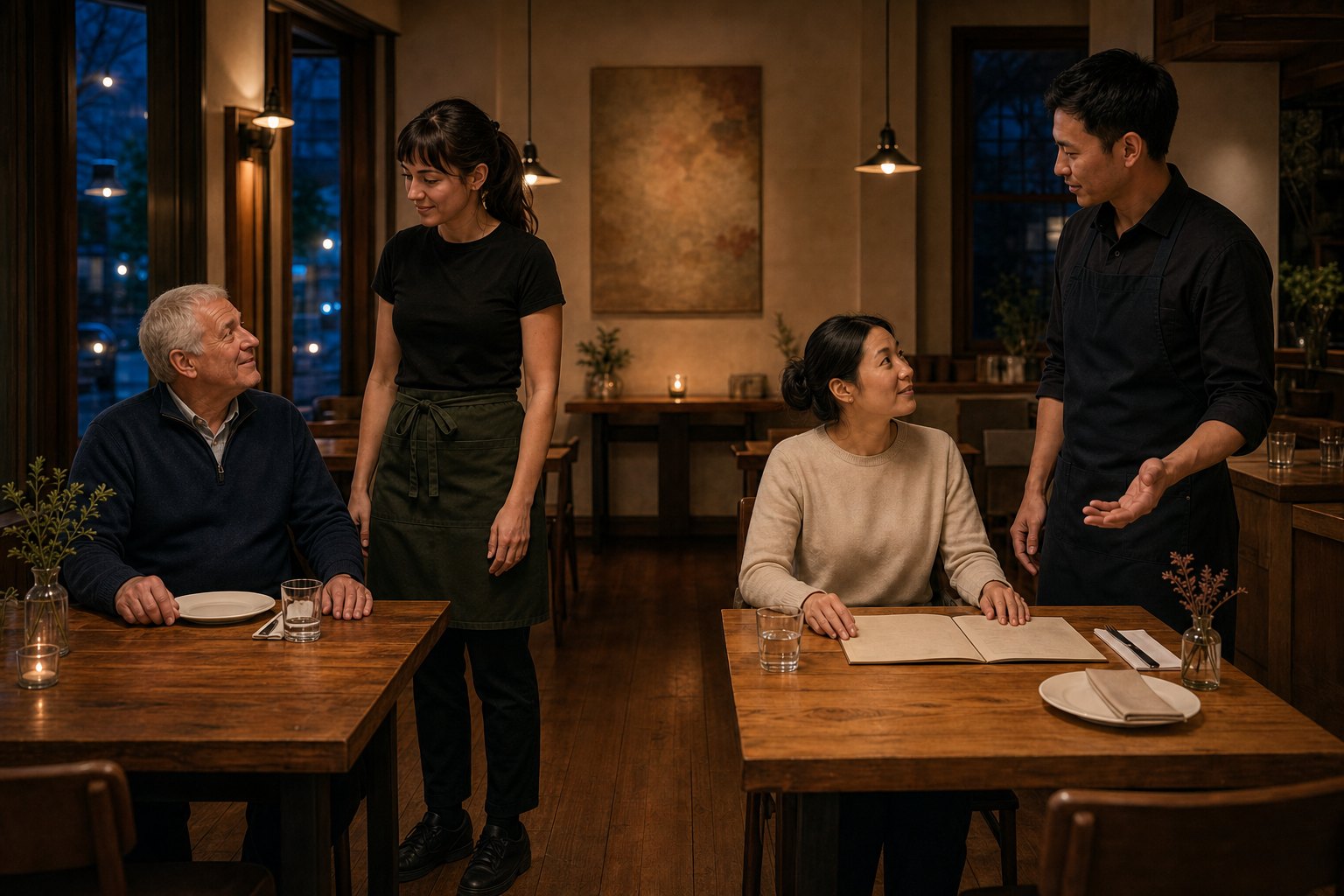
The regular enters without studying the door.
They know whether to wait, where coats go and which table will probably be offered. A member of staff looks up and recognises the face before checking the name. Perhaps nothing is said beyond hello. The ease is in what does not need explaining.
A few steps behind, a newcomer pauses.
Should they approach the desk? Is the empty table reserved? Does the menu on the wall contain the whole offer? The same room that feels effortless to one person presents a series of small uncertainties to another.
Neither experience is accidental. Restaurants accumulate habits around the people who return. Staff remember preferences, guests learn rhythms, and repeated encounters create a shorthand. That continuity can make a place feel alive rather than merely efficient.
It can also make the open door feel misleading.
A newcomer notices when greetings become warmer for someone else, when the better table appears after they were told none was available, or when a dish not on the menu is offered across the room. The restaurant may intend to reward loyalty. What the newcomer sees is a social order they do not yet understand.
The challenge is not to treat everyone as a stranger. It is to let recognition deepen hospitality without turning familiarity into rank.
What a regular gives a restaurant
Regulars are often described in commercial language: repeat visits, predictable revenue, lower acquisition costs, positive word of mouth.
All of this matters. A restaurant with returning guests has a steadier foundation than one constantly replacing its audience. But the contribution of regulars is also cultural.
They provide continuity across changing menus, staff and seasons. They remember the soup that disappeared, the server who left, the table that used to stand near the window. Their presence tells workers that yesterday’s effort was not immediately forgotten.
Regulars also stabilise the room. They know its pace. They do not need every custom explained. A calm familiar guest can make a difficult service feel more manageable, and an early table occupied by someone comfortable can make an empty restaurant feel inhabited rather than exposed.
Over time, some regulars become informal carriers of the place’s character. They greet staff without demanding attention, make room for others and model how the restaurant works. Their familiarity lowers social friction.
This is why recognition should not be dismissed as favouritism. Remembering a person is one of hospitality’s deepest pleasures. A restaurant that treats every return as a first encounter loses something essential.
The question is whether that memory remains relational or becomes territorial.
The first visit contains no evidence
A regular arrives with history. A newcomer arrives with possibility.
The restaurant knows what the regular orders, how they behave and perhaps how they tip. The newcomer has no record. Under pressure, uncertainty can be interpreted negatively. Staff may offer more time to the guest whose response they can predict and less to the person who requires explanation.
This is understandable. It is also how closed circles reproduce themselves.
Every beloved regular once entered without evidence. They may have mispronounced a dish, misunderstood the ordering system or taken too long to decide. Someone allowed the relationship to begin before it had demonstrated value.
The first visit is therefore not a lesser version of loyalty. It is the only route into it.
A restaurant that celebrates regulars but regards newcomers as interruptions eventually protects a shrinking community. The room becomes comfortable for those who already know how to belong and increasingly opaque to anyone outside.
An open door requires more than allowing entry. It means treating uncertainty as normal. The newcomer should not have to perform expertise, confidence or wealth before receiving patient attention.
Potential is harder to recognise than history. Hospitality is asked to make space for both.
Research on upscale restaurant environments also suggests that first-time and repeat customers do not necessarily read the same room in the same way. Familiarity changes the context in which décor, layout and atmosphere are interpreted. The practical lesson is modest: a room that feels obvious to returning guests may still need to explain itself to someone crossing the threshold for the first time.
Recognition without announcement
The most generous recognition is often quiet.
A glass of still water appears because that is what the guest usually chooses. The host asks whether the familiar table still suits rather than assuming. A server remembers an allergy without reciting the details publicly. A favourite dish is mentioned as information, not presented as an obligation.
Quiet recognition protects the regular from becoming a performance.
Some restaurants make familiarity highly visible. A name is called across the room. A drink arrives before it is requested. Other guests are told, through tone and spectacle, that someone important has entered.
The regular may enjoy this. They may also feel trapped by the identity the restaurant has assigned: the person who always orders the same thing, wants to talk, celebrates loudly or expects a favour.
Memory should remain provisional.
“Would you like your usual table?” is different from “Your table is ready.” The first remembers and asks. The second turns habit into possession.
Discretion also matters because recognition occurs in public. A benefit offered softly can strengthen a relationship without making the rest of the room witness a hierarchy. The same gesture announced dramatically may embarrass the recipient and alienate observers.
Familiarity does not need an audience to be real.
The room is watching
Restaurant service is unusually visible.
Guests sit near one another and have time to observe. They see who waits, who is moved, whose coat is taken, which table receives an extra dish and how quickly a familiar face attracts attention.
Preferential treatment therefore has at least two audiences: the person receiving it and everyone able to compare.
The recipient may feel valued. The observer may interpret the same moment as evidence about their own standing. Research on discretionary preferential treatment shows that visibility, justification and whether a benefit imposes on others all affect how it is received. A favour that delays another table or consumes a scarce resource is different from one that costs nobody else.
Observation does not produce only resentment. Experimental research also suggests that a visible benefit can increase a bystander’s intention to return when the recipient seems similar and the same treatment appears attainable. That finding makes legibility important: a privilege with an understandable route tells a different story from an arbitrary exception.
This distinction is practical.
Remembering a regular’s tea does not deprive a newcomer. Giving away the last desirable table after telling a waiting guest it was unavailable does. Offering an off-menu preparation may be harmless when the kitchen has capacity; allowing it to disrupt service throughout the room turns private recognition into public cost.
Restaurants sometimes say that guests should not compare. But the room itself invites comparison. Hospitality unfolds in shared sight.
A sound rule is simple: the more visible the privilege, the stronger its justification must be—and the less it should diminish another person’s experience.
The mythology of “the usual”
The usual is a small achievement.
It means a preference has survived long enough to become known. The guest does not have to construct the choice again, and the restaurant can offer continuity with one question.
Yet “the usual” can become a script that neither side knows how to revise.
The guest once ordered a strong drink after work and is now offered it on every visit. They no longer want it but feel awkward refusing the gesture of memory. A diner known for staying late now needs a quick meal. A person associated with one companion arrives with another. The restaurant remembers accurately and still gets the present wrong.
This is the paradox of recognition: memory can prevent attention.
Good regular service does not eliminate questions. It asks better ones. “Still sparkling?” “Would you like to see what has changed?” “Are you in a hurry tonight?” The shorthand remains, but it includes an exit.
The regular is not a stored order. They are a returning person, and return includes change.
Newcomers benefit from the same principle. They should be helped without being classified too quickly as difficult, inexperienced, extravagant or unlikely to return. One visit is too little evidence for a fixed role.
Hospitality remembers, then looks again.
The invisible rules of belonging
Many restaurants are easy only after someone explains them.
Perhaps guests order at the counter but sit before paying. Water is self-service. The menu is split across a board and a printed sheet. Bread is included at lunch but not at dinner. Regulars move through these rules without noticing them.
Newcomers notice.
An unexplained custom can feel like a test. The guest waits in the wrong place, asks for something unavailable or misses a special known to everyone else. If staff respond with impatience, the restaurant converts local knowledge into social status.
The problem is not informality. A place need not post instructions on every surface. The problem is allowing mistakes to reveal who belongs.
Good welcome makes the system legible before failure. A host says, “You can take any open table, and we’ll come to you.” A server explains that the smaller menu is available at the bar. A sign provides one useful direction rather than a list of prohibitions.
Regulars can help too. The best do not guard the rules as insider knowledge. They shift a chair, indicate where the queue begins or reassure someone that the owner will be back.
Belonging becomes generous when knowledge circulates.
Staff memory and the ethics of notes
Modern recognition is not always personal memory.
Reservation systems can record table preferences, allergies, birthdays, favourite bottles, complaints and spending. These notes help staff provide continuity even when the employee and guest have never met.
Used carefully, the system expands memory beyond one relationship. A dietary need does not have to be explained from the beginning on every visit. A guest who requires an accessible route can be welcomed without another negotiation.
But stored recognition changes the ethical shape of familiarity.
What did the guest knowingly share? Who can read it? How long does it remain accurate? Does a note describe a need, or judge a personality? “Prefers quiet table” supports care. “Difficult” can bias every future encounter without context or appeal.
Data can also make a first-time guest visible to the restaurant before the restaurant is visible to them. Staff may know a celebration, employer or spending history gathered elsewhere. What appears as uncanny attentiveness may feel intrusive.
The principle should be relevance with restraint. Record what protects safety, access and a clearly expressed preference. Avoid turning impressions into permanent character.
A guest profile should make hospitality easier, not make the person feel observed.
The danger of the regular’s ownership
Some regulars begin to speak of a restaurant as theirs.
The phrase can be affectionate. “Our place” names a relationship built through years of meals. It can also become a claim.
The regular expects the preferred table even when another guest reserved it. They interrupt staff who are serving someone else, comment on menu changes as though holding veto power, or treat newcomers as visitors to a private room.
Restaurants may tolerate this because the relationship is valuable. Small concessions accumulate until the guest’s comfort is being subsidised by employees and other diners.
At that point, recognition has crossed into ownership.
Boundaries protect the relationship. A regular can be warmly told that the table is booked, that the kitchen cannot make the old dish tonight, or that a server must finish with another guest first. Consistency reassures the rest of the room and reminds the regular that belonging is shared.
The best regulars understand this. They do not require the restaurant to prove affection by displacing someone else. Their ease makes space rather than consumes it.
A community is not strengthened by the member with the greatest permission to ignore its rules.
Newcomers are not a single category
“First-time guest” sounds neutral, but newcomers arrive with very different relations to restaurants.
One may be experienced and simply new to this address. Another may rarely dine out. Someone may speak the menu’s language but not the staff’s. Someone may understand every culinary reference and still need physical accessibility that the room has not anticipated.
Treating all newcomers as uninformed can be as alienating as assuming knowledge.
The useful approach is to offer orientation without requiring it. “Would a quick explanation of how the menu works be helpful?” leaves competence intact. The guest can say yes, no or ask a narrower question.
Tone matters. Explanations should not become performances of expertise in which the server demonstrates how much the guest does not know. Nor should unfamiliarity be treated as a sales opportunity to steer someone toward the most expensive “safe” choice.
Newcomers often need permission more than instruction: permission to ask, to order modestly, to pronounce imperfectly, to decline the house ritual, to stay quiet.
An open restaurant does not make belonging contingent on fluency.
The economics behind unequal warmth
Recognition can be sincere and economically shaped at the same time.
Staff know which guests visit often, spend generously, tip reliably or support the restaurant during difficult periods. In a business with thin margins and uncertain demand, prioritising those relationships can feel rational.
But assumptions about value are imperfect.
Research has found that servers hold different beliefs about which categories of guests are likely to tip, including a tendency to rate regular patrons highly. Such expectations can influence how attention is distributed before the guest has done anything at the current table.
The cited survey measured servers’ perceptions, not the actual generosity of those guest groups. That distinction matters. A stereotype can shape service even when it is inaccurate, and the service it produces may then affect both the tip and the likelihood of return.
This creates a self-fulfilling pattern. The person expected to reward receives warmer service and is more likely to return. The uncertain newcomer receives less investment and confirms the belief by not returning.
The restaurant sees loyalty. It may also be seeing the result of its own allocation.
Economic gratitude need not disappear. A business can acknowledge the people who sustain it. But baseline welcome should not depend on a prediction of future value. Accuracy, patience and dignity are not loyalty rewards.
The guest most likely to become a regular may be the one nobody yet recognises.
Children, solo diners and other tests of openness
The true openness of a restaurant is often visible at the edges of its imagined table.
How does it receive a person dining alone when larger parties are more profitable? What happens when children are present but no children’s menu exists? Can an older guest hear the explanation? Is a person who orders one dish treated as occupying space that belongs to someone more valuable?
Regular culture can intensify these tests. Staff may know that a familiar solo diner wants the corner seat and an unhurried meal. A new solo diner is offered the bar without being asked. The first has earned individuality; the second is processed as a type.
The aim is not identical handling. It is equal curiosity.
“Would you prefer the bar or a table?” gives the newcomer a choice that a regular may no longer need to voice. A family can be told honestly about the room’s constraints without being made to feel that children are breaches of atmosphere.
Openness is not the absence of limits. Restaurants have capacities, prices and styles. It is the practice of communicating those limits without suggesting that some people are embarrassing for having encountered them.
When regulars become hosts
Regulars can help a restaurant remain open in the broadest sense.
They know when conversation is welcome and when staff are busy. They can include a newcomer without interrogating them, recommend a dish without claiming authority, or simply demonstrate that many kinds of people are comfortable in the room.
This role should not be romanticised. Guests are not unpaid employees, and no newcomer owes conversation to the local characters.
Still, the culture of regulars affects the threshold.
A room where familiar guests occupy every social channel can feel closed even when seats are available. Inside jokes, shouted greetings and conversations across tables create energy for participants and distance for observers. A newcomer may feel they have entered halfway through a story.
The restaurant can balance this through layout, tone and staff attention. Regulars can be greeted warmly without allowing one conversation to dominate. New guests can receive clear orientation before staff return to familiar banter.
The strongest regular culture sends a subtle message: people are known here, and knowing begins with arrival.
It does not say: everyone important arrived before you.
Loyalty without public rank
Restaurants may wish to reward returning guests with invitations, priority bookings, complimentary items or flexibility.
These gestures can be meaningful, especially when they acknowledge support that helped the business survive. The difficulty is how they appear in a shared room.
A benefit is less corrosive when it is justified, discreet and does not impose on another guest. An invitation sent privately differs from moving a newcomer out of a preferred table. A small extra course differs from delaying another table’s order. Flexible cancellation for a long relationship differs from pretending a stated policy never existed.
Transparency also helps when benefits are formal. A loyalty programme with understandable terms may still create tiers, but it reduces the mystery of why one person received something another did not.
Formal terms do not make every hierarchy harmless. Experiments with non-members of loyalty programmes found more anger and weaker revisit intentions when preferential benefits were experienced as a threat to freedom. The operational question is therefore not only whether a rule is published, but whether ordinary guests still retain a dignified and usable choice.
Not every relationship can or should be contractual. Hospitality includes gifts. Yet a gift remains generous only if someone else is not quietly made to pay for it.
Restaurants can ask of every privilege: Who will see it? Who will wait because of it? What story will it tell the newcomer about their own chances of belonging?
Loyalty should create continuity, not a caste system.
When the person who remembers leaves
Restaurant memory often lives in employees rather than systems.
A server knows that one regular reads the whole menu before ordering the same dish. A host remembers which guest avoids the step near the back. A bartender can distinguish the person who wants conversation from the person who wants the comfort of being greeted and then left alone.
When those workers leave, the relationship changes.
The guest may experience the loss as a failure of the restaurant: nobody knows the name, the preference or the history. But it was an individual who performed the remembering, sometimes without recognition or compensation for that relational labour.
This reveals another danger in regular culture. Guests can become loyal to particular employees while the business treats those employees as interchangeable. The restaurant benefits from the worker’s memory, then expects a reservation database to replace it.
Some knowledge should be transferred, especially information about allergies, access and clearly requested preferences. Other knowledge belongs to the relationship that produced it. A new employee should not be required to imitate an intimacy they did not build.
The honest response to staff change is not to perform perfect continuity. It is to acknowledge a new beginning within an ongoing place.
“I know you have been coming here for years; I’m still learning how you like to use the room” can be more respectful than pretending the system knows everything.
Regulars have a role too. They can allow new staff to become competent without testing them against a predecessor. Return should carry patience in both directions.
A restaurant’s memory is strongest when it is shared, documented where necessary and never used to erase the people who created it.
Designing the welcome at both ends
The newcomer’s welcome and the regular’s recognition are often treated as separate skills. They can be designed together.
At the door, staff can acknowledge the familiar face while finishing with the person who arrived first. “Good to see you—we’ll be right with you” preserves recognition and order.
At the table, the server can offer newcomers a concise map of the menu, then allow questions. Regulars can be told what has changed rather than given the entire introduction again. Both receive relevant information without one group hearing a speech and the other receiving secret knowledge.
Reservation notes can support needs and preferences while keeping assumptions open. Table allocation can honour requests without making “usual” mean permanent ownership. Complimentary gestures can remain discreet and operationally harmless.
Training should include the observer’s perspective. How does the greeting of a regular look to the person waiting? Does banter delay service? Can the same warmth be expressed without public ranking?
These questions do not flatten relationships. They help the restaurant carry several relationships at once.
That is the real work of a shared dining room.
A place that can be entered twice
The first visit asks, “Can I be here?”
The return asks, “Do you remember that I was?”
A restaurant worthy of both questions does not choose between openness and memory. It understands that they depend on each other.
Without newcomers, the room hardens around a diminishing group. Without regulars, it loses continuity and becomes a sequence of transactions. New arrival keeps the restaurant porous. Return gives it depth.
The balance is visible in small acts. A regular is recognised without taking another person’s turn. A newcomer is guided without being made to feel ignorant. Staff remember preferences and still ask. Benefits are offered without turning the dining room into an audience for status.
Belonging then becomes neither anonymity nor ownership.
The regular does not need to pretend this is their first visit. The newcomer does not need to apologise that it is.
Both can sit down with a reasonable expectation: the restaurant will respond to who they are now, not only to the history they possess or lack.
The best welcome to a first-time guest contains a future tense. It says, without promising too much, that this room can be learned.
The best recognition of a regular keeps the same door open behind them.