The Empty Chair
An empty chair can mean delay, distance, conflict, illness or death. What a table does with that place reveals how people negotiate absence without erasing belonging.
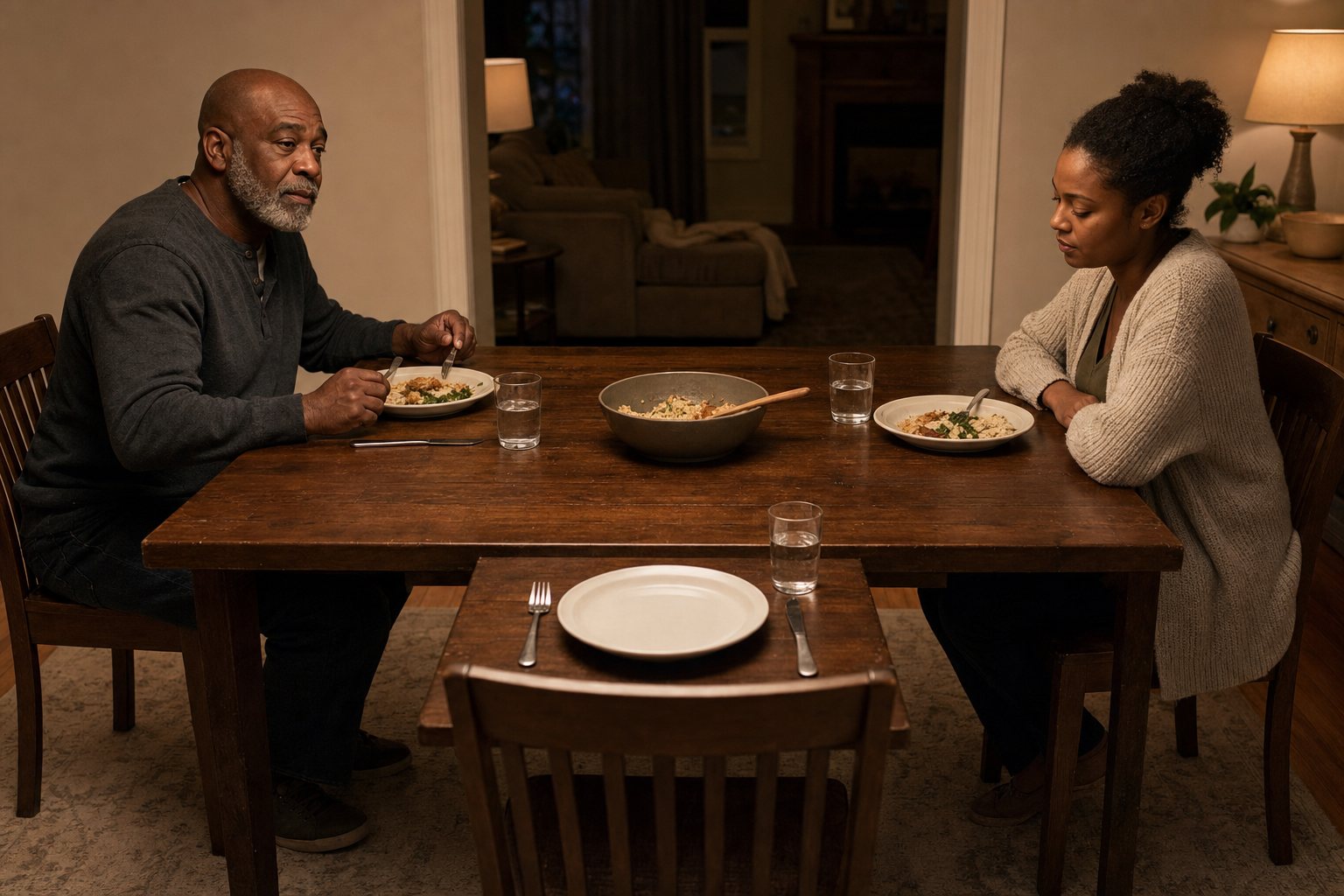
The plate in front of the empty chair is clean.
Two other plates hold the interrupted evidence of dinner: a little rice, a few greens, forks placed down between mouthfuls. Water has been poured into three glasses. Only two have been lifted.
The father looks towards the empty place. His daughter looks at her plate.
Nothing in the room explains the third person’s absence.
They may be late. They may be working. They may live in another country and still be included by habit. They may be in hospital, estranged from the family or dead.
The chair cannot tell us.
What it can show is that a table remembers the shape of a group. When one person is missing, the furniture makes the change visible before anyone finds language for it.
What an empty chair changes at a familiar table
People tend to sit where they have sat before.
The arrangement is rarely discussed each evening, yet bodies learn it. A glass appears near the hand that reaches for it. A chair is moved to make room for a walking aid. One person faces the kitchen because they stand most often. Another avoids the draught.
Repetition turns position into expectation.
The empty chair therefore means more than unused furniture when it belongs to a familiar arrangement. It marks a break in the map: the person who usually receives the serving bowl here is not here to take it.
Absence is not a single emotional category.
A child may be at a sleepover. A parent may be on a night shift. A partner may have moved out. A grandparent may no longer be able to travel. A relative may be missing without reliable news.
Some absences are welcome. Solitude can relieve conflict or give a household room to breathe. Some are ordinary and scheduled. Some contain fear, anger, grief or several feelings at once.
The image of an empty chair is powerful partly because it is incomplete. Care begins by refusing to decide too quickly which story it represents.
Placing a plate before an empty chair can mean, “We believe you are coming.”
It may be practical. The person is delayed and their food will be served when they arrive. It may be habitual: someone set the table for the old number before remembering. It may be ceremonial, deliberately giving absence a visible place.
These meanings should not be collapsed.
An untouched setting is not automatically a memorial, just as removing a plate is not automatically rejection. The action gains meaning from what the people present understand themselves to be doing.
“Shall we wait?” asks more than whether the food will cool.
It asks how certain the arrival is, whether the absent person expects the group to delay and whose hunger counts. Waiting can express loyalty. It can also make one person’s uncertain schedule govern everyone else.
Families develop rules: begin after ten minutes, keep one plate warm, wait for the person who cooked or continue when children need to eat.
No rule is generous in every situation. The useful practice is to make it speakable. “We are going to start, and I will save yours” preserves inclusion without suspending the whole table.
A message saying “twenty minutes” gives the table something to organise around.
Silence creates another experience. People check phones, delay serving and reinterpret every sound at the door. Irritation can coexist with worry.
The absent person may have a good reason for not communicating. The people waiting still experience the practical and emotional cost of not knowing.
When possible, a short message protects more than temperature. It releases the table from guessing whether to remain in the future or begin the present meal.
Recurring absence and the work of staying connected
Recurring absence is part of many household meal schedules.
Hospitality workers, carers, cleaners, drivers, health professionals and shift workers may feed other people or maintain public life while their own household eats without them. Evening and weekend labour becomes visible as repeated absence.
The family may adapt with a second meal, a plate left in the refrigerator or breakfast treated as the main shared table.
This is not necessarily a failed family meal. It is a reminder that togetherness is organised within labour conditions, not outside them.
A person who moves away stops occupying the chair daily, but the household may continue measuring meals against them.
“It is lunchtime there.” “She would have liked this.” “Send him a picture.”
Transnational families construct forms of presence through calls, messages, gifts, remembered tastes and imagined participation. These practices do not erase separation. They give relationship a route across it.
The empty place may therefore be both accurate and misleading. The person is physically absent while remaining active in the conversation, budget, menu and plans of the people eating.
People do not tell the same stories to every arrangement of listeners.
One absent person may have supplied context, challenged exaggeration, translated a family reference or changed which subjects felt safe. Without them, conversation can become quieter—or unexpectedly easier.
The people present may speak about the missing person, but they also speak differently because that person cannot answer.
This is one reason absence cannot be measured only by counting bodies. A table of three is not simply a table of four minus one. The routes through which humour, disagreement and memory usually travelled have changed.
Noticing this does not require idealising the absent person. They may have interrupted, dominated or protected. Their empty chair alters the balance either way.
Video calls can place a distant face at the end of a table.
The connection allows greetings, toasts and a view of the food. It also produces unequal participation. The remote person cannot smell the dish, follow overlapping conversation easily or reach for what is being passed.
Keeping a call open throughout dinner may feel intimate to one family and exhausting to another.
Digital co-presence works best when its limits are admitted. A ten-minute call can be a real part of the meal without pretending that distance has disappeared.
A jar arrives in a suitcase. A recipe is sent by message. Someone pays for a celebration meal they cannot attend.
Food and objects can act as proxies, allowing care to enter the room without the person who initiated it. The family may say, “This is from her,” and organise part of the meal around that absent contribution.
Proxy presence is real, but it can carry obligation as well as affection. A gift may be expensive for the sender. A traditional ingredient may ask the receiver to perform belonging in a particular way.
Gratitude can recognise both the connection and the distance: the person helped shape the table, but the people present still decide how the evening unfolds.
When the missing person carried the meal
The missing chair may have belonged to the person who planned, shopped, cooked, served or reminded everyone to sit.
Their absence appears twice: as a person not eating and as work no longer happening automatically.
The household may discover recipes but not quantities, ingredients but not timing, traditions but not the quiet sequence that made them possible.
Research on family meals describes both physical and cognitive labour: anticipating needs, coordinating schedules and deciding what counts as a meal. When the usual organiser is absent, replacing the dish is easier than replacing that knowledge.
People sometimes say, “We stopped having proper dinners after she left.”
The statement may praise a lost cook, but it can also reveal how completely one person had been assigned responsibility for family continuity. Others enjoyed a ritual without learning its work.
Honouring that contribution should not require freezing the household in incapacity.
Recipes can be written, tasks redistributed and simpler meals accepted as legitimate. Continuity is stronger when memory becomes shared competence rather than permanent dependence on one absent person.
When absence is necessary
Some people stay away because a table is unsafe for them.
They may be protecting themselves from humiliation, control, prejudice, addiction, violence or the demand to conceal part of their life. Other family members may describe the empty chair as tragic while the absent person experiences distance as necessary.
An invitation is not proof that return would be healthy.
The language of reunion can obscure the conditions that caused departure. Before asking how to fill the chair, a family may need to ask what would have to change for anyone to sit there freely.
Death often has recognised words and rituals. Estrangement may not.
The person is alive, but information is limited, contact is uncertain and membership becomes disputed. Should their name be mentioned? Are they invited? Does setting a place express hope or deny a boundary?
Different people at the same table may answer differently.
The resulting loss is difficult partly because it remains unresolved and socially hard to explain. Kindness does not demand reconciliation. It allows people to acknowledge that an absent living person can still occupy thought.
After divorce or a change in custody, an empty chair may alternate according to a calendar.
Children move between households. A table expands one week and contracts the next. Familiar foods, objects and rules may travel with them or remain sharply different.
Adults can make the transition harder by treating the child’s presence as proof of loyalty and absence as betrayal.
A steadier message is possible: your place here remains available, and you are allowed to belong where you are now. The chair can represent continuity without becoming a claim of ownership over the person.
Family scholar Pauline Boss uses *ambiguous loss* for situations in which presence and absence cannot be cleanly resolved.
A person may be physically missing yet psychologically present, as in disappearance, migration or uncertain separation. Someone may be physically present while illness or cognitive change alters how relationship is experienced.
The value of the idea is not that all these situations are identical. It is that uncertainty can prevent ordinary rituals of closure and leave families negotiating who is here, who is gone and what can be expected.
An empty chair may hold that uncertainty without solving it.
Illness changes where togetherness happens
A person may eat in another room because swallowing, fatigue, pain, infection risk or sensory overload makes the main table difficult.
Their chair is empty, yet they are nearby.
Families can interpret this as withdrawal when it may be adaptation. Conversely, insisting on presence at the shared table can make the symbolism of togetherness more important than the ill person’s comfort.
Connection might take another form: a shorter visit, a tray carried to them, one companion eating nearby or conversation before the meal. The chair is not the only place where belonging can be maintained.
Grief changes portions, habits and appetite
After a death, formal ceremonies gather attention around loss. Grief enters again through the ordinary repetition of the family table. Someone cooks too much. A favourite condiment remains in the cupboard. A story reaches the place where one particular laugh should have followed.
The chair is painful because the meal is ordinary and recurring. It demonstrates not only that a person died but that daily coordination had included them.
Grief is carried by quantities, habits and unfinished gestures as much as by deliberate remembrance.
Recipes often survive longer than household size.
A cook reaches automatically for the large pot, buys the usual loaf or divides a dish into the portions their hands already know. The surplus may be useful, wasteful or suddenly painful.
Reducing a recipe is not only calculation. It can feel like accepting a change before the person is ready. Continuing to cook the old amount may preserve continuity while creating burdens of storage and repetition.
There is room for gradual adjustment. Freeze part, share it, write a smaller version beside the original or cook the full dish only on certain days.
The quantity can change without declaring that the relationship mattered less.
Memory does not belong to the chair
Bereavement does not always require a relationship to disappear from inner and family life.
People may speak to the deceased, cook their food, repeat their sayings or imagine how they would respond. The concept of *continuing bonds* describes ways an emotional and symbolic relationship can be reconstructed after death rather than simply severed.
These bonds vary. They can comfort, trouble or change over time.
Leaving a place at the table is one possible expression, not a universal stage and not a measure of healthy grief.
One household leaves the seat untouched for a period. Another changes the whole arrangement immediately because the old geometry is unbearable.
Both may be acts of care.
People can preserve a recipe while removing the place setting. They can use the chair and still tell the person’s stories. They can avoid a commemorative meal one year and seek one the next.
Objects help memory, but they do not own it. No family member should have to prove love by maintaining a physical arrangement that prevents them from eating.
Across communities, food may be offered, avoided, shared with mourners or prepared on anniversaries. Friends and relatives may take over cooking. A place may be set symbolically, or the bereaved may withdraw from festive meals for a period.
These practices cannot be reduced to a single global custom of “the empty chair.”
Ritual meaning depends on religious teaching, region, household interpretation and change across generations.
When invited into another community’s mourning meal, the respectful position is learner, not collector of picturesque traditions.
Birthdays, holidays and annual gatherings return with a remembered number of places.
The first occurrence after a death or departure may receive special attention, but later years can also surprise. A changed recipe, a new child or another absence alters the comparison.
Hosts can name the person without requiring everyone to respond in the same emotional register. They can also let the meal proceed without a formal tribute if that is what the group needs.
Memory does not become less sincere when it is woven into conversation rather than announced.
“Why is Grandpa’s chair empty?”
The question may arrive while adults are trying to keep dinner ordinary. A child can notice the physical fact without understanding why it has become difficult to name.
An answer should match what is known and what the child can hold. False certainty creates later confusion; silence can make the subject feel dangerous.
“He is in hospital and cannot eat with us tonight” is enough when that is the truth. So is “We do not know when she will come back.” Clear limits can be more reassuring than elaborate avoidance.
Rebuilding a food system after loss
People do not eat only in response to hunger.
Companionship sets rhythm, portion and motivation. After loss, shopping for one can feel mathematically simple and emotionally strange. Familiar meals may produce comfort or become impossible to cook.
Research with widowed older adults shows that the loss of shared meals can disrupt eating patterns before people gradually establish a food system suited to their changed lives.
This is not merely a matter of nutritional knowledge. The eater is rebuilding the reason, timing and audience for preparing food.
A couple’s meals contain negotiations accumulated over years: who likes what, who shops, which leftovers are welcome and what time counts as dinner.
When one partner dies, the surviving person may discover freedoms alongside grief. They can eat foods the partner disliked, change the schedule or stop performing a meal format that no longer serves them.
These changes do not betray the relationship.
Rebuilding daily eating may involve preserving some shared practices and releasing others. The new table is not a replacement for the old one; it is the form life can take now.
Community meals are invitations, not cures
Shared meals for older or bereaved people are often proposed as an answer to isolation.
They can create connection, but joining an unfamiliar group requires energy and social risk. Research with widows and widowers found that many considered eating alone difficult while still not wanting organised community meals.
The apparent contradiction deserves respect. Missing one particular person does not create an automatic desire to eat with any available people.
Good programmes offer choice, continuity and time. They do not treat an occupied chair as proof that loneliness has been solved.
Making room without replacing anyone
At a later gathering, someone asks, “Can I sit here?”
The chair may be physically available and emotionally assigned. One person sees no problem; another experiences the new occupant as replacement.
No outsider can calculate the correct waiting period.
A host can reduce surprise by discussing the arrangement before guests arrive, especially at a first major gathering after loss. The question is not whether furniture has permanent ownership. It is whether people need warning while a familiar map is being redrawn.
New partners, spouses, friends and children enter tables with histories they did not create.
They may inherit a place associated with someone absent. Constant comparison makes belonging conditional: sit here, but understand that another person occupied it better.
Memory and welcome do not have to compete.
The absent person can be named as part of the table’s history without turning the newcomer into a substitute. A new relationship deserves its own place, even when the chair is old.
How restaurants should handle an empty place
A booking for four arrives as three.
The missing guest may be parking, delayed, unwell or no longer coming. Staff need enough information to pace service and manage the table. They do not need the private story.
“Would you like to wait before ordering, or shall we begin?” gives the group a practical choice. “What happened to your fourth?” may ask for more than hospitality requires.
The unoccupied place should remain available while arrival is plausible, without making the table defend it repeatedly.
Restaurants plan labour, purchasing and table time around reservations. An absent guest can leave unused capacity even when companions attend.
Deposits, card guarantees and cancellation policies make that cost explicit. They should also make the unit of commitment clear: is the fee attached to the booking, each missing person or the table reserved?
At the door, staff should not improvise punishment or ask servers to negotiate policy through embarrassment. Explain the agreed terms, distinguish a reduced party from a complete no-show and provide the route for exceptional circumstances.
Operational fairness and human sensitivity can coexist. The restaurant may need to account for an empty chair without treating the people who arrived as morally suspect.
Clearing an unused plate can create space and reduce clutter. Done too early, it can make a delayed person seem excluded before the group has decided to begin.
A server can ask quietly: “Would you like me to leave this place set?”
The question is operational, not psychological. It lets the diners control what the empty position means for the next stage of service.
If they ask for the setting to be removed, do so without ceremony. If they keep it, continue serving the present guests without repeatedly drawing attention to the absence.
A person who arrives after others have begun must enter an established rhythm.
They may be embarrassed, apologetic or rushed. Companions may want to retell the delay while the newcomer needs water and a menu.
Staff can restore orientation efficiently: name which courses have been ordered, offer the available choices and clarify timing without making lateness a public offence.
The goal is not to pretend everyone arrived together. It is to help the newly occupied chair join the meal that actually exists now.
Serving memorial meals without performing grief
Families gather in restaurants after funerals, on anniversaries or because the place mattered to the person who died.
They may request a particular table, order a familiar dish or leave one seat open. Emotion may surface unexpectedly during otherwise ordinary service.
Staff do not need to become grief counsellors. Simple acknowledgement is enough: “I’m sorry for your loss,” followed by attentive service and room for the gathering to set its own tone.
Avoid turning the story into restaurant content. A memorial meal is not a marketing opportunity.
A bereaved table may laugh loudly, tell irreverent stories, order celebration food or argue.
None of these behaviours proves the occasion is insincere. Grief can coexist with pleasure, irritation and hunger.
Service should respond to conduct, not judge whether emotion matches an expected performance. The same boundaries around safety and respect still apply.
Warmth is useful. Reverence imposed by strangers is not.
Restaurant teams remember recurring guests through orders, timing and familiar seats.
When one member of a regular pair arrives alone, staff may feel the change immediately. A direct question about the absent person can be welcome or painfully intrusive.
Recognition can begin without demand: “It is good to see you.” Let the guest decide whether to explain.
If they share news, listen and respond simply. Memory becomes hospitality when it offers continuity without claiming ownership of the guest’s private life.
Absence also reshapes the room when the missing person is an employee. Someone who leaves, becomes ill or dies may not have occupied a dining chair, but their absence is carried through service.
A section is reassigned. A dish loses the person who knew its final detail. Colleagues repeat a phrase the missing worker used.
Management should recognise both grief and workload. A tribute does not compensate for understaffing; operational cover does not eliminate emotional loss.
Teams need accurate information, permission for different reactions and practical redistribution of the work that has become visible.
Do not turn absence into content
An unoccupied place can be visually powerful, which makes it tempting to photograph, interpret or use symbolically.
But the people living with the absence may not want it converted into content. A host should not stage another person’s grief for guests. A restaurant should not post a memorial table without explicit permission.
Sometimes a chair is simply empty because someone could not come.
Restraint protects the difference between noticing absence and appropriating it.
Practical care happens away from the chair
When someone is grieving, ill or overwhelmed, friends often ask what they can bring.
Food can reduce work, but only if it fits the household’s needs, storage, dietary requirements and capacity to receive visitors. A large dish that requires immediate serving may create another task.
Ask, label, portion and make refusal easy. Consider breakfast, snacks and freezer space rather than repeating the same ceremonial meal.
The purpose is not to fill the empty chair. It is to support the people who still have to eat.
The table can change without forgetting
Chairs move. Households shrink and expand. A person returns after months, or does not return. Someone new is welcomed. The table itself may be replaced.
Continuity does not require preserving one arrangement forever.
It can live in a recipe adapted for fewer people, a story told accurately, a name spoken without pressure or a habit of pouring water for whoever is present.
Belonging is not measured by whether a chair remains empty. It is measured partly by whether change can occur without denying who once sat there.
The daughter’s phone lights beside her glass.
Their absent family member has been held at work. “Don’t wait. I’ll eat when I get home.”
Tonight, the uncertainty is small and temporary.
The father stands, lifts the clean plate and covers a portion from the serving bowl. The chair remains where it is, but the setting changes. Food is saved without requiring two people to postpone their dinner.
They begin talking again.
Other empty chairs carry stories that cannot be resolved by a message.
This one will be occupied later.