The Art of Offering Water
A glass of water can refresh, orient and reassure a guest—but only when the offer is timely, clear and attentive to choice.
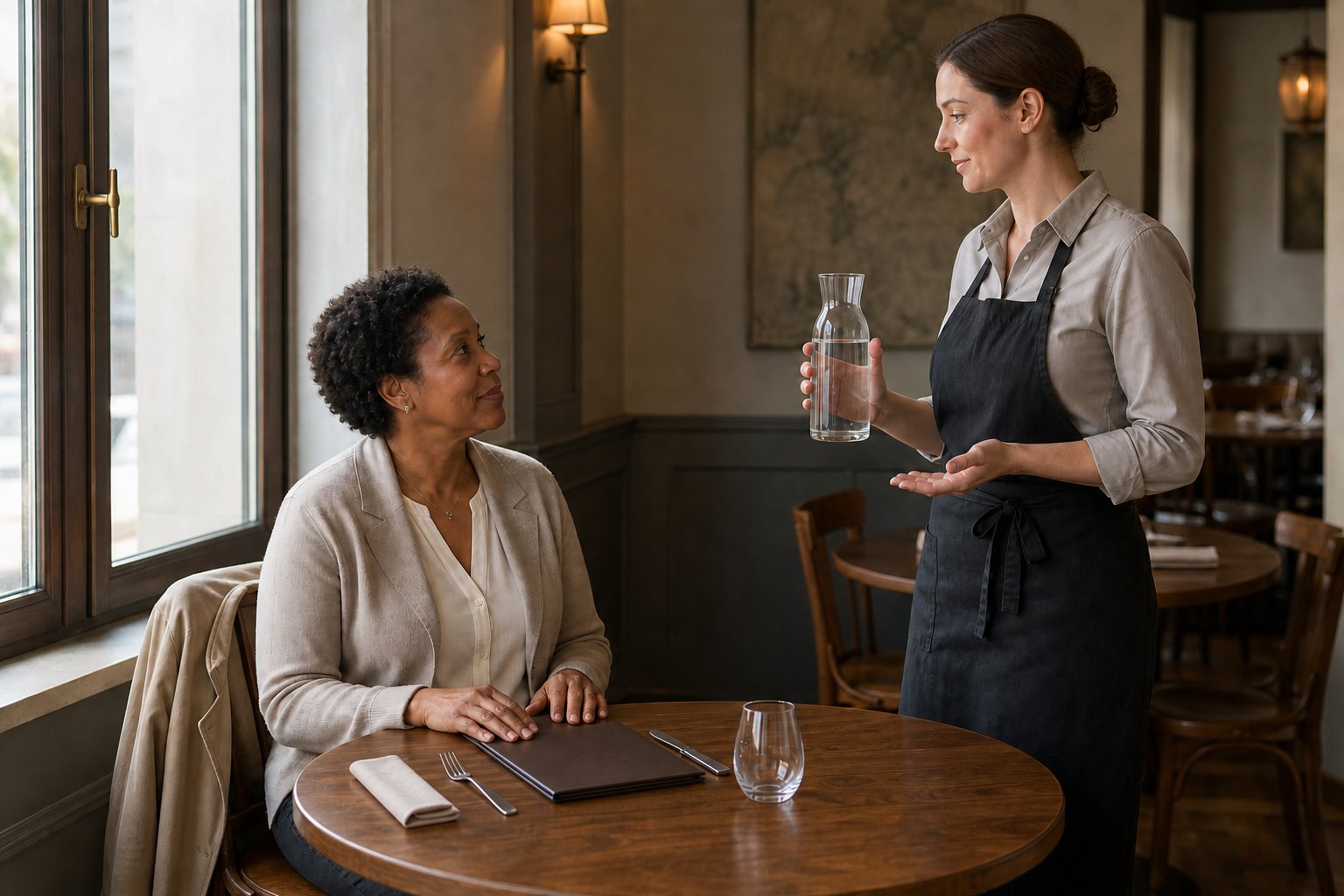
The guest has been seated for less than a minute.
Her coat is still folded over the back of the chair, and one hand rests beside the closed menu. The server approaches with a clear glass in one hand and a carafe in the other, places the glass within easy reach, and asks before pouring.
The water is not decorative. It is not waiting in an open glass that may have stood untouched through the previous setting. It arrives clean, cool rather than painfully cold, and without lemon, ice or a branded bottle deciding the guest’s preference in advance.
“Yes, please,” she says.
The first pour gives her something to receive before she must order, understand the room or explain anything about herself. Hospitality has begun with the smallest useful offer.
Water begins the welcome
A restaurant cannot yet know whether the guest wants a full meal, a short meeting or time to read the menu.
Water can be offered before those decisions. It meets a need without requiring the guest to reveal much, and creates a first rhythm between arrival and choice.
Water refreshes the mouth, supports comfort, and accompanies food.
At the same time, offering it says that the guest’s body has been noticed. The room is not asking for money, preference or performance before providing something basic.
Automatic service can look efficient while ignoring the person receiving it.
A glass filled without a word may be welcome in one context and intrusive in another. The art lies not in making water elaborate, but in making a routine responsive.
A new guest is reading the entrance, table, menu, staff, noise and expectations at once.
A calm water offer gives the interaction an easy first step. It allows the guest to answer a question whose meaning is clear before more consequential choices arrive.
“May I bring you some water?” requires very little time.
The question prevents waste, respects refusal, and avoids treating every glass as an instruction. The guest can accept, decline or ask what kinds are available without interrupting a completed action.
Some guests already have a drink, avoid cold water, limit fluids for medical reasons or simply do not want it.
No explanation is owed. The offer has fulfilled its social purpose when refusal is received as easily as acceptance.
Options and prices must be explicit
“Still or sparkling?” can hide whether tap water is available or whether both choices carry a charge.
A complete question names the meaningful options: complimentary tap water, filtered house water, bottled still water or sparkling water, with prices visible where relevant.
Water can feel like a gift at the beginning and become a source of resentment on the bill.
If the restaurant charges for a bottle, filtration or refill, that cost should be stated before pouring. Clarity protects the value of both the water and the welcome.
In some restaurant cultures, tap water appears automatically and without charge. In others, bottled water is expected, tap water must be requested or water service is treated differently altogether.
Travellers may not know the local convention. Staff can explain without presenting unfamiliarity as ignorance.
Even when it is complimentary, water depends on infrastructure, rent, washing, filtration, glassware and service labour.
Calling it free should not make that work invisible. The gesture can exceed the immediate transaction while still being supported by a business and a public water system.
Clean water depends on a clean system
A guest receiving tap water trusts that it is safe, that the glass is clean, and that the carafe has been handled properly.
These expectations are usually silent. A smudged rim or stale odour turns a small welcome into an immediate warning about the rest of the operation.
Water reveals glassware more clearly than many coloured drinks.
Lip marks, detergent film, lint and chips have nowhere to hide. Inspecting glasses against light is a practical task with social consequences: it tells the guest whether the simplest object at the table received attention.
Clean glasses do not emerge from a dishwasher ready for every room.
They are sorted, checked, polished, carried, stored and replaced. When this labour is rushed or understaffed, the defect appears at the guest’s lips.
A clean glass can still smell of cardboard, cupboards, polish or a damp cloth.
Upside-down storage on an unsuitable surface may trap odour. The service system must protect the glass between washing and the moment it reaches the table.
Servers need a reliable place to hold glassware that is not the rim.
This is both hygiene and etiquette. Touching the surface from which a guest will drink communicates carelessness even when no visible mark remains.
A clear carafe allows the guest to see the water and its condition.
It should be clean inside, free from damaged edges, and proportionate to the table. A heavy vessel filled to the top may look generous while being difficult for many guests to lift safely.
Vessels should preserve independence
A guest with limited grip, pain or tremor may be able to lift a glass but not a large bottle.
Smaller carafes, attentive pouring or vessels with easier handles preserve autonomy without making assistance conspicuous.
A very wide, delicate or top-heavy glass may be visually refined and practically difficult.
Stable bases, moderate weight, adequate grip and a rim that does not demand excessive head movement make water easier to drink for more people.
The correct place is not merely a diagram from service training.
The glass should be visible and reachable without crossing hot plates, candles, phones or another person’s setting. A left-handed guest or wheelchair user may benefit from a different position.
Water placed just beyond comfortable reach can remain untouched even when wanted.
Guests should not have to expose pain, limited mobility or embarrassment by repeatedly asking for an object the table could have placed more thoughtfully.
Some guests need or prefer a straw. Others avoid one for sensory or environmental reasons.
Offering it discreetly where useful is better than placing it automatically or requiring the guest to justify the request. Reusable straws also need rigorous cleaning and safe storage.
Plain water should remain an option
Very cold water can be refreshing, uncomfortable or painful depending on the person.
Room-temperature, chilled, and iced water should not be treated as a hierarchy of sophistication. A brief question can prevent the guest from waiting for a glass to warm before drinking.
Ice occupies volume, dilutes flavour additions, and creates condensation.
It may also cause discomfort for sensitive teeth or make a light glass harder to control. Adding it after consent is more hospitable than treating it as the definition of water.
It is handled through machines, scoops, bins and staff routines.
Because it looks clean, maintenance can be neglected. Scoops need proper storage, hands need separation from ice, and machines need scheduled cleaning rather than attention only after a complaint.
A slice of lemon may look fresh, but it changes taste, introduces handling and can create dietary or sensory problems.
It should be an offered addition, not evidence that plain water was considered incomplete. The same applies to cucumber, herbs and flavoured drops.
House water infused with fruit or herbs may delight some guests and surprise others.
Ingredients should be visible or named. “Water” should not require a diner with an allergy to discover what has been floating in the dispenser.
Carbonation can refresh the palate, intensify fullness or cause discomfort.
It is a preference, not an upgrade in character. Staff language should not make guests choosing tap water appear less generous or less informed.
Source and taste claims need accuracy
Opening a bottle at the table can verify what was ordered.
It should not become theatre that hides the source, size or price. Refilled branded bottles and vague claims about purity damage trust more than an ordinary, accurately described house carafe.
Water may come from a municipal system, spring, well, filtration system or packaged supplier.
If the restaurant tells a story about origin, mineral character or sustainability, it should be verifiable. Water is too basic to become a stage for invented provenance.
Minerals, treatment, pipes, temperature and storage affect flavour.
A guest who notices chlorine, metal or staleness is not being difficult. Repeated comments may reveal a filter, plumbing or storage problem worth investigating.
The water served daily should not be known only through technical reports.
Managers and staff can taste it at opening, after filter changes and when temperature or odour shifts. Familiarity makes unusual conditions easier to notice before guests do.
Filtration can improve flavour and consistency.
It also creates cartridges, cleaning schedules, maintenance records and claims that need accuracy. A neglected filter can make the promise of improvement less safe than the ordinary supply it replaced.
Pouring and refilling should preserve control
Filling a glass to the rim looks abundant but makes it difficult to lift without spilling.
A moderate pour leaves safe space, reduces waste and allows the guest to control the glass. Generosity is not measured by surface tension.
The carafe should approach without crossing the guest’s face, sleeve or personal belongings.
The server needs a stable angle, control of the vessel and awareness of nearby conversation. Grace comes from reducing risk, not from exaggerated flourishes.
Reaching for a glass while asking about a refill makes refusal physically awkward.
The server can ask, wait for the answer, and then pour. This fraction of a pause turns service from assumption into cooperation.
An empty glass may mean the guest wants more, is finished or has been unable to catch anyone’s attention.
Attentive staff notice level, pace, weather, food and the guest’s cues. They do not need to monitor consumption as though it were a performance target.
A glass that never visibly empties makes it difficult for the guest to know how much they have consumed.
It can also interrupt conversation and create waste. Asking at sensible intervals gives the guest a clearer relationship with the drink.
Guests should not need repeated eye contact, waving or a public complaint to receive more water.
Service stations, section checks and clear responsibility help prevent refills from depending on who is most assertive at the table.
One vessel at a large table often stays near the person who first poured.
Several smaller carafes, thoughtful placement or staff refilling can prevent reach and confidence from determining who drinks.
Children, spills and recovery
An adult wine-style water glass may be too tall, delicate or easy to tip.
A stable child-sized cup offered without condescension allows children to participate in the setting. Lids can be useful, but should not be assumed for every age.
Water will sometimes fall because a glass is knocked, a table moves or a hand shakes.
The response should be quick and calm. Treating a spill as a moral failure can embarrass a guest more deeply than the wet tablecloth warrants.
Removing the water is only the first step.
Wet menus, napkins, chairs and clothing may need attention. A fresh glass and a clear place setting tell the guest that the meal can continue without carrying the accident as its main event.
Health needs privacy, not supervision
Research on hydration in later life warns that thirst alone may not reliably signal low intake for every older adult.
A restaurant should not diagnose or pressure anyone. It can make drinking easier through visible water, manageable vessels, patient offers and accessible toilets.
“Would you like some more water?” respects an adult’s decision.
“You need to drink” crosses into instruction unless a specific care relationship or emergency justifies it. Hospitality supports choice rather than using health language to control the guest.
Some guests use water to take medication during a meal. Others manage fluid intake under medical advice.
Staff need not ask why. Prompt water, privacy and acceptance of unusual timing are usually enough.
A guest declining alcohol or asking for repeated water does not need speculation.
Offering appealing non-alcoholic drinks and reliable water serves everyone without turning one person’s body into table conversation.
Weather, queues and outdoor access
On a hot day, guests may arrive already thirsty from walking, waiting or public transport.
Water should be offered promptly rather than held until the drinks order. Outdoor queues and terraces may also require visible access before guests are formally seated.
Heavy clothing, heated rooms and salty food can create need even when nobody appears overheated.
Room-temperature water may be more welcome than ice. Seasonal attentiveness is better than a fixed assumption about what refreshment looks like.
A guest can spend significant time at a bar, entrance or host stand before reaching the table.
When waits are long, offering water communicates that hospitality has begun even though the table is not ready. The glass also needs a clear place to rest and a plan for collection.
Standing without water affects people differently.
Older adults, pregnant guests, children, workers arriving from heat and people with health conditions may need support sooner. Seating and water can be offered without demanding a public explanation.
Sun, dust, insects and unstable surfaces change the water experience.
Covered carafes, shaded placement, stable glasses and frequent checks prevent an outdoor table from receiving a lesser version of care.
Lids can protect water but also create weight, awkward mechanisms or trapped condensation.
The design should be tested by the people who pour it, including guests with limited dexterity. Protection that prevents access defeats its purpose.
Water hospitality includes toilets
Guests regulate drinking partly according to whether a clean, accessible toilet is available.
Offering abundant water while toilets are hidden, inaccessible or poorly maintained creates a contradiction. The whole bodily journey matters.
A guest asking for the toilet does not need a joke or public announcement.
Simple directions, good signs and an accessible route reduce embarrassment. Staff should know where the adapted facility is and whether it is actually usable.
Water should remain through the whole meal
Delays feel different when a guest has nothing at the table.
Water does not compensate for unexplained waiting, but it provides comfort while staff communicate honestly about timing. It should not be used to postpone the acknowledgement of a problem.
Some dishes predictably increase the desire to drink.
Water can be replenished before the need becomes urgent, while other suitable drinks remain available. Staff should avoid turning tolerance for spice into a challenge that makes requesting water look like failure.
Long meals create repeated need without requiring repeated interruption.
Well-placed carafes, quiet refills and opportunities to choose temperature or sparkling water help guests regulate themselves across courses.
Detailed attention to wine can make water seem like a secondary beverage.
Guests drinking alcohol need reliable water, and guests not drinking alcohol deserve a glass that is equally clean, accessible and respectfully served.
At the end of a meal, glasses are sometimes removed to clear visual space.
Guests may still want water with coffee, dessert, medication or the journey home. Asking before clearing prevents the table from becoming less hospitable as the bill approaches.
Once payment begins, service can become visibly impatient.
A final water offer is a small way to keep the guest a guest until departure. It should not be performed as a tactic for prolonging the table, but as completion of the care already established.
Hospitality extends beyond seated guests
A person collecting food may arrive thirsty and wait near the counter.
Where operationally possible, a clearly available cup of water can extend hospitality beyond seated service. The cup, lid and filling point still require hygiene and waste considerations.
Couriers may wait in heat or cold while orders are completed.
Offering water recognizes their physical presence without pretending the commercial relationship is equal. It should accompany, not replace, accurate preparation times and respectful treatment.
Staff hydration and workflow make service possible
A restaurant cannot celebrate water hospitality while workers struggle to drink during long shifts.
Accessible staff water, clean vessels, safe storage and realistic breaks are operational necessities. Care offered publicly becomes more credible when it exists behind the service door.
Workers may need designated containers to protect hygiene and comply with local rules.
Those systems should still make drinking easy. A policy that technically permits water but places it several floors away does not support hydration in practice.
A refill requires clean carafes, ice or temperature control, access to the supply, and time.
Poor station design creates drips, collisions and delays that appear to guests as inattention. Thoughtful layout turns a repeated task into reliable service.
Before service, someone fills filters, checks bottles, polishes glasses and stocks ice.
During service, someone collects, washes and replaces everything. The effortless glass depends on work distributed across the team.
When everyone is vaguely responsible for water, empty glasses can belong to nobody.
Sections, runners and support roles need clear expectations that still permit any staff member to respond when a guest asks. Systems should create ownership without creating indifference outside it.
“Keep glasses full” is easy to remember and too blunt to guide good judgement.
Training can explain consent, placement, accessibility, cost, observation and waste. Staff make better decisions when they understand what the routine is meant to accomplish.
A standard phrase ensures options are mentioned consistently.
It should not become so rapid that the guest cannot hear the difference between complimentary and charged water. A script serves hospitality only when the answer can alter what happens next.
Language and custom need clarity
Water options should not require specialised vocabulary.
Pointing to a bottle, showing the carafe or using a translated menu can support guests across languages. Essential information about cost and carbonation must survive the translation.
The phrase may refer to tap, still, room-temperature or unflavoured water depending on speaker and place.
A clarifying question is safer than guessing. It can be asked without making the guest feel that an ordinary request was inadequate.
In some homes and cultures, a beverage is offered repeatedly because the first refusal is understood as politeness. Elsewhere, repeating the offer feels like pressure.
Restaurants serve people carrying different expectations. Clear, gentle offers allow generosity without requiring staff to stereotype guests by appearance or accent.
Some service traditions pair water with strong coffee, spirits or other drinks.
The pairing has practical and cultural meanings that vary by place. It should be understood within its own tradition rather than treated as a decorative flourish to borrow casually.
Water can welcome through washing hands, feet or objects as well as through drinking.
These practices have specific religious, cultural and practical meanings. A restaurant should distinguish potable water, handwashing facilities and ceremonial uses clearly, without collapsing them into one exotic idea of hospitality.
Home offers create orientation and independence
At home, asking “Would you like some water?” can give a visitor something to hold while the host finishes a task.
It reduces the uncertainty of arrival and buys both people time. The glass becomes a temporary place in the room before conversation finds its own shape.
Hosts do not need special bottles, garnishes or matching glassware to welcome well.
Clean water in a usable vessel, offered without apology, is enough. Hospitality weakens when the host turns a basic provision into evidence of inadequacy.
Some people hesitate to request water because they do not want to create work.
Making the offer early removes that negotiation. In restaurants and homes, the small gesture says that thirst is an ordinary need rather than an interruption.
In a longer visit, pointing out the kitchen tap, water jug or self-service station can increase independence.
The instruction is a form of permission: you do not need to wait for me to notice every time. It should be adapted when access or household boundaries make self-service difficult.
Water can pause conflict but not replace emergency care
During a difficult conversation, a glass of water can create a pause and give the body a simple action.
It does not repair conflict or replace accountability. Its value lies in offering time and physical steadiness without pretending the problem has disappeared.
A guest who appears seriously unwell may need more than a refill.
Staff should follow emergency procedures, seek appropriate help and avoid assuming water is a universal treatment. Training matters because hospitality cannot substitute for medical judgement.
Sustainability must improve systems, not shame thirst
Water is sometimes poured automatically, left untouched and discarded with melted ice.
Restaurants can measure waste, ask before pouring and offer refills at the table. Conservation should improve attentiveness rather than shifting inconvenience entirely onto guests.
Packaging, transport, chilling, storage and disposal shape its environmental cost.
Guests may still choose it for taste, trust or convenience. Accurate information and credible alternatives support better choice without turning the table into a moral lecture.
House bottling and filtration can reduce packaging.
They also require sanitising, traceability, safe caps and clear separation between clean and used vessels. Sustainability claims do not excuse weaker hygiene.
In water-stressed places, unrestricted pouring can look careless rather than generous.
Local conditions should shape service practices. Offering water on request, using smaller first pours and refilling attentively can respect scarcity without denying a basic need.
A guest should not be shamed for drinking water.
Communication can explain that water is poured on request to reduce waste while making refills easy. The burden belongs primarily to sound systems, not to public judgement of individual thirst.
Correction, consistency and refusal complete the standard
Water touches reservations, hosting, service, washing, maintenance, accessibility, billing and waste.
Because it appears simple, failures are difficult to explain away. Guests reasonably wonder how more complex promises will be kept when the first glass is neglected.
If the water tastes wrong, the glass is marked or the charge was unclear, staff should respond directly.
Replace the glass, investigate the source, correct the bill and thank the guest for saying something. Defending the routine protects the system at the expense of trust.
Every guest deserves clean water, clear options and timely attention.
Not every guest wants the same temperature, quantity or frequency. Excellent standards establish dependable care while leaving space for preference.
Repeatedly pressing water on someone can be framed as generosity.
Real welcome includes the ability to decline. The host’s intention matters less than whether the guest retains ease and control.
The glass remains within reach
At the table, the guest takes a sip while reading the menu.
The server does not wait for praise. The carafe is placed where the guest can reach it without moving her coat; the server confirms that tap water is complimentary, then steps away before the next decision is due.
Later, the server will ask once before refilling. When a drop runs down the carafe, it will be wiped away before it reaches the menu. None of these actions will become the story she tells about dinner.
That may be the measure of the work.
The water has refreshed, oriented and reassured her without demanding attention for itself. A basic human need has been met with enough care that the guest can turn toward everything else.