The Customs We Carry to New Tables
Traditions survive not by remaining untouched, but by being remembered, adapted and offered again at new tables.
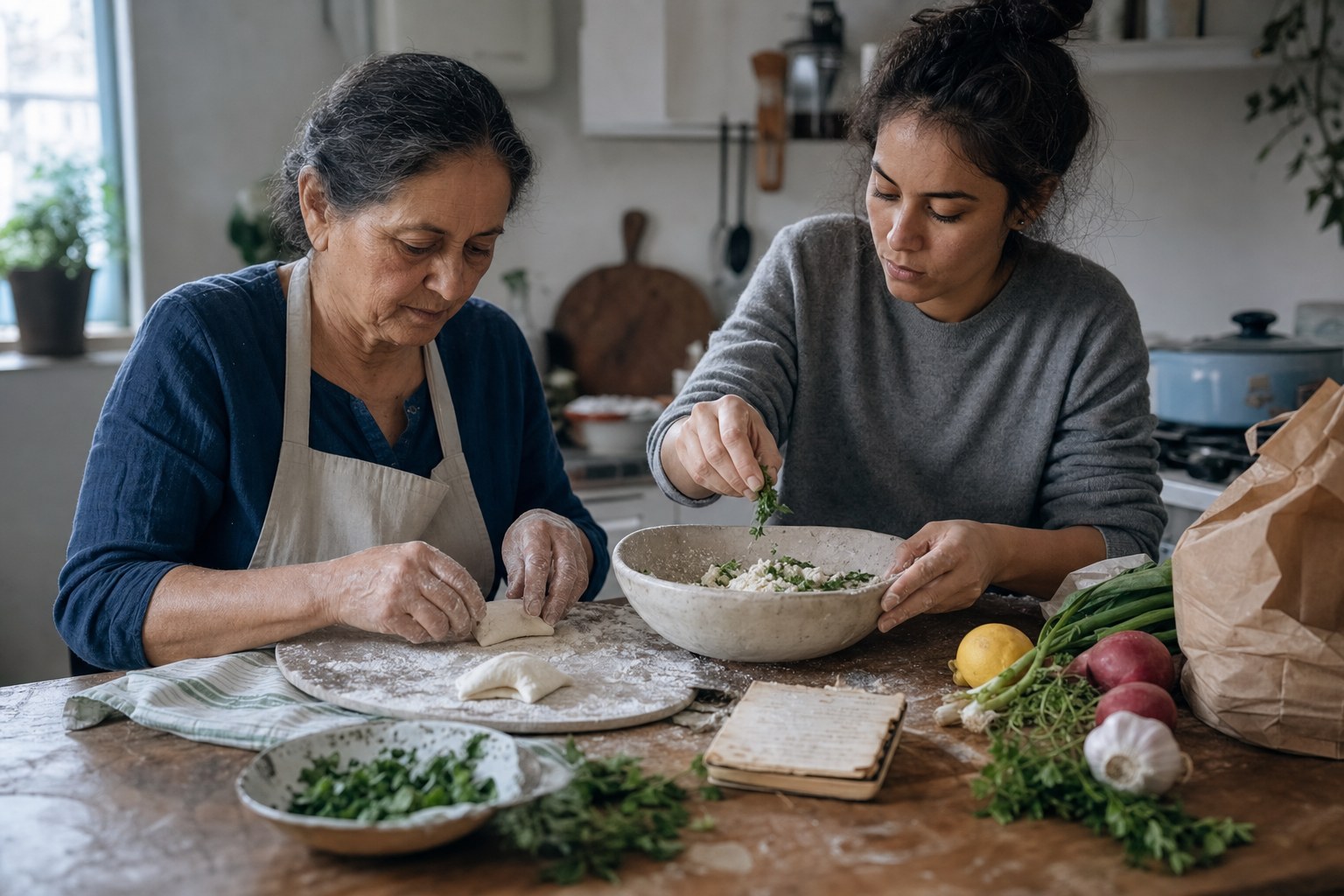
It may begin in an unfamiliar grocery aisle.
A person searches for the flour, herb or cut of meat that a familiar dish requires. The packaging is different. The names do not correspond exactly. An ingredient that was ordinary in one place is expensive, seasonal or impossible to find in another.
Eventually, something else is chosen.
At home, the substitution is examined with suspicion. The dough behaves differently. The aroma is close but not exact. Someone tastes the finished dish and says, “It isn’t quite the same.”
Then it is made again.
Perhaps the quantity of water changes. A local vegetable proves better than the imported substitute. A different pan creates a texture that nobody expected. After several attempts, the adapted version becomes familiar in its own right.
Years later, another person may learn that version and regard it as the way the dish has always been made.
This is how many customs travel: not intact, but alive.
What travels with us
Food traditions rarely move as complete systems. They travel in fragments.
A recipe may be written on the back of an envelope, described during a telephone call or reconstructed from watching somebody cook years earlier. A particular utensil may be carried carefully to a new home while the ingredients it once held must be replaced. Sometimes there is no written recipe at all—only the memory of a taste and the conviction that the current attempt is not there yet.
People carry customs for many reasons and across many kinds of distance. They move for work, study, marriage, safety or possibility. Families separate and form again. Children grow up speaking differently from their grandparents. A dish associated with one climate is prepared in another, where the seasons and available produce follow a different rhythm.
The custom must find a new place in ordinary life.
This may require changing when the dish is prepared, who participates and what equipment is used. A long communal process can become a weekend activity for one household. Food once made outdoors may move into a small apartment kitchen. A celebration involving many relatives may be recreated for three people around a modest table.
Something has changed, but something has also continued.
The important element may not be an exact ingredient. It may be the sequence of actions, the generosity of the portion or the expectation that nobody should eat alone.
Memory is an ingredient
People rarely remember a dish as a precise list of quantities.
They remember a hand testing the texture of dough. They remember the sound of a lid lifting, the colour of the sauce when it was ready or an instruction to continue stirring until something “looked right.” They remember being allowed to taste from the spoon, being told to wait or being sent to carry a plate to the table.
Such knowledge is difficult to record because it lives in repetition and proximity. The learner does not simply receive information. They observe timing, pressure, confidence and correction.
When that proximity is lost, memory begins to do more work.
A person attempts to recreate a childhood flavour and discovers that accuracy is not the only measure of success. The food must also carry a feeling: the sharpness of a familiar aroma, the warmth of a bowl held in both hands or the sense that a particular day has returned.
Memory is selective. It softens some experiences and intensifies others. The version we try to reproduce may never have existed exactly as we remember it.
Yet this does not make the effort meaningless. Memory is not merely an imperfect archive. It is also an active ingredient. It guides the cook toward what the dish needs to evoke, even when it cannot provide exact instructions for getting there.
Substitution is not necessarily surrender
Adaptation is sometimes described as loss.
A different ingredient, method or shape may be treated as evidence that the original custom is disappearing. The person cooking may feel apologetic before anybody has tasted the result.
But substitution can also demonstrate commitment. The cook changes the recipe because they want to continue making it under new conditions.
There is creativity in deciding what must remain and what can move. One spice may be essential because it carries the dish’s recognisable centre. Another ingredient can be replaced without changing what the meal means to the people eating it. A laborious step may be shortened on an ordinary weekday but preserved for a celebration.
These decisions are rarely neutral. They can generate disagreement, particularly when several people feel responsible for protecting the same tradition.
One relative insists that the adapted dish is no longer authentic. Another points out that the family has already changed it many times. A younger cook wants to accommodate a dietary need. An older one worries that too many alterations will leave nothing recognisable behind.
Both concerns can be sincere. A tradition can become so rigid that people can no longer participate in it, but it can also be changed until its history is difficult to see.
The task is not to prevent change. It is to change with attention.
When new people reach the table
Every new participant encounters a custom from a different position.
A partner tastes a family dish for the first time. A child refuses the ingredient everyone else considers essential. A friend asks why something is served in a particular order. What seemed obvious inside the household must suddenly be explained.
Explanation often reveals that there was never only one version.
Relatives disagree about the correct shape, the proper sequence or whether a certain ingredient belongs at all. One person describes something as a family tradition, only to be reminded that it began with a neighbour two generations earlier. The supposedly ancient method may have been an adaptation to an old shortage, a new appliance or one cook’s personal preference.
These discoveries do not necessarily weaken the custom. They reveal the many hands that have already shaped it.
A new participant can also notice what insiders have stopped seeing. They may ask who is expected to perform the work, why one person is always served first or whether somebody who cannot eat the traditional dish is offered an equally meaningful alternative.
Welcoming these questions does not require abandoning the tradition. It allows the tradition to remain hospitable to the people now carrying it.
Who gets to call something authentic?
The word authentic often promises certainty. It suggests that somewhere there is a correct version against which every other version can be measured.
Sometimes this distinction matters. Recipes and names can be detached from their histories, simplified for sale or presented without acknowledging the communities that sustained them. Careful attention to origin protects knowledge from being treated as anonymous decoration.
But authenticity can also become a gate that only certain people are permitted to open.
Who is allowed to adapt a dish? Does a person lose authority after moving away? Is the version prepared by a grandchild less meaningful because it uses a different ingredient? Can a tradition remain genuine when the language spoken around the table has changed?
There are no universal answers. Different customs carry different histories and responsibilities.
A more useful question may be whether the adaptation remains in conversation with what came before. Does it acknowledge its sources? Does it understand what has changed? Does it preserve respect for the people whose knowledge made the new version possible?
Continuity does not require pretending that nothing has moved.
Carrying without freezing
To carry a custom forward is not to preserve it behind glass. It is to give it another occasion.
The new table may be smaller. The kitchen may be far from the place where the dish was first learned. The language around it may be different, and the ingredients may be imperfect.
Still, someone recognises the gesture.
They understand why the first portion is offered to another person. They know why a particular dish appears on a particular day. They hear a phrase used in the kitchen and remember who used to say it.
Tradition survives through such recognition, but it also survives through use. It must be prepared, served, questioned, enjoyed and sometimes revised.
What is carried forward is therefore more than a recipe. It is a relationship between memory and the present—a way of telling people at a new table that this food has travelled, that others stood behind it and that they are now being invited into its continuing story.
The custom remains alive because somebody decides it is worth making space for again.