The Staff Meal
What restaurant workers eat together reveals hierarchy, care and the culture sustaining service out of guests' view.
The dining room is ready for people who have not yet arrived.
Water glasses catch the light. Menus sit square with the edge of each table. A server checks the reservation notes while another folds the last napkins. In the kitchen, sauces are warm, knives are lined beside chopping boards and the first printed orders are still an hour away.
At a table near the back, the restaurant is already feeding someone.
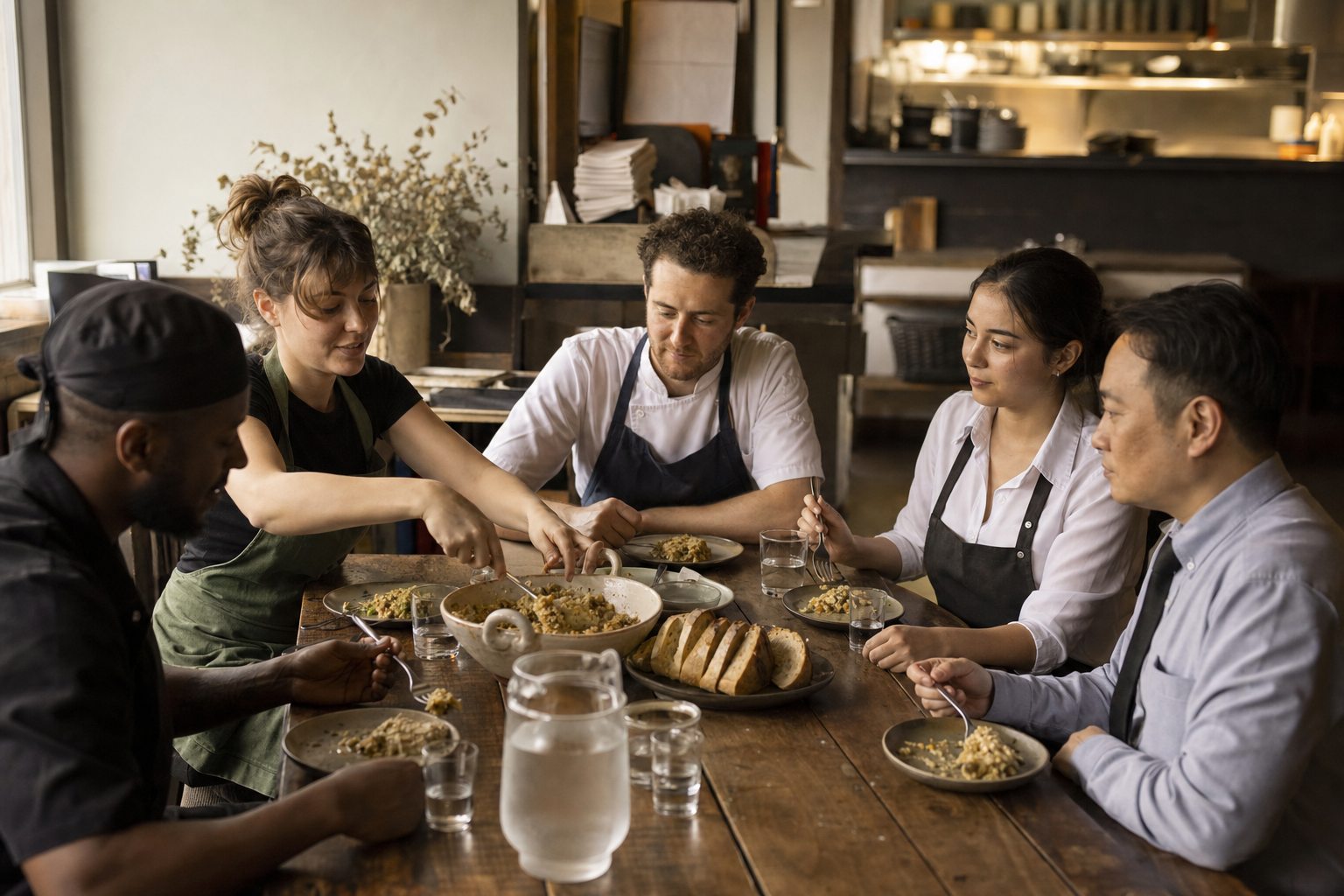
A large bowl has been placed between cooks, servers, porters, hosts and managers. There may be rice beneath a stew, pasta made with a sauce carried forward from the previous service or bread beside something that was prepared separately from the evening menu. People sit if there are enough chairs. Others lean against a counter or eat in the few minutes between one task and the next.
This is not a course guests can order.
It may never be photographed, described by a server or written into the story the restaurant tells about itself. Yet the staff meal belongs to the life of the place as surely as the dishes polished for public view. It feeds the people who will spend the next hours carrying plates, answering questions, controlling heat, washing pans, noticing empty glasses and absorbing the changing mood of the room.
The meal is practical. People need to eat before work intensifies.
It is also revealing.
Who cooked it? Who chose what everyone would eat? Who is already seated, and who is still working? Is there enough? Can someone decline a dish without having to explain their body, religion or appetite to colleagues? Does the meal gather the restaurant for a moment, or merely place food near people who have no protected time to receive it?
A staff meal can express generosity without becoming evidence of a generous workplace. It can create belonging while leaving hierarchy intact. It can carry memory, skill and humour across departments, yet it can also show whose preferences are treated as normal and whose needs remain an inconvenience.
The public meal and the staff meal are not opposites. They are connected systems of attention.
One is designed, priced and performed for guests. The other reveals what remains when hospitality turns away from the dining room and looks at the people expected to sustain it.
Restaurant staff meals take different forms
The phrase “restaurant staff meal” suggests a recognisable ritual: a team sitting together before service while a cook places shared dishes in the centre. That version exists, but it is not universal.
Some restaurants serve one prepared meal at a fixed time. Some allow workers to order a limited selection from the menu. Some provide an allowance, a discount or food after a shift. Others provide no organised meal at all: people bring their own food or assemble something quickly from what is available.
The form changes with the size, schedule, resources and habits of the restaurant.
Even within one workplace, the experience may not be shared equally. A daytime team may eat before the evening staff arrive. Kitchen workers may eat near the pass while servers take turns elsewhere. Someone beginning a short shift may not be included at all. The meal described as communal may actually happen in fragments.
This variation matters because the staff meal can easily become a symbol before it is examined as a practice.
A photograph of cooks around a table can make a restaurant appear intimate, egalitarian and rooted in care. It can support the familiar claim that everyone working there is “like family.” But a shared dish does not tell us whether people had time to finish it, whether their dietary needs were considered or whether participation felt voluntary.
Belonging cannot be inferred from proximity.
People can eat from the same pot while experiencing the workplace very differently. One person may feel welcomed into a tradition. Another may understand that the food was not made with them in mind. A manager may regard the meal as a gift while an employee regards it as the only practical chance to eat during a long shift.
The staff meal deserves attention precisely because it is ordinary. Its meaning is not secured by calling it generous.
What a restaurant feeds its workers matters. So do the conditions under which they are able to eat it.
Protected mealtime turns food into a meal
Protected mealtime matters because food can be present without a genuine meal taking place.
A pot may be ready at four o’clock, but one cook is still preparing garnish, the host is answering the telephone and a porter is clearing the equipment needed for service. By the time those tasks finish, the first people have eaten and returned to work. The table remains, but the shared moment has already passed.
Restaurant time is organised around other people’s appetites.
Lunch staff may eat after the public lunch has ended. Dinner staff may eat in the late afternoon, before they would ordinarily want an evening meal. A busy team may depend on quick mouthfuls taken while standing. Someone closing the restaurant may discover hunger only after transport options have become fewer and the city has moved toward sleep.
Calling food a benefit does not resolve the question of time.
If the meal is repeatedly interrupted, rushed or postponed, the restaurant is providing calories without fully providing the conditions of eating. The distinction is important. Appetite does not disappear because service is approaching, and nourishment cannot be stored indefinitely as an intention.
A dependable staff meal therefore requires more than a recipe. It requires a place in the schedule that the work is expected to respect.
Break rules differ across jurisdictions and contracts, so a shared meal cannot substitute for local employment compliance. In the European Union, the Working Time Directive requires a rest break when a working day exceeds six hours, while national law or collective agreements determine its duration and terms. The Directive also defines a rest period as time that is not working time. That distinction matters when a staff meal is routinely interrupted by service tasks or converted into a compulsory briefing: food may be offered, but the legal and practical meaning of a break must be assessed separately.
This does not mean every department must stop simultaneously or that a small restaurant can always create a long, quiet break. It means the meal should not depend entirely on individual workers finding invisible gaps inside a system that has already filled every minute.
Time also affects dignity.
When some people sit while others continue serving them, the arrangement may simply reflect rotating responsibilities. If it happens predictably to the same roles, it describes a hierarchy. The person who cooked the meal may be the last to taste it. The porter who washed the pans may arrive after the preferred portions have gone. Front-of-house staff may receive a briefing while eating, turning the meal into another meeting rather than a pause from work.
Operational information sometimes needs to be shared before service. The menu has changed, an allergen requires attention or a large booking will affect the room. But when every staff meal becomes a compulsory briefing, an interval presented as care becomes another instrument of work.
A meal can support work without being required to contain more work.
Staff meal menus have their own logic
Staff meal menus are often shaped by a different economy from the guest menu.
It may use ingredients that are plentiful, cuts that reward slower cooking or produce that is still sound but no longer suited to a carefully specified public dish. A sauce prepared for one purpose may begin another life. Bread may become a thickener, a pudding or the centre of a meal rather than something discarded at the end of service.
This can be intelligent cooking.
A skilled staff meal does not need expensive ingredients or elaborate presentation. It can demonstrate the restaurant’s ability to see possibility in what is available. The cook is working within limits, but limits can produce food that is direct, sustaining and deeply anticipated.
The language of resourcefulness, however, needs care.
Using surplus thoughtfully is not the same as giving workers whatever the restaurant could not sell. Food prepared for staff should still be safe, coherent and sufficient. It should not turn employees into the final destination for neglect.
The difference lies partly in intention.
When a cook looks at available ingredients and asks what good meal they can become, surplus is treated as a resource. When unwanted food is placed before staff because disposal would be inconvenient, the workers themselves are treated as a disposal system.
People can usually feel the distinction.
They know when a meal has been cooked for them, even if it is simple. Seasoning has been considered. Portions make sense. Someone has noticed that a vegetable, sauce or source of protein is missing. The meal has a centre rather than being a collection of unrelated remnants.
This attention does not require restaurant-level performance. The meal does not need tweezers, commentary or plates designed for photographs.
They need food that recognises them as the intended diners.
Dietary inclusion at the staff meal
Dietary inclusion at the staff meal begins with recognising that communal food can create ease because it removes repeated decisions. One meal is ready; people serve themselves and continue with the evening.
The same simplicity can exclude.
A single dish may contain meat, dairy, gluten or an ingredient someone avoids for religious, medical or personal reasons. A worker who cannot eat it may be offered bread, a plain garnish or the instruction to find something else. What appears to be a shared benefit then becomes additional work for the person left outside it.
Staff dietary needs are sometimes treated differently from guest dietary needs.
The restaurant may maintain detailed allergen information for the dining room while relying on informal memory behind the scenes. A guest’s restriction produces a procedure. A worker’s restriction becomes a preference colleagues are expected to remember when convenient.
That difference reveals where professionalism is directed.
Care does not need to take the same form for staff and guests, but it should not disappear when no bill will be presented. A kitchen capable of discussing allergens precisely with diners can record the needs of the people it feeds repeatedly.
This is especially important because the staff meal is repeated.
An unsuitable dish offered to a guest may affect one evening. An unsuitable staff meal can recur several times a week, asking the same person to improvise, go hungry or bring supplementary food while others receive a complete meal.
Accommodation does not require producing a separate banquet for every individual. It may mean designing a base dish that several people can eat, keeping components separate, providing a dependable alternative or asking in advance rather than discovering the problem when the meal is served.
The question is not whether everyone eats exactly the same food.
It is whether difference has been anticipated without turning one worker’s participation into a recurring negotiation.
Staff meals carry knowledge across the restaurant
Staff meals can connect parts of a restaurant that guests experience as one place but workers inhabit as separate worlds.
A server tastes an ingredient they will later describe. A cook hears how guests responded to a dish. A porter explains the food they prepare at home. Someone from the bar contributes a salad; someone from pastry brings something that would never appear after the restaurant’s formal menu.
Knowledge moves sideways.
It does not travel only from the head chef toward everyone else. A restaurant may employ people with different culinary histories, languages and relationships to food. The staff meal can make those histories visible in a form that is practical rather than ceremonial.
One person cooks a soup associated with childhood. Another shows colleagues how they season rice. A dish enters the restaurant without first needing to become a concept for guests.
These exchanges can be among the most alive parts of working together.
They can also become unequal.
Food from one person’s background may be celebrated at the staff table, then adapted for the public menu without clear recognition of where the knowledge came from. A worker may be asked to repeatedly represent a country, region or tradition, as though identity were an ingredient the restaurant can summon on demand.
Curiosity needs boundaries.
The staff meal should allow people to share without making sharing an obligation. A dish can open conversation, but the person who cooked it does not owe colleagues a complete cultural explanation. Nor does one meal make the restaurant an authority on the tradition it briefly encountered.
Credit matters when knowledge moves.
If a staff dish influences the public menu, the transition should not erase the worker who introduced the technique, flavour or idea. Recognition may be private, public or material, depending on the contribution and the worker’s preference, but it should be more substantial than the vague claim that inspiration emerged from “the team.”
A communal table can circulate knowledge generously only when the workplace notices who is doing the giving.
Workplace hierarchy sits at the staff table
The staff meal is often described as the moment when workplace hierarchy softens.
Uniforms remain, but everyone eats the same food. The chef, server, porter and manager share a table that does not divide them by menu price or reservation status. Conversation moves beyond immediate tasks. For a short time, the restaurant appears as one group.
The softening can be real.
Eating together creates forms of contact that a service structure does not always permit. A new employee learns names. Someone who usually communicates through requests at the pass has time to hear a complete sentence. Humour crosses departments. A difficult previous service can be acknowledged without becoming a formal review.
Yet hierarchy does not vanish because people are holding the same bowls.
It shapes who speaks, who chooses the music, who sits beside whom and whether disagreement feels safe. A senior cook can criticise the food playfully; the person who prepared it may not be able to answer with equal freedom. A manager can decide that the meal should become a meeting. An employee cannot always decide that the meeting should end.
Even generosity can move downward in ways that preserve status.
The chef may be praised for “feeding the team” although another worker planned and cooked the meal. A manager may present staff food as a benefit without recognising the additional or unacknowledged labour involved in producing it. The story of care gathers around the most visible authority while the practical work remains elsewhere.
This does not make shared eating false.
It means the table should not be asked to prove equality the workplace has not created. A warm meal can improve a day. It cannot by itself resolve unequal pay, insecure schedules, disrespect or the fear of speaking honestly.
Food can express care. It should not be used to substitute for the conditions care requires.
Restaurant family language can comfort and conceal
Restaurants often describe teams through restaurant family language.
The word can name real attachment. People work through pressure together, learn one another’s rhythms and witness parts of life that do not fit neatly into a job description. They celebrate birthdays after closing, cover shifts during emergencies and recognise when a colleague is unusually quiet.
A staff meal can deepen that attachment.
Repeated eating creates memory. There is the dish everyone hoped would return, the cook who always added too much chilli and the evening when the team sat longer because service had gone unexpectedly well. The table becomes a record of working life.
But family language can also make boundaries harder to defend.
In a workplace, family language can imply obligations beyond the job itself. People are expected to forgive, stay late, accept uneven burdens and understand without requiring everything to be stated. When a workplace calls itself a family, ordinary professional needs can begin to sound disloyal.
A worker asking for a real break is not rejecting community.
Someone declining to attend a meal outside paid hours is not refusing friendship. A person can appreciate being fed without owing the restaurant gratitude large enough to cover another failure. Belonging should not create a debt that management alone can calculate.
The staff meal is strongest when it does not need mythology.
It can simply be good practice: people doing demanding work are given suitable food and enough time to eat it. Friendship may grow there. Culture may form around it. Those outcomes are valuable precisely because they are not compulsory.
Care becomes more credible when workers are not required to perform closeness in return.
Restaurant workers deserve hospitality too
Restaurant workers sustain the outward attention on which public hospitality depends.
Servers notice discomfort before it becomes a complaint. Cooks coordinate many plates so a table can begin together. Hosts absorb uncertainty at the door. Porters keep tools, surfaces and circulation possible. Managers read the room while protecting the sequence of service.
The staff meal briefly reverses the direction.
Someone must ask whether these workers are hungry, whether there is enough food and whether the person arriving last will find a complete portion. Someone must notice that the meal has become monotonous, that one colleague cannot eat it or that the team is being called back to work before plates are finished.
This is hospitality without customers.
It may be less polished than what happens in the dining room, but the underlying questions are familiar: Who is expected? What do they need? Can they participate with dignity? Does the setting allow the meal to do what it promises?
The answer cannot rest on one generous cook.
If staff food depends entirely on the goodwill of whoever has spare time, it becomes vulnerable to the busiest days—the days when nourishment may matter most. A dependable practice needs responsibility, ingredients, time and an understanding that feeding the team is part of operating the restaurant rather than an optional flourish.
The same is true of cleanup.
The person who cooks should not automatically inherit every pan because the meal was “for staff.” Nor should the lowest-status worker be expected to clear a communal table everyone used. Shared benefit does not require identical tasks, but it should not make invisible labour more invisible.
Hospitality directed inward is not softness.
It supports attention, steadiness and the physical ability to work. More importantly, it recognises that workers do not need to earn basic consideration by transferring it successfully to guests first.
A staff meal is evidence, not a verdict
At the end of a staff meal, bowls empty at different speeds.
Someone takes a second portion. Someone saves food for the colleague who has not yet arrived. Chairs move back, cups are carried toward the sink and the restaurant begins its transition from private preparation to public service.
Soon the front door will open.
Guests will enter a room in which care appears to begin with them. Water will be offered, coats placed, questions answered and dishes described as though the restaurant’s attention has been waiting intact for their arrival.
But hospitality began earlier.
It appeared in whether workers knew they would be fed, whether the food was made with them in mind and whether the schedule allowed them to stop. It appeared in who cooked, who received credit and who was expected to continue working while everyone else ate.
The staff meal cannot tell us everything about a restaurant.
A thoughtful meal does not cancel poor conditions. A rushed one does not prove that nobody cares. Workplaces are more complicated than a single table, and no ritual should be required to carry the full moral weight of employment.
Still, repeated ordinary practices deserve to be read.
They reveal what a restaurant considers necessary even when guests will never see it. They show whether resourcefulness becomes nourishment or an excuse, whether difference is anticipated and whether dignity can be protected without pretending hierarchy has disappeared.
The meal behind the dining room is not valuable because it resembles the meal in front.
It is valuable because the people serving dinner are also people who need to eat.
When a restaurant understands this without turning the understanding into theatre, the staff table becomes neither proof of family nor a hidden act of charity.
It becomes part of the work of feeding people well.