The Open Kitchen
Seeing cooks at work can create trust and spectacle while changing how staff experience pressure and observation.
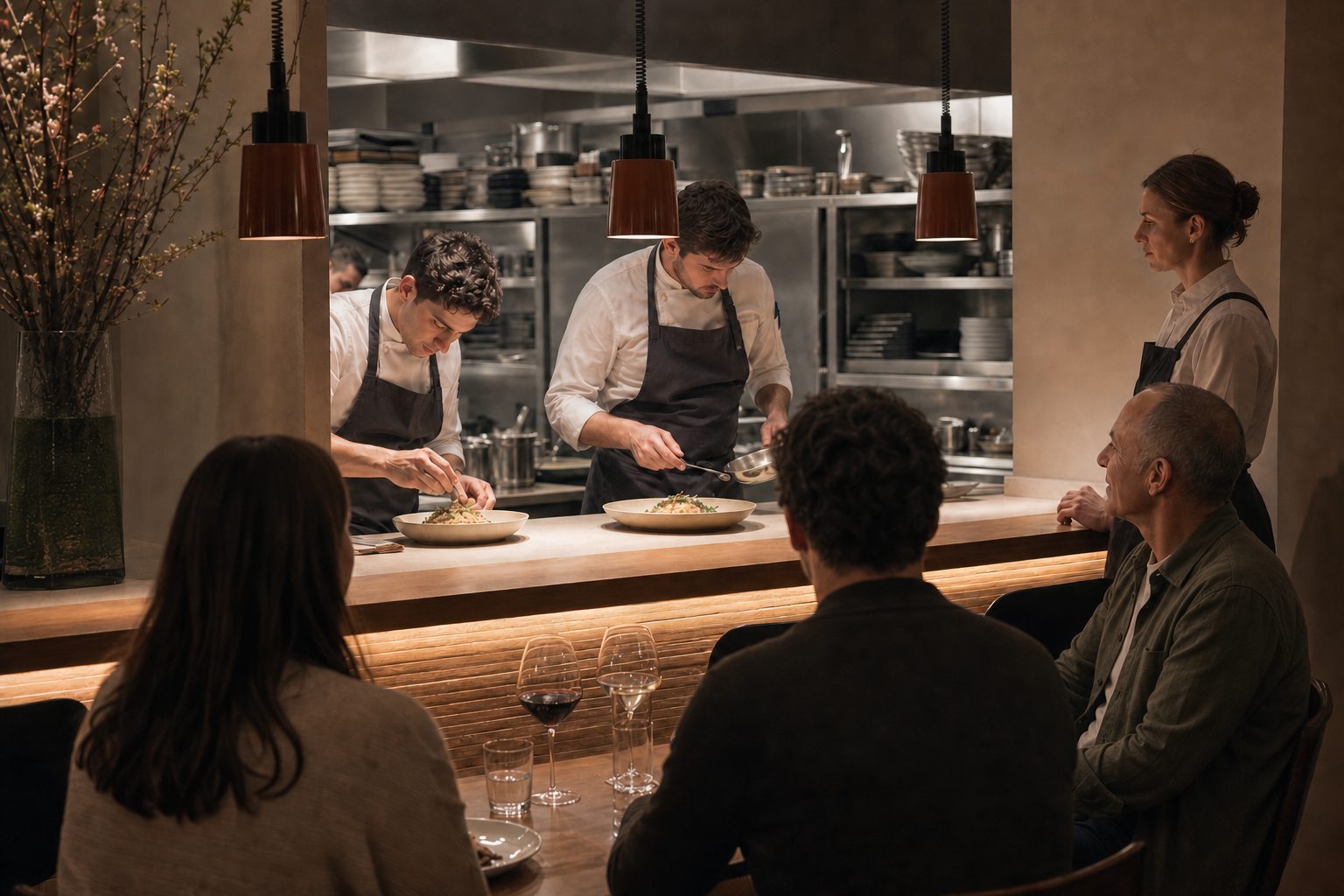
The cook is close enough to see but too far away to hear.
Through a wide opening behind the bar, a pan is lifted from the flame. A second cook wipes the edge of a plate. Someone calls for a garnish, although the words dissolve into the dining room before they become intelligible. A server waits at the pass while four finished dishes are checked beneath a row of warm lights.
At the table, one guest follows the movement without intending to.
They notice the speed of the hands, the brief pause before a plate is released and the towel folded against a cook’s apron. Another guest looks only when a flare rises from the stove. For a few seconds, the kitchen becomes the brightest part of the room.
A wall that might once have separated preparation from dining has been removed, lowered or replaced with glass. Work is now part of the view.
An open kitchen appears to offer transparency. Guests can see where the food comes from. They can watch ingredients become dishes and witness some of the attention that a finished plate usually conceals. The restaurant no longer asks diners to imagine an invisible room behind a swinging door.
But visibility is not the same as understanding.
A guest sees a cook repeat one movement twenty times without knowing whether the repetition expresses skill, delay or exhaustion. They see a plate returned to the pass without hearing the explanation. They see composure without knowing how much effort it requires. The kitchen is open, but the conditions surrounding the work remain largely closed.
The opening creates a relationship between two rooms that once observed each other less directly.
For diners, the kitchen may become evidence, entertainment and atmosphere. For cooks, the dining room becomes an audience that is present even when nobody appears to be watching. Every gesture can become part of the dining-room image. Every disruption can become part of someone else’s evening.
An open kitchen does not simply reveal labour.
It changes what labour must do while being revealed.
An open kitchen turns work into atmosphere
In a closed kitchen, much of the restaurant’s intensity remains backstage.
The dining room receives finished plates, brief appearances by servers and occasional sounds from behind a door. Guests may understand that the kitchen is busy, but they encounter that busyness mainly through its results: a delay, a hot plate, a missing item or a course arriving at precisely the right moment.
Opening the kitchen moves part of that intensity into the design.
The copper pans, tiled walls, flames, hanging utensils and concentrated bodies become visual material. They give the dining room motion. Even before a guest identifies a particular task, the presence of work can make the restaurant feel alive.
That energy is often deliberate. Seats may face the pass. A counter may place diners within a few metres of preparation. Lighting may frame the cooking line more clearly than the tables. The kitchen is not merely uncovered; it is composed as a view.
The view can deepen anticipation. Seeing bread removed from an oven or herbs added at the final moment makes the plate feel connected to an unfolding process. A dish arrives carrying a recent memory: that may be the pan we watched, that may be the sauce being spooned across the room.
Yet atmosphere can detach work from the people performing it.
A flame becomes excitement. Speed becomes energy. Repetition becomes rhythm. The dining room receives the aesthetic effect while the cook continues to carry the heat, concentration, physical strain and consequences of error that produce it.
This does not make pleasure at the view improper. Restaurants shape rooms to make labour and hospitality perceptible. The problem begins when visibility turns demanding work into decoration and treats the worker’s composure as another feature supplied with the meal.
The open kitchen asks labour to produce food and atmosphere at the same time.
Open-kitchen visibility supports trust without proving everything
Guests often read an open kitchen as evidence of confidence.
If the restaurant is willing to expose preparation, the reasoning goes, it must have little to hide. Clean surfaces, organised stations and careful handling become visible signs of standards that would otherwise depend on reputation or inspection.
This trust can be meaningful.
A diner may see ingredients stored with care, dedicated utensils kept apart for particular preparations or a cook pause to clean a surface. Someone with a dietary concern may feel reassured when a server can point to a preparation area and explain what happens there. Visibility can make a restaurant’s claims feel connected to observable practice.
But a kitchen cannot be fully assessed from a table.
The guest sees one angle during one service. Storage rooms, deliveries, preparation completed earlier and cleaning performed after closing remain outside the frame. Even the visible action may be difficult to interpret without technical knowledge. A spotless counter can support good practice, but it cannot certify the entire system.
The reverse is also true. A moment that looks disordered may have an ordinary explanation. A cook may move a plate back because the garnish is wrong, because the temperature needs checking or because the table is not ready. A stack of pans may indicate carelessness or simply the compressed timing of service.
Visibility produces impressions more readily than it produces proof.
The restaurant should not rely on the spectacle of openness to replace clear information. Dietary procedures still need explanation. Hygiene still needs systems, training and accountability. Sourcing claims still need substance. Guests should not be expected to infer safety or ethics from how calm the kitchen looks.
An open view can reinforce trust when the underlying practices deserve it.
It cannot create those practices by itself.
Open-kitchen theatre changes how labour feels
The reassuring appearance of control also requires work.
Every service contains performance.
Servers regulate tone, pace and expression while responding to requests. Hosts receive uncertainty without allowing the doorway to feel uncertain. Cooks coordinate timing under pressure so that the dining room experiences a sequence rather than a collection of separate struggles.
The open kitchen makes one part of this performance visible.
A cook may become aware of posture, facial expression and the appearance of the station in a new way. Frustration that might once have been expressed briefly now has to be managed within the guest’s sightline. A correction between colleagues may need to happen without looking like conflict. An exhausted body may still be required to communicate precision.
None of this means that closed kitchens should permit humiliation, chaos or unsafe behaviour. Respectful working conditions should not depend on whether guests can see them. But observation changes self-consciousness. Being visible introduces another reason to control a gesture beyond the needs of the task itself.
That pressure can be energising for some cooks. Direct contact with the dining room makes the purpose of the work tangible. They can see guests receive a dish, notice pleasure and understand the pace of the room. The kitchen may feel less isolated from the hospitality it helps create.
For others, the same exposure can be draining.
Concentration now occurs in front of strangers. A mistake is not only a problem to solve; it may feel like a public event. The cook cannot know which guest is casually interested, which is filming and which is interpreting every movement as evidence about competence.
The audience is irregular but continuous.
Most diners are not staring. Yet the possibility of being watched can influence behaviour even when nobody’s attention is obvious. The kitchen becomes a workplace with a glass wall onto a room of changing observers.
Good design should recognise this psychological cost. Visibility may be part of the restaurant’s identity, but it should not require workers to remain permanently available as performers.
Open-kitchen exposure is distributed unevenly
An open kitchen does not reveal every worker in the same way.
The person at the pass may be framed clearly and associated with authorship. Cooks at the stove receive attention when flame or movement draws the eye. Someone plating at the counter may become the visible image of precision.
Other labour remains peripheral.
Dishwashing may be hidden around a corner. Preparation may happen downstairs or early in the morning. Cleaners arrive after guests leave. Deliveries are unpacked through another entrance. The calm, beautiful line visible during dinner depends on tasks that the architecture may continue to exclude from the story.
Even within the visible team, exposure can follow hierarchy.
A senior chef may choose when to engage with guests, while a junior cook remains continuously in view. A worker positioned at the counter may be photographed more often than someone at the back. People whose appearance, accent or mannerisms attract unsolicited attention may carry a greater burden from the same openness.
Visibility is therefore not automatically recognition.
Recognition gives labour context, value and dignity. Exposure merely makes a body observable.
A restaurant can celebrate an open kitchen while still allowing the people inside it little control over how they appear. Guests may photograph cooks without asking, post close-up images online or narrate a worker’s mood from a few seconds of expression. The person becomes part of the restaurant’s public content without having agreed to perform for an unlimited audience.
Clear norms can protect that boundary. A restaurant may welcome photographs of dishes while discouraging identifiable images of staff. Counter seats can offer proximity without granting permission to record every interaction. Managers can treat discomfort with filming as a workplace concern rather than an obstacle to guest engagement.
The right to watch food being prepared is not a right to possess an image of the person preparing it.
Diners interpret fragments as stories
From the table, guests assemble narratives quickly.
A cook smiles while speaking to a colleague: the kitchen must be friendly.
A plate returns to the pass: something has gone wrong.
Nobody speaks for several minutes: the team must be tense.
Orders move rapidly: the kitchen is efficient.
These interpretations are understandable. People search visible behaviour for meaning. An open kitchen invites that reading by presenting work as part of the experience.
But the fragment rarely contains enough context.
Silence may reflect concentration rather than strain. Laughter may coexist with poor management. A plate held back at the pass may demonstrate attentive quality control. Smooth movement may come from preparation and trust, or from fear of making error visible.
The dining room cannot reliably diagnose workplace culture from choreography.
This matters because transparency is sometimes used as a moral shortcut. A restaurant appears open, informal and collaborative, so guests assume that labour conditions must also be good. Yet wages, scheduling, breaks, contracts and the ability to raise concerns are not visible from a counter seat.
The most consequential parts of work often resist display.
If a restaurant wants openness to express respect for craft, its employment practices should support that claim. The view should not be used to create intimacy with labour while the workers remain replaceable behind it.
Guests can appreciate skill without imagining that observation has given them complete knowledge. The honest response to visible work is not certainty but attention: this plate required coordination; these movements belong to people; what looks effortless may have been made so through preparation, experience and strain.
The open kitchen can make labour harder to ignore.
It should not make labour easier to romanticise.
Sound, heat and smell cross the opening
A kitchen enters the dining room through more than sight.
Metal touches metal. Extraction systems hum. Timers sound. Orders are called and confirmed. Heat gathers near counter seats. Butter browns, bread warms and smoke carries evidence of the stove before the plate arrives.
These sensations can create immediacy. The smell of cooking sharpens appetite. The sound of a pan can make the room feel connected to preparation rather than separated from it. Guests may enjoy being close to the point where ingredients become dishes.
The same openness can overwhelm.
A seat beside the pass may be louder and warmer than one across the room. Smoke or strong aromas can become uncomfortable. A guest who is sensitive to sound may struggle to follow conversation while the kitchen adds another layer to an already active dining room.
What feels like energy to one person can become sensory labour for another.
Design must therefore do more than produce a dramatic sightline. Extraction, acoustic treatment, ventilation and the placement of seats determine whether openness supports the meal or competes with it. A counter can feel intimate without placing guests inside the operating conditions of the line.
The sensory exchange also moves in both directions.
Cooks hear fragments of dining-room conversation. They may hear praise, complaint or remarks about the staff. Guests can direct questions across the counter when the cook is handling several tasks. The boundary is visually open, but responsibility for interaction may remain unclear.
Proximity should not make every worker instantly available for conversation.
Some kitchens build deliberate moments of contact: a dish is handed over, a cook explains one ingredient or the team greets guests at the beginning of a counter service. These exchanges work because they have a place in the rhythm. Unplanned demands can interrupt timing and place the worker in the position of choosing between responsiveness and concentration.
An open kitchen needs boundaries precisely because the boundary appears to be absent.
Open-kitchen cleanliness can become a performance
Order is necessary in any functioning kitchen.
Tools need places. Surfaces need cleaning. Ingredients need labels and temperatures need control. During service, organisation protects speed as well as safety.
In an open kitchen, order also acquires an audience.
Wiping a counter can reassure guests. Neatly aligned containers communicate discipline. The visible absence of clutter supports the calm the restaurant wants the room to feel.
But appearance and safety are not identical.
A kitchen may devote extra effort to keeping the visible line immaculate while less visible areas carry the disorder. Staff may clear tools for the sightline more often than the task requires. A surface can look perfect while a procedural risk remains unseen.
The pressure can also encourage concealment at the wrong moment. If a spill, broken plate or mistaken order occurs, the safest response may be obvious and disruptive: stop, clean thoroughly, discard and reset. A workplace too concerned with maintaining the image of seamlessness may treat the visible interruption as the greater failure.
Guests should be able to see correction without interpreting it as collapse.
A cook replacing a utensil, remaking a plate or pausing to sanitise a station is not breaking the theatre. They are revealing the practices that make the food dependable. A restaurant confident in its work does not need every visible minute to look effortless.
True transparency includes the possibility of repair.
The pass is a border, not merely a stage
The pass is where kitchen time meets dining-room time.
On one side, dishes are coordinated by temperature, sequence and preparation. On the other, tables are moving through conversations, requests and pauses that do not obey the same clock. A finished plate waits because one dish is missing. A server asks whether a course can be held. A cook asks why a table has not been cleared.
When this border is visible, guests can sometimes see the negotiation.
That can reveal how much work surrounds simultaneity. Four people receiving hot food together is not a natural event. It is an achievement produced by timing across stations and communication across roles.
It can also tempt diners to monitor the process.
A guest believes they recognise their plate beneath the heat lamp and begins to worry. Another recognises a dish ordered later by a neighbouring table and wonders why it is leaving first. The visible sequence appears to offer information, but the guest rarely knows which order belongs to which course, what is being remade or whether a plate at the pass is theirs at all.
Staff should not have to answer every interpretation created by the sightline. Yet prolonged waiting in full view can feel more difficult than waiting for an invisible process. The restaurant has made the work observable, so visible confusion deserves attention.
The pass works best when openness is supported by communication. If a delay is substantial, the table should hear an explanation from a server rather than construct one from gestures across the room. If a dish must be remade, information can prevent quality control from looking like neglect.
Visibility increases the need for interpretation; it does not eliminate it.
Open kitchens should leave room for dignity
The most thoughtful open kitchens are not necessarily the most exposed.
They choose what the dining room can see and what the team needs in order to work well. A framed opening may reveal the pass without placing every station on display. Glass can preserve a visual connection while containing sound and heat. A counter may support deliberate contact while other preparation happens beyond direct view.
Partial visibility is not dishonesty.
Every workplace needs spaces in which people can pause, speak privately, correct an error and recover composure. Staff need access to water, breaks and moments outside the guest’s gaze. The fact that hospitality is public does not make every part of the worker’s day public property.
Managers shape whether openness feels like recognition or surveillance.
If workers are publicly corrected because an unavoidable disruption has disturbed the visual calm, openness has become disciplinary. If guests’ cameras are always prioritised over staff comfort, the restaurant has made exposure part of the job without acknowledging its cost. If only the senior chef receives the credit generated by the view, the visible team remains scenery.
An open kitchen should be discussed with the people who work inside it. Where do they feel watched? Which interactions help them connect to the meal? Where do heat, noise and interruption make concentration harder? What should guests be encouraged to photograph, and what should remain protected?
These are operational questions, but they are also questions about dignity.
Architecture decides who may look at whom. Hospitality decides what that looking is allowed to demand.
Open-kitchen transparency is a practice, not a floor plan
A closed kitchen can be accountable.
An open kitchen can conceal.
The distinction lies not only in walls but in how the restaurant communicates, organises work, corrects errors and responds. Guests need accurate information about ingredients and procedures whether they can see the stove or not. Workers need safe conditions and respectful management whether or not their station forms part of the dining-room view.
Openness becomes meaningful when sight is connected to substance.
The kitchen can reveal craft without pretending that craft is effortless. It can allow guests to witness concentration without making workers available for unrestricted observation. It can show correction as part of care rather than hide every interruption behind a performance of perfection.
The guest at the table may continue to watch.
They see a cook taste a sauce, adjust it and taste again. They see two plates leave together. They see someone step back from the line while a colleague takes the station for a moment. None of these fragments explains the whole workplace.
They do, however, interrupt the fantasy that a dish simply appears.
Food reaches the table through bodies, judgement, repetition and coordination. The open kitchen can make that fact present in the room.
Its value is not that it turns labour into theatre.
It is that, handled carefully, it lets the meal acknowledge the people and practices that made it possible without asking them to surrender their dignity for the view.