The Menu as an Archive
An old menu preserves more than dishes and prices. Its language, omissions and revisions reveal how a restaurant imagined its guests—and what it chose to forget.
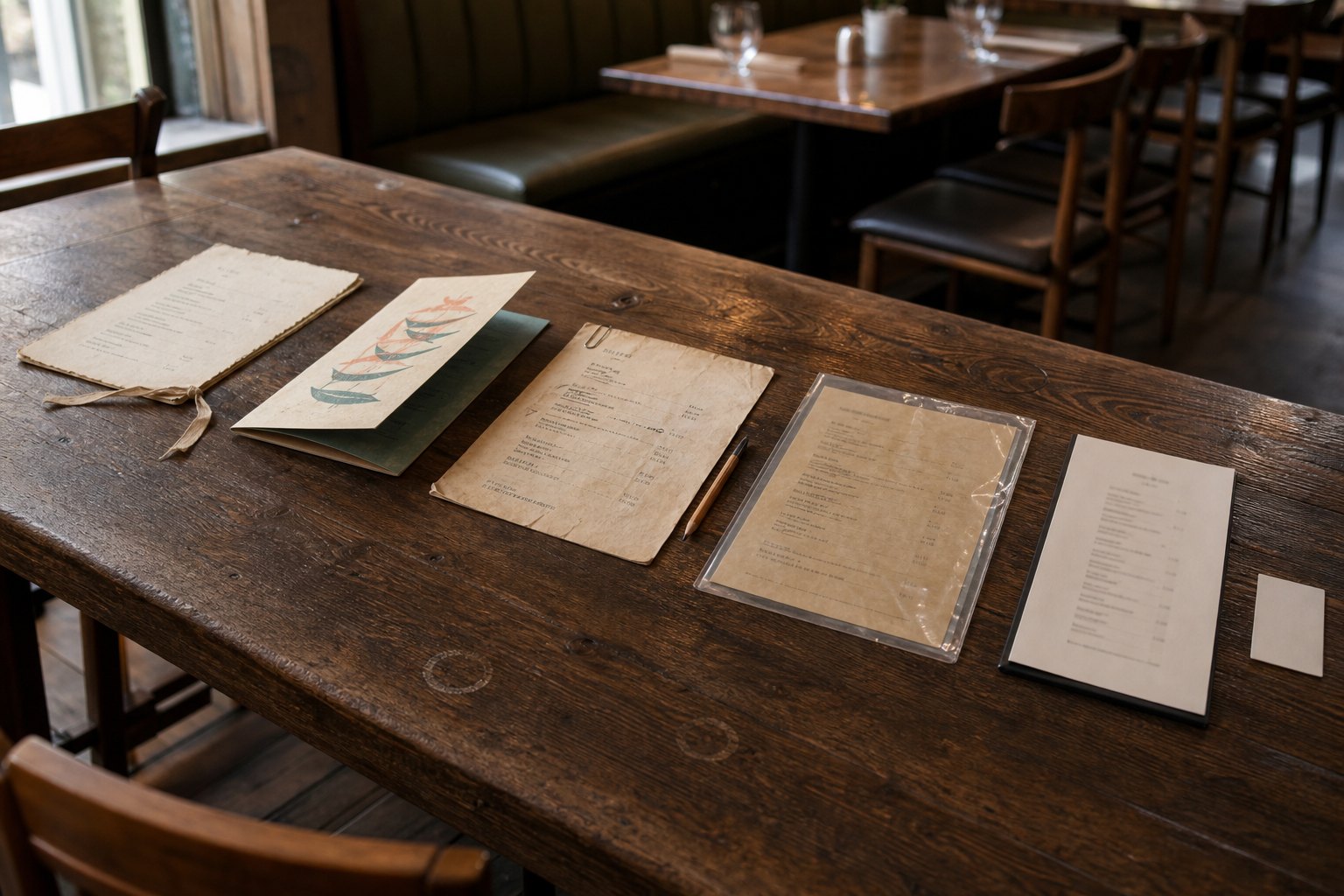
A menu is usually read in the future tense. It tells us what could arrive: the soup that might begin the meal, the fish that might be shared, the dessert we may regret declining. Even before an order is placed, it converts appetite into expectation.
Years later, the same page changes direction. The future has disappeared from it. The dishes will not arrive, the listed prices cannot be paid, and the dining room for which the choices were arranged may no longer exist. What remains is evidence.
This is the quiet transformation that turns a menu into an archive. A document designed to last through a service, a season or perhaps a year begins to preserve a restaurant’s history. Its headings, omissions, adjectives, paper, prices and corrections hold traces of how a place understood food and how it imagined the people who would eat there.
The record is unusually intimate because it was never written as history. A commemorative book knows it is looking backward. A menu is busy with the present. It has ingredients to sell, expectations to manage and a kitchen’s limits to translate into choices. That practical purpose makes the old menu vivid. It also makes it partial.
To read a menu as an archive is therefore not to treat it as a complete account. It is to ask what kind of account it was trying to give.
The page becomes more reliable when it is read beside other records: kitchen notes, photographs, supplier histories, staff memories, guest recollections and the material marks left by use. The menu is not the whole archive. It is often the document that tells us where to begin looking.
The menu is the restaurant speaking in public
Every restaurant has many versions of itself. There is the version the cooks know through deliveries, prep lists, substitutions and pressure. There is the version servers know through questions, complaints, regulars and the rhythm of a room. There is the version owners know through wages, invoices, rent and risk.
The menu is the version offered to the guest.
It turns a complicated organisation into a public voice. A dish that required several hours of labour may receive one line. An ingredient chosen because a supplier had too much of it can appear as a seasonal conviction. A compromise made to keep the kitchen moving may be presented as timeless simplicity.
None of this makes the menu false. It makes it edited. Like every public document, it selects what can be said, what should be emphasised and what does not belong in the story being told.
The editing begins with categories. Starters, mains and desserts suggest one route through a meal. Small plates propose another. A page organised by vegetables, grains, sea and fire divides the world according to a restaurant’s own grammar. A tasting menu removes most visible choice while promising that sequence itself will become a form of care.
Those structures can outlive the dishes inside them. Place menus from the same restaurant side by side and the deepest change may not be a new ingredient. It may be a new idea of how a guest should proceed.
A bill of fare and a portrait of its reader
A menu does not only describe food. It describes, indirectly, the person expected to read it.
Does it explain every ingredient, or assume familiarity? Does it translate a culinary term, leave it in another language, or replace it with a fashionable English equivalent? Are side dishes included, separately priced or not mentioned? Can a guest assemble a modest meal, or does the structure presume several courses? Are children, solo diners, abstainers or people with dietary needs visible in the choices?
Each decision sketches an imagined guest.
An old menu may reveal that a restaurant expected diners to recognise preparations now considered obscure. Another may explain a familiar food at great length because the intended audience was being introduced to it as exotic. A menu that once advertised abundance may later praise restraint. A dish described first through luxury—cream, butter, imported spirits—may return decades later through provenance, seasonality or the name of a farm.
The change is not simply vocabulary. It marks a change in what the restaurant believes will reassure, entice or impress.
This is why historical menus can feel uncannily social. They show more than what people ate. They show what establishments believed people wanted to become while eating: worldly, comfortable, modern, traditional, healthy, indulgent, efficient or at home.
Prices that refuse to explain themselves
Prices attract the eye of anyone opening an old menu. They invite instant comparison. A full dinner for a figure that now buys little more than coffee seems to offer a clean measure of change.
But a menu price is not a self-explanatory fact.
To understand it, we would need to know wages, currency value, portion size, service charges, taxation and what came automatically with the dish. We would also need to know who could afford to enter the restaurant at all. A low number on a page does not mean a meal was broadly accessible. A high one does not tell us whether the dining room was extravagant, whether ingredients were scarce, or whether the price carried the cost of music, spectacle and location.
Even within one restaurant, comparison is difficult. A dish may keep its name while its composition changes. A portion may become smaller, more refined or designed for sharing. Bread, water, side dishes and service may move in or out of the stated price. The menu gives us the amount but not the whole transaction.
Still, prices matter. Repeated across many menus, they show relationships. Which ingredient commanded a premium? What was offered as an everyday choice? When did a supplement appear? Which course expanded as another contracted?
An archive becomes most revealing when the prices are not treated as trivia, but as clues requiring company.
The life of a dish across several pages
Follow one dish through a restaurant’s menus and it may appear to have several lives.
At first it is fully described, perhaps because it is unfamiliar. Later the explanation shrinks as the dish becomes associated with the place. It may acquire the founder’s name, then lose it when a new chef wishes to claim a different identity. A garnish changes with the season. The principal ingredient remains while the sauce migrates through the fashions of the decade. Eventually the dish is moved to a short section of “classics,” where age itself becomes part of its appeal.
Or the opposite happens. A once-central dish becomes difficult to source, expensive to prepare or uncomfortable to defend. It disappears without ceremony. Years later, a chef brings it back in altered form and calls the return a rediscovery.
The menu sequence exposes both continuity and invention. Restaurants often need the two at once. Guests want to recognise a place, but they also want evidence that it is alive. The printed page negotiates between those desires.
That negotiation can be tender. A restaurateur may keep a modest dish because regulars rely on it, even when it no longer fits the new design. A new team may change everything except one soup. The archive then shows identity not as an unbroken tradition, but as a series of decisions about what deserves to remain.
Names travel even when recipes stand still
Sometimes the ingredients change less than the name.
A preparation may move from one language to another, from regional specificity to broad description, or from a generic label to a story about origin. Words that once signalled sophistication can later sound mannered. Terms once used casually may become recognised as inaccurate, appropriative or offensive. A restaurant may revise them because its audience has changed, because its staff have changed, or because the wider culture has learned to hear the words differently.
These shifts leave linguistic layers in the archive. The dish is never only edible. It is also classified.
Consider the difference between a menu that calls something “foreign,” one that identifies a country, one that names a region and one that credits a cook or family. Each locates authority differently. A broad category can make food legible to newcomers, but it can also flatten difference. A precise name can restore context, yet precision may itself become a marketing performance if the people connected to the dish remain absent.
Old menus allow us to see these transitions without pretending that newer language is automatically complete. They show a restaurant learning, rebranding, correcting, forgetting and sometimes circling back.
The recipe travels through the kitchen. Its name travels through the room.
Design is part of the argument
Before a guest reads a dish, the menu has already made a claim.
Heavy card, gold lettering and a bound cover create one kind of attention. A single sheet on recycled paper creates another. A laminated book promises durability and range. A handwritten board turns changeability into atmosphere. A menu without currency symbols may soften the sensation of spending. One with prices aligned in a strict column makes comparison almost unavoidable.
These are not neutral containers for information. They shape how choice feels.
The illustrated mid-century menu, the densely typeset hotel carte, the colourful family-restaurant booklet and the contemporary page with abundant white space each place the diner in a different relationship to the establishment. One offers spectacle, another authority, another reassurance, another apparent restraint.
Wear adds a second design, made unintentionally. Softened corners show how a menu was handled. A greasy thumb mark identifies a frequent point of contact. A cracked laminate records years of wiping. A wine ring may be the only surviving trace of the table at which the menu was used.
Collectors often preserve clean examples, for understandable reasons. But the damaged copy may be the stronger social object. It remembers not only what the restaurant wanted to say, but that people actually sat down and read it.
Corrections bring the kitchen closer
The most revealing marks are sometimes the least elegant.
A price written over another price. A dish crossed out before service. A strip of paper pasted over an ingredient. A note that something is available only on Friday. These interventions interrupt the menu’s confident public voice.
They bring time back into the document.
The printed menu suggests that the restaurant is settled. Corrections reveal that it is continuously adjusting: to a missed delivery, a shortened season, a supplier’s change, a new cost, a guest request or a cook who has left. A pristine page presents the system. A revised one records the system under pressure.
Daily sheets and inserts are especially valuable because they resist the illusion of permanence. They show a restaurant thinking quickly. They may also preserve foods that never entered the formal menu: a surplus turned into soup, a festival special, a staff idea tested for one evening.
Yet these fragile pages are precisely the ones most likely to disappear. They are thrown away after service, stained beyond use or replaced by a file that is overwritten the next morning. The archive therefore favours what was durable enough to survive, not necessarily what was most representative.
Absence begins with the material itself.
What the menu leaves outside the frame
No menu can tell us exactly what was cooked.
A listed dish may not have been ordered. An unavailable dish may have remained on the page. A substitution may never have been printed. Regulars may have known to ask for something that newcomers could not see. Staff may have served one group generously and another reluctantly. None of that appears in the official list.
Nor does the menu usually name the labour behind the food. It may celebrate the chef while leaving cooks, dishwashers, porters, growers and servers anonymous. It can describe a sauce in detail while saying nothing about who learned to make it, who was permitted to claim it, or how difficult the work became on a busy night.
There are silences of power too. A colonial-era menu may present ingredients and names as though they arrived without conquest or trade. A menu selling an exotic experience may reveal more about the fantasies of its intended guests than about the culture it claims to represent. A children’s menu may preserve assumptions about what young people should eat, while telling us little about what they actually wanted.
The menu is evidence of representation, not proof of experience.
That distinction does not weaken the archive. It tells us how to use it responsibly.
One menu is an anecdote; many become a pattern
A single old menu can fascinate through rarity. Thousands allow different questions.
The New York Public Library’s historic menu project reports 1,335,570 dishes transcribed from 17,562 menus, turning individual pages into searchable data. The Smithsonian’s Virginia Mericle Menu Collection preserves more than four thousand additional examples, with moderately priced and everyday restaurants represented alongside better-known rooms.
Scale changes what can be seen. Researchers can trace the rise and decline of names, compare prices cautiously, observe the spread of ingredients, and notice when categories such as children’s meals or family dining become prominent. They can also study design and marketing, not only cuisine.
But scale creates its own temptation: to mistake what has been collected for what existed.
Archives are shaped by collectors. A person asks certain restaurants to mail menus; establishments willing to reply become overrepresented. Luxurious menus are kept as souvenirs while ordinary sheets are discarded. Institutions digitise part of a collection, and the digitised portion becomes easier to study than the rest. A searchable dish is noticed more readily than a difficult illustration or an untranscribed note.
The pattern is real, but it is a pattern of survival as well as dining.
Good archival reading keeps both in view.
The restaurant’s memory and the guest’s memory
An establishment may preserve its menus to maintain a continuous identity. A guest keeps one for different reasons.
The guest’s copy might mark an anniversary, a journey, a reconciliation or the first meal after a long separation. It may contain a date, a signature or a small stain no conservator would have chosen. Its value lies partly outside the restaurant’s story.
This creates two archives on the same paper.
For the restaurant, the menu can document authorship, brand and change. For the guest, it can be a prompt that returns the sound of a room, the person across the table and the feeling of ordering without knowing what would happen next.
The distinction matters because hospitality is always co-produced. Restaurants offer structures—rooms, dishes, sequences, gestures—but guests attach those structures to their own lives. The official archive tends to preserve intention. Personal collections preserve attachment.
Bring the two together and a menu becomes more than a product list. It is a meeting point between what a place hoped to be and what somebody experienced there.
Neither memory is complete. Together, they make the page less lonely.
When the archive becomes a brand
Restaurants understand that age can be valuable.
An old menu displayed in a frame can demonstrate continuity more efficiently than a paragraph of history. A revived dish can turn the archive into an event. Anniversary menus, heritage typography and references to founding years invite guests to dine not only in the present restaurant, but inside its accumulated time.
This can be generous. A restaurant may use its archive to honour former cooks, recover local suppliers or return a forgotten preparation to the people who remember it. History can deepen a meal.
It can also be simplified into atmosphere.
The difficult years disappear. Ownership changes are softened. A dish borrowed from elsewhere becomes an eternal house tradition. The past is curated to look inevitable, as though the restaurant had always been moving toward the version now being sold.
Every archive is curated, but branding intensifies the selection. It prefers usable history.
The answer is not to forbid restaurants from telling stories about themselves. It is to ask for richer stories. Who made the dish? When did it leave? Why did it return? Which ingredient had to change? What did the old name conceal? Acknowledging interruption does not weaken tradition. It shows that tradition was maintained by choices, labour and adaptation rather than magic.
An honest archive can still be beautiful.
The fragile memory of a digital menu
Paper survives partly because it can be forgotten in a drawer.
Digital menus can appear more durable. They can be copied perfectly, stored cheaply and shared instantly. Yet many are harder to preserve as versions. A restaurant updates a web page and yesterday’s menu vanishes. A PDF is replaced at the same address. A QR code remains on the table while its destination changes. Delivery platforms and reservation services display their own copies, then redesign or close.
The current menu becomes wonderfully accessible. The sequence of menus becomes strangely elusive.
Digital systems can preserve far more if versioning is intentional. A restaurant can save dated files, export web pages, keep image assets and record the context of major changes. But storage alone is not an archive. Without names, dates and explanation, a folder of nearly identical files becomes another form of forgetting.
There is also a visual loss when a dynamic menu is reduced to screenshots. Interactions, dietary filters, translations and availability signals may have shaped how the menu worked. The future historian needs not only the words but the behaviour.
The blank QR card belongs in the archive too. It records a moment when the menu ceased to be only an object and became a doorway.
How a restaurant might keep its own record
Preserving menus does not require turning a working restaurant into a museum.
A simple practice is enough to begin. Keep one clean copy of each substantial revision and one used copy when its marks tell a story. Date both. Save daily specials occasionally, especially when they respond to a local event, a seasonal glut or a disruption in supply. Export digital versions rather than overwriting them.
Then add context that the menu cannot provide.
Who developed the dishes? Which suppliers mattered? What left because it failed, and what left because it became impossible to make fairly? Which correction came from guests? Which change reduced pressure on the kitchen? A short note from a cook or server can prevent the archive from becoming only the owner’s voice.
Photographs of the room help, as do floor plans, staff-meal notes, reservation books and oral histories. The aim is not total preservation. No institution, family or restaurant can keep everything. The aim is to keep relationships around the menu so that a future reader does not have to make the page explain more than it knows.
Records involving identifiable staff or guests also need consent, privacy rules and clear access decisions. Preserving a restaurant’s memory should not require making every private detail public.
Good archives do not eliminate gaps. They make gaps visible.
Reading with sympathy and suspicion
An old menu deserves two forms of attention at once.
The first is sympathy. Someone made choices under particular constraints and tried to welcome a public. The strange description, crowded design or crossed-out line belonged to a working day. It should not be judged only by current taste.
The second is suspicion. The menu is persuasive. It arranges food and history to produce desire. Its language may conceal labour, flatten culture or presume a guest with money, knowledge and bodily ease. Age does not make those choices innocent.
Reading with sympathy alone turns the menu into nostalgia. Reading with suspicion alone drains it of human effort.
Together, the two approaches let the document remain complicated. A menu can be artful and exclusionary, generous and strategic, historically valuable and factually incomplete. It can preserve a vanished dish while erasing the person who taught the kitchen to make it.
This complexity is not an obstacle to the archive. It is the reason to keep one.
The page after the meal
At the table, a menu helps us decide what comes next.
In the archive, it asks a different set of questions. Who was expected? What counted as choice? Which words made a dish desirable? What was expensive, ordinary, explained or left unnamed? What did the restaurant believe should never change, and what did it quietly allow to disappear?
The answers are never contained in one page. They emerge through comparison: menu beside menu, public language beside kitchen memory, clean copy beside stained one, restaurant story beside guest recollection.
That is why an old menu should not be read as a transparent window onto the past. It is closer to a mirror placed in a dining room. It reflects the food, but also the room’s arrangements, the ideals of the establishment and the person invited to look.
For a few minutes during service, the menu was an instrument of anticipation. Then the meal happened and the page was cleared away.
If it survives, anticipation becomes testimony.
The dishes are gone. The restaurant may be gone. Yet the menu keeps asking us to read what was offered, what was promised and what the promise could not hold.