The Bill Arrives
The bill does more than state a price. Its timing, clarity and presentation determine whether the final minutes of a meal feel like a graceful departure or an abrupt end to hospitality.
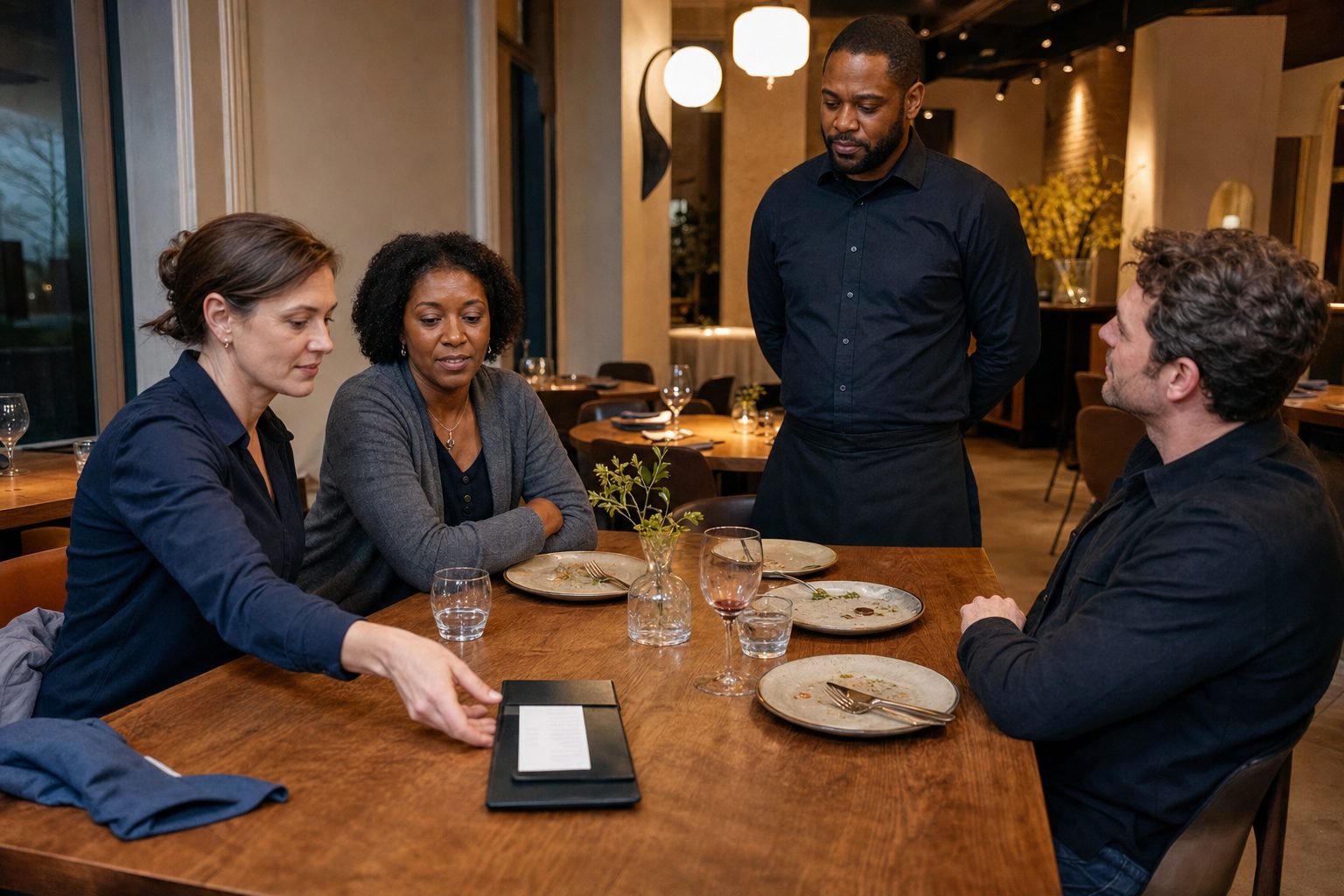
The bill arrives in a small dark folder.
Until this moment, the table has held bread, plates, glasses and the remains of a conversation that nobody has quite finished. Now it holds a number.
One diner reaches first. Another looks away, perhaps out of politeness. A third asks whether they should divide everything equally or remember who ordered the second glass of wine. The server steps back. For a few seconds, the meal becomes a calculation conducted in public.
Nothing about this is unusual.
It is still a change.
Throughout dinner, the restaurant has translated money into other things: warmth, ingredients, attention, time, light, music, clean linen and the temporary feeling that the table belongs to the people sitting around it. The bill translates all of that back into price.
Handled well, the translation feels clear and unsurprising. The guests understand what they are paying, the staff are treated fairly and the table can end without embarrassment.
Handled poorly, the last object of the meal can revise the memory of everything that came before it.
The bill is not outside hospitality. It is hospitality’s final piece of communication.
The bill changes the grammar of the table
A menu speaks in possibilities.
Would you like another plate? Shall I bring more water? Can we tempt you with dessert?
The bill speaks in completion.
These are the things you chose. This is what they cost. The restaurant has finished giving, and payment is now due.
That change is necessary. A restaurant is a business, and welcome cannot be separated from the economic structure that makes it possible. Ingredients must be bought. Rent, energy, equipment and insurance must be paid. Staff time deserves compensation. The table has occupied scarce space through a service period.
Yet necessity does not make the transition socially simple.
The guest who asks for the bill is announcing readiness to leave. The server who presents it without being asked may be making the same announcement on the restaurant’s behalf. Even when no offence is intended, the object can carry a message about whose time now matters.
This is why the smallest details become legible. Was the bill placed gently or dropped while the server turned away? Did it arrive immediately after the request, or after a long wait during which leaving became harder? Did a payment terminal appear before anyone had seen an itemised total? Did the server remain close enough to help without standing over the decision?
The end of a meal has its own grammar. The bill supplies the punctuation.
Payment begins with the menu
The total at the bottom of a receipt should not be the first clear account of what dinner costs.
Payment begins with the menu.
Displayed prices allow diners to choose within their means without having to reveal those means. Descriptions clarify whether a side dish is included, whether water is charged, whether bread appears automatically and whether a supplement applies. A visible note can explain a cover charge, mandatory fee, discretionary service charge or minimum spend before any order is placed.
When that information is absent or difficult to find, the final amount acquires the quality of a verdict.
Research on hospitality pricing has found that concealing prices can make an establishment seem more expensive while weakening perceptions of value and fairness. The result is revealing. Removing the number does not necessarily release the guest from thinking about money. It may make money more present because uncertainty has replaced choice.
Clear pricing is sometimes mistaken for a lack of elegance. In reality, it protects the social ease that elegant service is meant to create.
A diner should not need to ask the price of a special while companions listen. A person deciding whether to order dessert should not have to calculate an undisclosed service fee later. A host should not learn only at payment that a fixed menu excluded drinks described casually as part of the experience.
The bill feels hospitable when it confirms the agreement already made.
Price surprise has a long memory. Restaurants often think of it in accounting terms.
Was the item entered correctly? Did the system apply the offer? Is the amount legally payable?
Guests experience surprise relationally.
An unfamiliar charge asks them to reconstruct the meal. Was this mentioned? Did everyone understand? Will objecting make the evening awkward? If the charge is optional, who must request its removal, and in front of whom?
The money may be small while the social cost is large.
Imagine a diner who has invited three relatives for a celebration and quietly planned the maximum they can afford. An unexplained fee pushes the total beyond it. Challenging the bill may expose a private limit to the whole table. Paying silently may protect the celebration while leaving resentment attached to the restaurant.
Clarity is therefore not only consumer information. It is a form of discretion.
It allows people to manage their resources without a public confession. It also protects staff from being placed at the end of the evening as interpreters of a policy they did not design.
Every unexpected line creates a conversation. If the restaurant expects the server to conduct that conversation, the server needs language, authority and accurate information. Better still, the guest should have encountered the essential information before ordering.
Who pays is a table question
The amount belongs to the restaurant and the table at once.
For the restaurant, it records sales. For the diner, it may also record generosity, status, obligation, fairness and the terms of a relationship.
Who invited whom?
Was “this is on me” a firm promise or a polite opening move? Is one person paying because they earn more, because they chose the venue or because their culture gives the host a particular responsibility? Is a business dinner being reimbursed? Is somebody hoping that colleagues will not notice they avoided alcohol or ordered less?
The server does not need to solve these questions. The restaurant does need to avoid making them harder.
Asking “one bill or separate?” early can help where separate payments are operationally possible. It can also feel mechanical if posed before guests have settled. Asking at the end may be more natural but slower during a busy close.
There is no universally graceful script.
The useful principle is to make the restaurant’s payment options knowable before the moment becomes pressured. A note on the booking confirmation, menu or ordering system can explain whether bills can be split by item, by amount or only evenly. Staff can then ask with confidence rather than improvise a rule at the table.
Predictability gives diners room to manage the social meaning themselves.
The social question continues when someone reaches first. A bill placed at the centre does not become neutral.
Servers often read cues: the person who booked, ordered the wine, held the menu longest or made eye contact when the bill was requested. Those cues can be useful. They can also reproduce assumptions about age, gender, race, wealth, family authority or business status.
Placing the bill in front of the wrong person may be a small error. Repeating the assumption after correction can turn it into a judgement.
At a table of two men and one woman, the woman may be the host. At a family table, the older diner may be a guest. The person in formal clothing may not be paying. The person who appears least affluent may have planned the entire evening.
Neutral presentation is not achieved by pretending nobody has signalled.
It comes from following explicit language. If a diner says, “Could you bring me the bill?”, the request has identified the recipient. If someone quietly offers a card in advance, the restaurant can record that intention without staging a contest later. If two guests reach at once, a light question—“How would you like me to handle it?”—returns the decision to them.
The server facilitates payment. The server does not appoint the table’s provider.
Splitting the bill needs more than arithmetic
“Shall we divide it evenly?”
The question sounds efficient because the calculation is easy.
The answer may not be.
People consume differently. One drinks wine, another water. One orders a main course, another joins for coffee. Dietary needs can make one person’s food more expensive. A diner may have chosen carefully within a budget while a companion ordered freely under the assumption of an equal split.
Economic experiments in restaurant settings have shown that equal splitting can change what people choose because each person bears only part of the cost of an additional item. But the discomfort of splitting is not fully captured by efficiency. It involves friendship, dignity and the fear of appearing ungenerous.
Restaurant systems can reduce the administrative burden without deciding what fairness means for the group.
Itemised bills that are easy to read help. Payment systems that allow a specific amount, selected items or an even division give the table options. Staff who explain what is possible without sighing or joking about complicated groups prevent a practical request from becoming a moral test.
There are operational limits. Ten separate card transactions take time. Item-by-item splitting can create errors. A restaurant may reasonably restrict methods, especially during peak service.
The hospitable version of a limit is announced, consistent and explained without punishment.
Bill timing is part of service
A bill can arrive too early and too late.
Too early, and it feels like eviction.
The plates have just been cleared. One person is still drinking. The table has not asked to leave, but the folder appears as if the restaurant has already imagined the next party in the chairs.
Too late, and the guest becomes trapped at the very moment they are trying to release the table.
Coats are on. A taxi is approaching. The card is visible. Eye contact has been attempted several times. The server who was attentive throughout dinner has disappeared into side work, another section or the queue at a single payment terminal.
Restaurants often devote extraordinary care to pacing courses and treat payment as an administrative afterthought. Yet the wait for a bill may be the only delay the guest experiences while urgently wanting time to move faster.
Good timing begins with observation.
The empty coffee cups, folded napkin, phone checked for transport, glance toward the door and attempt to catch a server’s eye are departure cues. None is conclusive alone. Together they suggest that a gentle offer may be useful: “Whenever you’re ready, I can bring the bill.”
That sentence preserves choice. It opens an exit without closing the table.
The table may not be ready. A request for the bill is clear.
The absence of a request is not.
Some diners expect to ask. Others expect the server to notice. Some cultures consider an unrequested bill discourteous; elsewhere it is routine after coffee or at closing time. In fast-casual settings, payment happened before the meal. In tasting-menu restaurants, the final course may trigger a well-rehearsed closing sequence.
Context matters.
So does the pressure carried by the room.
A restaurant with reservations waiting cannot offer unlimited occupancy. A small dining room may depend on turning a table at the time stated in the booking. Staff also deserve a real end to their shift. None of this becomes less true because the final guests are still talking.
The strongest closing practice begins before conflict.
If a table has a defined duration, communicate it during booking and arrival. If the kitchen or bar closes at a particular time, make that visible. Near the limit, offer a specific next step rather than a mysterious sequence of cleared glasses and brightened lights.
“We will need the table at nine, but there is time for coffee” is more hospitable than silently delivering a bill at 8:42 and expecting the object to carry the whole message.
The payment terminal rearranges pressure
The paper bill allows a pause.
A handheld payment terminal often compresses the end into a live interaction. The server brings the device, enters the amount, turns the screen and waits. The guest checks the total, chooses a payment method, responds to any gratuity prompt, enters a code and waits for approval while the employee remains physically present.
This can be efficient. It can also make private decisions feel observed.
The design of the terminal matters. Can the guest see an itemised bill before payment? Is the screen readable? Are optional choices clearly optional? Can a diner select a custom amount or no tip without asking the server to intervene? Does the employee know where to look so that privacy is more than a promise?
A server may feel awkward too.
They did not design the prompt, choose the suggested percentages or decide whether the screen begins at twenty per cent. Yet they become the human face of every interface decision. A system that generates pressure for the guest can generate embarrassment for the worker who must hold it.
Technology does not remove the social encounter. It rearranges who carries its discomfort.
Tips are not simple service scores
In some places, tipping is unusual. In others, it is optional but customary. Elsewhere, it forms a substantial part of a worker’s expected income.
An international journal cannot treat one system as universal.
Even within a tipping culture, the amount is not a clean measure of service quality. Large-scale restaurant data show that tips vary with factors such as bill size, tax, discounts, time at the table and how busy the restaurant is. Research on tipping motivations also points to social conformity, future visits and the wish to recognise service.
The guest is not simply grading the server.
The guest may be following a norm, calculating from a total that includes tax, responding to a suggested percentage, protecting a public image or working within personal means. The server, meanwhile, may have provided excellent service while depending on kitchen timing, reservation policy, menu clarity and staffing levels beyond their control.
This is why tipping systems deserve more honest language.
If a restaurant relies on gratuities as part of compensation, that fact shapes both labour and the payment encounter. If service is included, say so clearly. If a discretionary charge is added, explain whether it may be removed and how it reaches workers. If no tip is expected, guests may welcome being released from guessing.
Silence does not make the system neutral. It makes the server and guest negotiate it at the most exposed moment.
Suggested generosity can feel compulsory because digital prompts are forms of choice architecture.
The percentages shown, their order, the presence of calculated amounts and the visibility of a “no tip” option can influence what people choose. Recent research using transaction data found that displaying suggested percentages alongside their monetary amounts increased both the likelihood and size of tips. Other studies have found that gratuity guidelines can reduce brand favourability when diners experience them as a threat to freedom.
Convenience and pressure can occupy the same screen.
A guest may appreciate not having to calculate. The same guest may resent a starting suggestion that feels detached from local custom or the kind of service received. A worker may benefit from higher tips while also absorbing irritation created by the prompt.
Restaurant owners face a real tension here. Compensation matters. So does trust.
The answer is not necessarily to eliminate suggestions. It is to inspect the full encounter rather than optimising only the average tip. Are the options proportionate? Is every choice equally usable? Is the server required to watch? Does the screen imply that declining is an error? Are customers asked before service has occurred?
A voluntary payment remains voluntary only when refusal is socially and technically possible.
Service charges need two kinds of clarity
A service charge answers one question and creates another.
It may simplify the guest’s calculation, distribute income across a team and reduce the volatility of individual tips. It may also be mistaken for a gratuity, a compulsory fee or revenue retained by the business.
The first clarity concerns the diner.
Is the charge mandatory or discretionary? At what percentage? Was it disclosed before ordering? Does the displayed total already include it? If it can be removed, can that happen without a humiliating negotiation?
The second concerns the worker.
Who receives the money? How is it allocated? When is it paid? Are kitchen, bar and support staff included? Does the restaurant deduct administrative costs?
Rules differ by jurisdiction. In Great Britain—England, Scotland and Wales—statutory requirements that took effect in October 2024 require qualifying tips and service charges to be allocated fairly and transparently to workers without employer deductions, supported by a code of practice. Northern Ireland and other jurisdictions have different legal and wage structures.
The broader principle travels.
When a payment is described as being for service, diners and workers both deserve to know what the description means.
Itemisation makes correction ordinary
A clear bill permits a guest to check it without implying distrust.
Items should be recognisable. Quantities should be visible. Discounts, deposits, taxes, service charges and payments already made should be distinguished. If the menu uses poetic dish names, the bill should not translate them into internal abbreviations that only staff can decode.
Good itemisation also helps the restaurant.
The guest can identify a duplicate drink or missing deposit before it becomes a chargeback, angry review or private decision not to return. The server can trace an error quickly. Managers can see patterns in voids and corrections.
The purpose is not to invite an audit of every leaf of salad.
It is to make legitimate questions easy.
“Could you help me understand this line?” should be received as a request for information, not an accusation. The employee should be able to inspect the bill without immediately defending it. If there is an error, correction should not require the guest to prove innocence through a long reconstruction of the meal.
The final interaction is a poor place for institutional pride.
A restaurant that checks calmly communicates confidence more effectively than one that insists the system cannot be wrong.
A billing mistake arrives late but lands widely. A wrong bill can be corrected in seconds.
Its timing gives it unusual power.
The meal is over. The guest is preparing to leave. There may be transport to catch, children becoming tired or colleagues waiting to move to another appointment. The restaurant has little remaining experience with which to repair the effect.
A duplicated item may also raise a larger suspicion. If the guest had not checked, would they have paid it? Is this an isolated input error or a practice? Were other totals wrong too?
The response should match both the amount and the doubt.
First, acknowledge and correct. Then present the revised bill clearly. If payment has already been taken, explain the refund process and timing rather than saying only that it has been “done.” If the mistake reveals a system problem—an automatic fee applied incorrectly, a deposit not credited, an item assigned to the wrong table—the restaurant should investigate beyond the individual receipt.
Speed matters, but composure matters with it.
The employee who made an input error should not be blamed at the table. Public humiliation does not make the total more accurate. It merely adds another failure to the final minutes.
Budget is not a defect in the guest
Restaurants need revenue.
Guests need prices they can act on.
These needs are compatible until hospitality begins to treat financial limits as evidence that someone does not belong.
A diner can value craft and still ask what something costs. A group can enjoy an expensive restaurant and still want separate bills. A person can decline another drink because of budget rather than taste. A guest can question a discretionary charge without rejecting the labour of the staff.
The language used around payment reveals who a restaurant imagines as comfortable there.
“If you have to ask…” jokes, eye-rolling at split payments and conspicuous announcements that a card has been declined turn private financial information into public theatre. Even a well-intended rescue—loudly offering that someone else at the table can pay—may intensify embarrassment.
Discretion is a service skill.
When a payment fails, describe the technical event quietly and without interpretation. Offer another attempt or method. When a guest asks about a price, answer directly. When a group needs time to organise payment, give it within the operational limits of the service.
Hospitality does not require pretending money is unimportant. It requires refusing to use money as a measure of human worth.
Payment access is part of welcome
The smoothest payment method for the restaurant may not be available to every guest.
Some people rely on cash. Some use cards that require a signature or a physical reader. Some need a receipt in a particular format for expenses. A visually impaired diner may be unable to read a small terminal screen. A guest with limited dexterity may need the device placed on the table. Travellers may not recognise local prompts or may encounter a currency-conversion choice they do not understand.
Accessibility at payment is often improvised because it appears at the end.
It should be designed earlier.
Staff can know which methods are accepted, whether cash change is available, how to print or email a receipt and how to move a terminal without taking a customer’s card out of sight where local practice discourages it. They can offer assistance without assuming incapacity.
Digital convenience should add routes rather than quietly close them.
A QR code may let one diner pay privately and quickly. It should not become the only understandable path if connectivity, battery, vision, language or technical confidence makes it unusable.
The last step of an experience should not reveal that the welcome was built for only one kind of body, bank account or device.
The staff are closing more than a table
From the dining room, payment can look like a brief exchange.
Behind it sits a system of labour.
Checks must be reviewed, discounts authorised, deposits applied, tips recorded, receipts produced, cash counted and card transactions reconciled. A server may be responsible for several tables trying to pay at once. One incorrect table number can place drinks on the wrong bill. One unavailable manager can delay a simple correction. At closing, the team may still face side work and cash-out procedures after the last guest leaves.
Understanding this does not oblige diners to accept long or confusing payment.
It does explain why the end improves when restaurants design for the actual workload.
Enough functioning terminals matter. So does a clear route for authorisation. Staff need training on split payments before a party of twelve asks. Booking deposits should flow visibly into the point-of-sale system. Policies should not change according to which manager is present.
The goal is not frictionless technology for its own sake.
It is to keep operational friction from being transferred to the guest and emotional friction from being transferred to the worker.
Hospitality continues after payment approval
Payment approval is not the same as departure.
The terminal beeps. The receipt prints. The economic obligation has ended.
Hospitality has one more opportunity.
A sincere thank-you, help with coats, directions to the exit, confirmation of a taxi or a simple goodnight can complete the relationship. The gesture need not be elaborate. It should not depend on the amount spent or the tip left.
This matters because payment can make guests feel suddenly anonymous. For two hours, preferences were remembered and glasses refilled. Once the card is approved, attention moves visibly elsewhere.
Restaurants cannot stage a personal farewell for every table during a rush. They can avoid making payment feel like the point at which the guest ceases to exist.
The same is true when gratuity disappoints a worker.
Servers are human. A low or absent tip can affect income and morale, especially where compensation depends on it. The restaurant should create room for that reality away from the guest. A cold goodbye, visible glance at the receipt or comment about generosity turns an already difficult labour system into a personal confrontation.
The farewell should not be sold back to the diner.
A graceful ending is designed
The bill is sometimes described as a moment to be made invisible.
It cannot be.
Money has been present from the first menu decision, in the ingredients chosen by the kitchen, the time available for the table and the labour performed throughout the room. Trying to conceal payment often makes it stranger.
A graceful ending comes from visibility without exposure.
Prices are clear before ordering. Additional charges do not appear as surprises. The bill is itemised. Payment options are known. Timing responds to the table while respecting the restaurant’s limits. Technology supports privacy. Tipping or service-charge expectations are explained honestly. Questions can be asked without accusation. Workers have enough authority to correct ordinary problems.
None of these practices removes money from hospitality.
They place money inside a relationship governed by clarity and dignity.
The restaurant receives what it is owed. The worker is not forced to negotiate compensation through shame. The diner is not made to prove belonging by appearing unconcerned about cost.
The bill can then do what a good final object should do.
It can confirm the meal rather than reinterpret it.
The table is released
After payment, the folder closes.
Chairs move. Napkins are left behind. The temporary world of the table begins to separate into coats, bags, plans and different journeys home.
What remains is not the receipt alone.
The guests remember whether the total made sense. They remember whether choice remained possible, whether a question was welcomed and whether the person taking payment was allowed to remain a host rather than becoming an enforcer. Staff remember whether the closing sequence gave them the tools and time to finish their work with composure.
The bill marks an exchange, but it does not need to reduce the meal to one.
At its best, it says: this experience had a real cost; that cost was communicated honestly; the work behind it mattered; and now the relationship can end without confusion or diminishment.
The final act of restaurant hospitality is not avoiding the transaction.
It is allowing everyone at the table to leave it with dignity.