Sharing Plates, Unequal Choices
Shared formats promise sociability but can allow confident diners to dominate taste, budget and portion decisions.
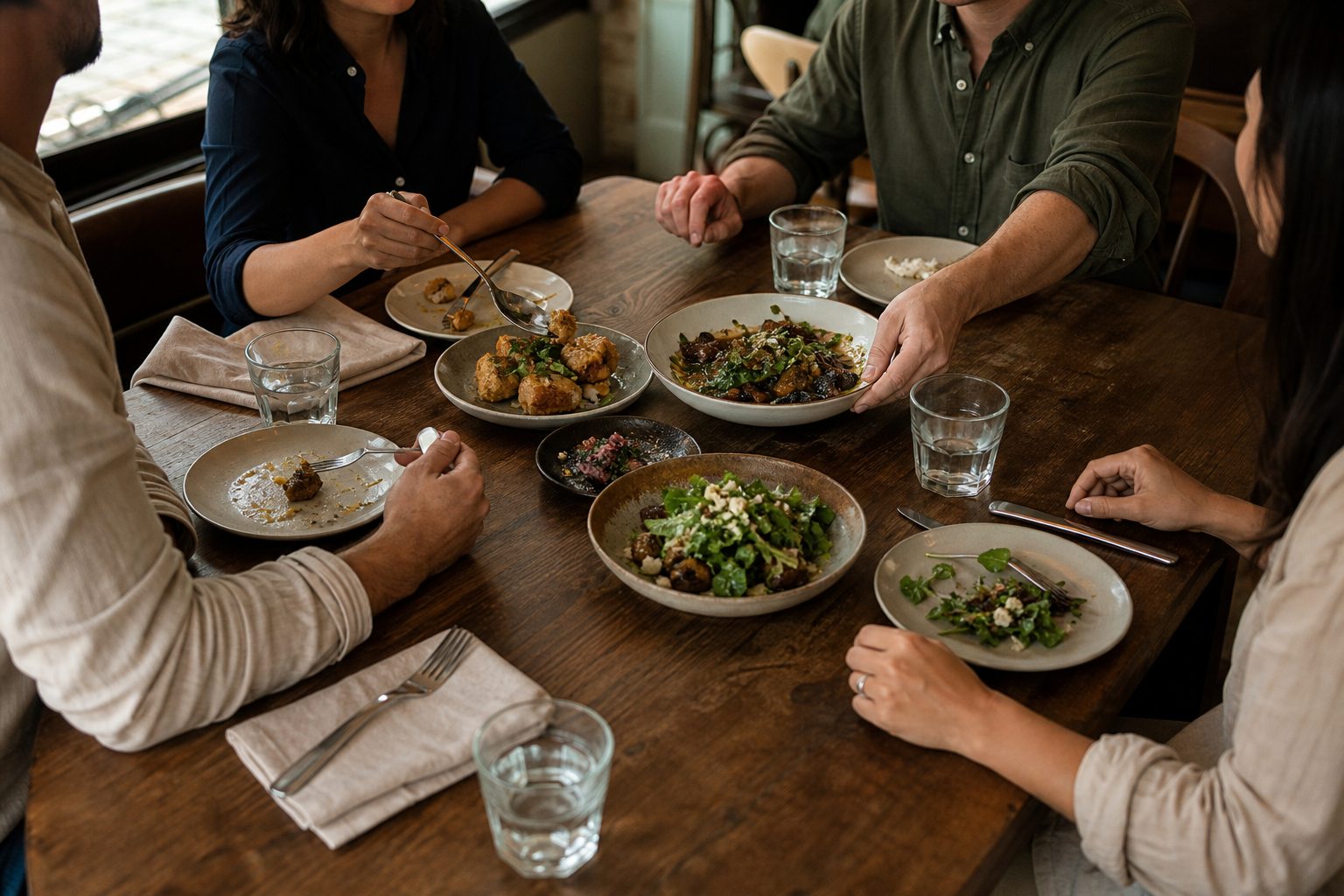
The menus are still open when somebody says, “Shall we just get a few things for the table?”
The suggestion sounds generous.
One person names a dish immediately. Another adds two more. Somebody says they are happy with anything. A fourth diner studies the prices while the conversation moves ahead without them. At the far end of the table, a vegetarian waits for a pause long enough to ask whether one of the shared plates could remain free of meat.
Within a minute, the order has begun to belong to the most confident voices.
Nobody intended to dominate. The table is relaxed. The food will arrive on beautiful plates, everyone will lean towards the centre and the meal will look like a picture of sociability.
Yet shared dining does not remove individual preference. It gathers different appetites, budgets, dietary needs and levels of confidence into one visible negotiation.
A dish placed in the middle is available to everyone in theory. In practice, people do not reach with equal ease, speak with equal authority or take the same amount. Some diners are comfortable saying what they want. Others would rather accept a disappointing order than make the table reorganise itself around them.
Sharing can be one of the most pleasurable ways to eat. It can also make inequality harder to see because every decision appears collective.
Shared plates promise connection, not fairness
Shared plates promise connection, and their attraction is not an illusion.
Passing food creates movement between people. Diners notice what others enjoy, offer the best piece and make room for one more taste. A table can explore more of a menu than any individual would order alone. The meal unfolds through comparison: this sauce changes that vegetable; the bread becomes useful again when another plate arrives; somebody who would never have chosen the unfamiliar dish discovers that they like it.
Sharing also softens the boundaries of ownership.
A plate ordered for one person can feel like a declaration that must be defended. A dish ordered for the table invites curiosity. Nobody needs to commit to an entire portion before tasting it. The risk of choosing something new is distributed.
At its best, communal eating turns attention outward. Diners watch whether a companion has tried a dish, rotate a plate towards someone who cannot reach and save a portion for the person returning from the washroom. Care becomes practical.
Restaurants understand this appeal. Menus increasingly describe food as designed for sharing, and servers explain that dishes will arrive when ready. The format promises informality, abundance and a meal built together rather than delivered as a row of separate transactions.
The problem begins when the promise of togetherness is treated as proof of fairness.
Shared food can create generosity, but it does not guarantee it. The same format that encourages discovery can hide who chose the dishes, who ate enough, who paid more than intended and who spent the meal adapting.
The shared table offers an opportunity for care. It does not perform that care by itself.
Communal ordering rewards the first voice
Communal ordering often begins as an open question, but it rewards the first voice.
“What does everyone feel like?”
The answer rarely arrives from everyone at once.
Some diners think aloud. They point to dishes, make combinations and respond quickly to the server. Their confidence gives the conversation momentum. This can be helpful, especially when a large menu has left the table uncertain. Somebody needs to begin.
But beginning can become deciding.
Once several dishes have been proposed, disagreement requires more effort. A quieter diner is no longer simply expressing a preference; they are interrupting an emerging plan. If the confident person is also the host, the restaurant regular or the person perceived to understand the cuisine best, their suggestions carry additional weight.
Expertise can improve an order. It can also turn other diners into passengers.
The regular knows which dishes are essential and how many plates the table needs. Their knowledge may be offered generously. Yet a first-time guest can end up tasting the regular’s ideal meal without ever being asked what brought them to the restaurant.
Groups develop informal roles. One person always orders the wine. Another calculates quantity. Someone is trusted to “choose for us.” These roles make decisions easier, but convenience can disguise repetition. The same preferences appear at every meal because the same people convert desire into speech.
An equal invitation is not enough if the conversation moves too quickly for different kinds of speakers.
A short pause changes the order. So does asking the person who has not spoken whether there is one dish they would particularly like to try. The goal is not to force everybody to perform an opinion. It is to make sure silence is not automatically interpreted as consent.
“Anything is fine” can hide unequal choice
The easiest phrase at a shared table can hide unequal choice because it is also one of the least precise.
“Anything is fine.”
It may mean genuine flexibility. The diner trusts the group and looks forward to being surprised.
It may also mean that they have not understood the menu, cannot find a comfortable place in the conversation or do not want their limited budget to become public. It can mean, “I have preferences, but none of them feels important enough to inconvenience everyone else.”
People use accommodation for many reasons.
A guest may be grateful for the invitation and reluctant to contradict the host. A younger diner may defer to older relatives. Somebody joining colleagues may not want to appear difficult in front of a manager. A person unfamiliar with the cuisine may assume that their instincts are less valid than those of the enthusiasts at the table.
The phrase can even conceal exhaustion. Making choices is part of the labour of a meal, and sometimes a diner truly wants somebody else to carry it.
The difficulty is that different meanings produce the same words.
Treating “anything is fine” as unlimited agreement can leave one person eating around ingredients they dislike while insisting that everything is lovely. Treating it as a problem to be solved can be equally intrusive. Not every quiet diner needs to be questioned until they confess a hidden preference.
Good communal ordering leaves a door open without demanding an explanation.
“We’re thinking of these four. Is there anything missing for you?”
The question gives the diner something concrete to respond to. They can approve the plan, add one request or identify a need without taking responsibility for rebuilding the entire order.
Flexibility should be welcomed. It should not be used as the table’s permission to stop noticing.
Shared plates make appetite visible
Separate plates allow diners to manage their own hunger with relative privacy, while shared plates make appetite visible.
Shared plates make appetite visible.
Everyone can see who reaches first, who takes a second portion and who leaves food behind. The table must estimate a collective quantity before it knows how hungry each person is. This turns a physical need into a social statement.
Some diners are comfortable saying, “I’ll need more than that.” Others have learned to make hunger appear modest.
Expectations around gender, age, body size and politeness shape who feels entitled to claim a larger portion. A person with a small body may be assumed to want less. Somebody trying to avoid comments about their appetite may wait until others have served themselves, then discover that very little remains.
The opposite misunderstanding also occurs. A diner who eats lightly may be urged repeatedly to take more because the group ordered an amount that now needs to be finished. Their refusal is treated as a judgement on the food or a failure to participate.
Communal portions create uncertainty even when nobody is self-conscious.
Is the dish meant to provide one taste each or a substantial part of the meal? Should everybody take a piece now, or will there be enough to return to it? When plates arrive at different times, early dishes can disappear before the table understands the total quantity.
People watch one another for clues. Restraint becomes contagious. So does speed.
A simple orientation can reduce the pressure. The server can explain that a dish contains four pieces, that a portion is small or that the current order may leave the table wanting one more plate. Diners can agree to divide an obviously countable item before the first person serves themselves.
The purpose is not to regulate every bite. It is to prevent politeness from becoming a quiet method of underfeeding someone.
Dietary needs become group negotiations
At a table of individual dishes, a dietary requirement mostly shapes one person’s order. With shared plates, dietary needs become group negotiations.
At a shared table, it can reorganise the meal.
An allergy may determine which plates can safely occupy the centre. A vegetarian diner may depend on the group ordering enough meat-free food to make a complete meal rather than a collection of side dishes. Religious practice, intolerance, pregnancy, medication and personal conviction can all affect what sharing means.
The diner must decide how much to disclose.
Some needs require precise communication with the restaurant. Others are preferences the diner may not wish to explain or defend. In both cases, the shared format makes private boundaries relevant to everybody’s choices.
This can produce generous adaptation. A group discovers dishes it would otherwise have ignored, and the person with the restriction eats as fully as everyone else.
It can also produce symbolic inclusion.
The table orders six plates containing meat and one vegetable dish “so there’s something for you.” Everyone then tastes the vegetable, leaving the vegetarian diner with a fraction of the only substantial food they can eat. Because the dish was technically shared, nobody appears to have taken another person’s meal.
Cross-contact creates a different difficulty. A serving spoon moves from one plate to another. Sauce drips into a dish that had been safe. Someone says, “It’s only a little,” because they understand the restriction as a preference rather than a boundary.
At that point, etiquette must give way to food safety. Official allergen guidance emphasises accurate ingredient information, procedures that manage cross-contact and clear disclosure when a business cannot provide an allergen-free dish. A separate serving spoon at the table can protect an already safe arrangement; it cannot repair uncertainty about how the dish was prepared. The restaurant should explain what can genuinely be shared before the group turns a medical boundary into an improvised social compromise.
Fair sharing does not always mean every dish is available to every diner.
Sometimes the most hospitable choice is to keep one plate clearly for the person who needs it, to order duplicate dishes or to use separate serving utensils. The table may sacrifice the visual ideal of complete communality in order to make participation real.
Inclusion is not achieved by placing one acceptable dish in the middle. It is achieved when each diner has enough food they can actually eat.
Shared bills can hide unequal costs
“We’ll split everything” sounds like the natural conclusion to a shared meal, but shared bills can hide unequal costs.
It may be fair. It may also complete an inequality that began with the order.
One diner proposed the expensive specials. Another ate none of them. Somebody drank wine while a companion had water. A guest watching their spending tried to steer the table towards fewer plates, but their hesitation was read as indecision. When the bill arrives, the cost is divided evenly because calculating individual benefit now seems contrary to the spirit of the evening.
Money is often the hardest preference to express.
Taste can be discussed as enthusiasm. Budget exposes circumstances. Saying “I don’t like that dish” may feel easier than saying “I cannot comfortably pay for it.” The shared format rewards diners who can treat price as secondary and asks everyone else to reveal a limit or absorb the consequences.
The problem is not solved by itemising every bite.
Communal meals depend on some looseness. People take different amounts, and hospitality sometimes means paying for a friend without measuring equivalence. A perfectly audited table would destroy much of the pleasure sharing is meant to create.
But looseness should be chosen, not imposed.
Budget belongs near the beginning of the conversation, before enthusiasm becomes an order. A host can name the intended scale of the meal. Diners can agree on a rough number of plates or ask the server what a complete order is likely to cost per person. A costly addition can be offered as a separate choice rather than quietly absorbed into the common bill.
Restaurants can help by making prices and portion guidance clear. Servers should be able to discuss quantity without treating concern about cost as a lack of sophistication.
Generosity loses its meaning when somebody else is required to finance it silently.
Table design shapes access to shared food
Even after the order has accommodated everyone, table design shapes access to shared food because the physical table distributes food unevenly.
Some seats are closer to the centre. Some diners can reach easily; others wait for plates to be passed. A large arrangement of glasses, candles and serving dishes may place one plate directly in front of a person who becomes its unofficial guardian.
Round tables can support sharing, but diameter matters. Long rectangular tables create local neighbourhoods: one end may finish a dish the other end barely saw. Heavy plates remain where they were placed. Small bowls move only when somebody notices.
Serving utensils influence the meal as well.
A spoon that is too small makes taking a reasonable portion feel greedy because it requires several movements. A dish with no serving utensil invites diners to use their own cutlery, which may be uncomfortable or unsuitable. Food that must be divided at the table gives power to whoever holds the knife.
Speed creates another geography.
The diner nearest an arriving plate interprets it first. They decide whether to begin serving or wait. If the kitchen sends dishes rapidly, the centre becomes crowded and plates disappear from view. If food arrives slowly, the hungriest diners may take more from the early dishes before realising how long the meal will last.
These details can appear trivial beside the larger idea of hospitality. They are the material conditions through which hospitality is experienced.
Passing a plate is a small act, but it redistributes access. Rotating a dish, serving the person who cannot reach and checking that the far end has tasted something turn shared dining from an arrangement into a practice.
The food is not equally shared because it occupies the centre. It becomes shared through repeated acts of attention.
Communal dining can flatten or invite difference
Communal dining is often praised for encouraging compromise, but it can flatten or invite difference.
Compromise matters. A group cannot construct a meal around every individual wish without eventually recreating separate plates.
But compromise has different forms.
One version asks every diner to surrender the same amount of preference. Another repeatedly asks the most accommodating person to surrender theirs.
The difference is visible across several meals rather than one. The friend who dislikes spicy food always agrees to the hot dish because everyone else is excited. The diner who loves bitter flavours never proposes them because the group has already labelled their taste unusual. The person who avoids alcohol continues paying an equal share of wine-heavy bills. Each occasion seems minor. Together they define whose pleasure counts as the table’s normal pleasure.
Shared meals can do the opposite.
They can make difference easier to explore because the order has room for contrast. One dish can be hot and another gentle. A familiar plate can sit beside an unfamiliar one. People do not need identical tastes in order to eat together; they need enough overlap and enough curiosity.
This is a richer idea of communality than unanimous preference.
The table does not prove its closeness by wanting the same thing. It demonstrates care by building a meal in which different desires can appear without becoming a threat to the group.
Sometimes that means one dish is mainly for two diners while everyone is welcome to taste it. Sometimes it means ordering a small additional plate after the first round. Sometimes the table discovers that separate portions for one course make the rest of the sharing more relaxed.
A shared format should serve the people eating. The people should not have to serve the purity of the format.
Restaurants design shared-plate negotiation
Restaurants do not merely offer shared plates. They design shared-plate negotiation by establishing the conditions under which diners make decisions.
Menu language matters.
“Designed for sharing” can describe a genuine culinary structure, or it can transfer the work of calculating a meal to the customer. Without guidance about portion, sequence and price, diners must solve a puzzle while trying to remain sociable.
Servers often become the interpreters.
They can explain how many plates usually make a meal, identify dishes that are difficult to divide and notice when a table has ordered only one substantial option for a diner with restrictions. They can ask whether the group wants serving spoons or individual side plates. When one person answers every question, the server can keep their attention open to the rest of the table.
This requires tact.
The server should not expose disagreement or appoint themselves as the guardian of quieter diners. A question such as “Does that selection work for everyone?” can widen the conversation without identifying anyone as a problem. Naming the number of pieces in a dish gives the group useful information without instructing them how to behave.
Kitchen decisions matter too.
A plate advertised for sharing should be physically shareable. Countable items can match common group sizes or be adjustable. Sauces and garnishes can be arranged so one diner does not accidentally receive all of them. When a dish cannot reasonably be divided, the menu or server can say so.
The bill is part of the design. Flexible payment systems allow groups to divide alcohol, supplements or individually requested dishes without an awkward reconstruction at the counter.
Restaurants cannot make every group fair. They can avoid building needless ambiguity into a format that already asks diners to negotiate.
Fair shared meals require attention
Fair shared meals require attention from the moment the first plates arrive.
This time, the table has ordered enough for the vegetarian diner to eat fully. The expensive special was discussed rather than slipped into the order. Someone has asked for an additional bowl of rice because the initial estimate of hunger was too modest.
Nothing about the arrangement is perfectly equal.
One diner will eat more of the crisp dish. Another will have most of the greens. Two people will taste everything, while somebody else will return repeatedly to the plate they already know they like. The bill will not correspond exactly to consumption.
Fairness does not require that every person receive an identical fraction of every dish.
It requires that nobody’s appetite, safety or budget be treated as less real because the food is communal. It requires enough clarity for people to make choices and enough attention to notice when the apparent collective has been built around only some of its members.
The work can remain light.
A pause before ordering. A question addressed to the whole table. A plate passed before it is emptied. An acknowledgement that one dish belongs primarily to the person with fewer options. Permission to add food without making hunger embarrassing. Permission to decline a costly extra without becoming the enemy of pleasure.
These gestures do not weaken sociability. They make it more credible.
The table begins to move.
A diner takes a portion, then turns the plate towards the person beside them. Someone asks whether everybody has tried the dish before taking the final piece. The server clears an empty plate and makes room for the next one.
The food in the middle has not erased difference.
It has given the table a chance to respond to it.