When the Server Becomes the Guide
Knowledge offered without condescension can make unfamiliar food accessible while preserving surprise and choice.
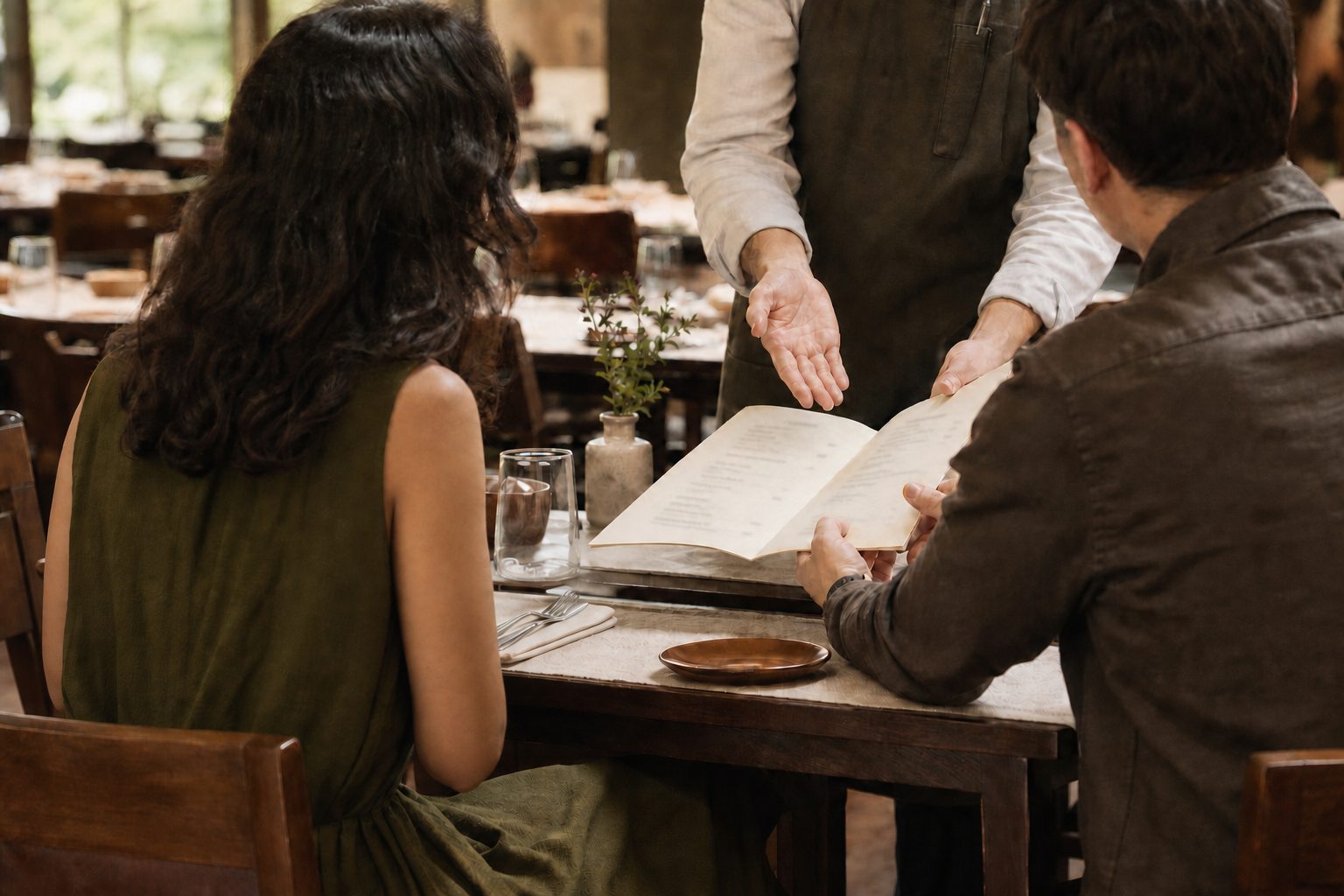
The diner reaches the bottom of the menu and returns to the top.
The words are clear enough to read. Their meaning is less certain.
Several ingredients are unfamiliar. The dishes are arranged without the categories the diner expected, and the portion sizes are difficult to imagine. One description sounds appealing but includes a preparation they cannot picture. Another has a price that makes choosing incorrectly feel expensive.
The server approaches.
“Would you like a little help with the menu?”
The question can change the meal.
Asked warmly, it releases the diner from having to perform knowledge they do not possess. It makes curiosity possible without embarrassment. The server can explain the shape of the menu, describe an unfamiliar flavour and help a table order enough food without quietly doubling its intended budget.
Asked badly—or followed by a lecture—the same question can establish a hierarchy. The server becomes the expert, the diner becomes the pupil and the meal begins with a test nobody agreed to take.
Guidance in a restaurant is therefore more delicate than delivering information. It requires knowledge, observation and restraint. The server must help diners find their way while leaving the destination genuinely theirs.
Restaurant menu uncertainty arrives before the food
Every menu assumes something about the person reading it.
It assumes familiarity with ingredients, techniques, regional names and the restaurant’s preferred way of ordering. It may expect diners to understand that plates are meant to be shared, that the sequence will be chosen by the kitchen or that a short description conceals a complex preparation. Even an apparently simple menu asks people to estimate portion, richness, value and compatibility before anything reaches the table.
Regular diners learn the local grammar. They know whether four small plates will feed two people and what the kitchen means when it calls something a snack. They recognise which dishes anchor a meal and which are designed to accompany them.
First-time guests do not have that map.
Their uncertainty may remain invisible. A diner can read slowly, copy a companion’s choice or order the most recognisable item without admitting that the rest of the menu made little sense. Somebody worried about appearing unsophisticated may avoid asking how to pronounce a name. A person watching their budget may hesitate to ask whether the server’s enthusiastic recommendation is also the most expensive option.
The server meets diners at the point where the restaurant’s assumptions encounter their actual knowledge.
Good guidance begins by recognising that uncertainty is not a failure. It is a predictable condition of entering an unfamiliar place.
Restaurant menu uncertainty is not distributed equally. Reading in a second or third language, using a screen reader, lip-reading in a loud room or needing more time to process several choices can turn a brief ordering ritual into concentrated work. A server does not need to identify or announce the reason. They can make help available in more than one form, give the table time and avoid treating speed as proof of confidence.
Reading the table before offering guidance
Not every table wants the same amount of explanation.
Some diners arrive with questions prepared. They want to know how a dish is made, where an ingredient comes from and what the kitchen is trying to express. Others have already chosen and would prefer the ordering to remain brief. A group may contain both.
The server must notice signals without turning them into rigid judgements.
Menus still open after a long interval may suggest uncertainty. So can repeated glances around the room, a conversation that stops when the server approaches or a direct question about how ordering works. But silence does not always mean confusion, and confidence does not guarantee understanding.
A simple invitation is often enough: “I’m happy to explain how the menu works, if that would be useful.”
The wording leaves room for refusal. It does not announce that the diner looks lost. It presents guidance as part of the service available to everyone.
Once the conversation begins, the server can ask what kind of help is wanted. Does the table need the structure explained? Are they deciding between two dishes? Do they want a broad recommendation, or are they trying to accommodate a dietary need, a limited amount of time or a particular budget?
These questions prevent a common mistake: answering with everything the server knows rather than what the diner needs.
Reading the table is not mind-reading. It is the practice of offering an opening, listening to the response and adjusting the amount of guidance accordingly.
Menu explanations should make food imaginable
An unfamiliar dish becomes easier to choose when a diner can imagine eating it.
That does not require reciting every component.
A useful description gives shape to the experience. Is the dish bright or deep, delicate or substantial, crisp or soft? Is it served hot, chilled or at room temperature? Does the unfamiliar ingredient bring bitterness, sweetness, acidity, smoke or fragrance? Is the portion a first taste, a plate for one or something the table will naturally share?
The server translates from the kitchen’s technical knowledge into the diner’s practical decision.
This translation should not erase the dish’s identity. Replacing every unfamiliar name with a rough comparison can make the food sound like an imitation of something supposedly more normal. A regional preparation deserves its own name and history, not only the phrase “it’s basically like” followed by a more familiar food.
Comparison can still be helpful when used carefully. Texture may resemble something the diner knows; the level of heat may be placed on a recognisable range. The comparison should open a door, then allow the dish to remain itself.
The most effective explanations are often short. A few concrete details give diners enough confidence to continue asking or to make a choice. Too much description can replace anticipation with a verbal reconstruction of every bite.
Guidance should make the food imaginable without making the encounter unnecessary.
Restaurant knowledge can welcome or rank people
Restaurant knowledge carries social power.
The person who recognises the ingredients, pronounces every term and understands the ordering conventions appears to belong. The person who asks what a word means risks being treated as an interruption to the room’s confidence.
Servers can soften this difference or intensify it.
Condescension rarely appears as open ridicule. It may be a surprised tone, an unnecessary correction or an explanation delivered slowly after the diner has already understood. It can enter through a phrase such as “Obviously, you know…” which forces the guest either to pretend or to contradict the assumption.
Expertise becomes welcoming when it is offered without making ignorance visible as a defect.
The server can pronounce a dish naturally within the answer rather than asking a diner to repeat it correctly. They can say “This is our first season serving it” instead of implying that everyone else already knows it. They can explain a custom as useful context, not as a rule that visitors are likely to break.
Tone matters as much as accuracy. The same factual answer can communicate patience, amusement, superiority or genuine enthusiasm.
Good guidance also avoids overpraising adventurousness. A diner who chooses an unfamiliar ingredient does not need to be congratulated for bravery. The compliment can make the food sound like a dare and place the server’s attention on the diner’s presumed boundaries rather than the dish.
Knowledge should reduce the distance between guest and restaurant. If it makes the distance more visible, the explanation has failed even when every fact was correct.
An honest restaurant recommendation is not an order
“What do you recommend?” sounds like a simple question.
It can mean several things.
The diner may want the restaurant’s signature dish, the server’s personal favourite, the most representative preparation or merely help choosing between two options. They may hope for something light, avoid a flavour they dislike or want assurance that the expensive dish is worth ordering.
A recommendation becomes more useful after one small question: “What are you in the mood for?”
The answer may reveal that the diner wants comfort rather than novelty, vegetables rather than meat, one substantial plate rather than a long sequence or a dish that can be shared without negotiation. The server’s expertise then works within the diner’s preferences.
Without that exchange, recommendations can become sales instructions. The server names the dishes management wants moved, the highest-margin items or the tasting format that produces the largest bill. Commercial awareness is part of restaurant work, but disguising an upsell as personal guidance damages trust.
Honest enthusiasm is different. A server can explain why a dish is especially good that evening, mention that an ingredient has just entered its season or suggest a preparation the kitchen handles particularly well. The recommendation has a reason the diner can evaluate.
The final choice must remain easy to decline.
A guide points out routes and consequences. They do not take the traveller’s place.
Price and portion guidance belongs in the conversation
Guidance that ignores cost is incomplete.
Restaurants often speak confidently about flavour while leaving diners to calculate value from partial clues. Sharing menus can be especially uncertain. The server recommends six plates, bread, a side and perhaps one more item “for the table,” but the diner does not know whether this is necessary, abundant or simply the restaurant’s preferred spend.
Clear portion guidance protects both appetite and budget.
“Most pairs choose four plates, but three will be enough if you prefer a lighter meal” gives the table a usable range. “That dish is priced per person” prevents a surprise. “The special is larger and costs…” allows the diner to decide before enthusiasm becomes commitment.
Price clarity does not make hospitality less graceful. Avoiding the subject can force diners to ask questions that expose their financial limit in front of companions or make them discover the cost only when the bill arrives.
Servers should not assume that a guest who enters an expensive restaurant is indifferent to price. Nor should they direct different levels of explanation toward diners based on clothing, age, accent or perceived status.
A recommendation becomes more trustworthy when the server can name a less expensive route without changing tone. The diner learns that guidance is intended to support their meal, not maximise it.
This trust may produce a larger order. It may also produce a smaller one. Hospitality is demonstrated by the quality of the guidance in either case.
Food allergy guidance requires verified information
Questions about allergies and dietary requirements change the nature of guidance.
Preference allows flexibility. Safety requires accuracy.
A server may know the menu deeply and still need to confirm how a sauce is prepared, whether a garnish contains an allergen or if cross-contact can be avoided in the kitchen. Returning with a verified answer is more professional than responding immediately from memory.
Confidence can be dangerous when the restaurant’s information systems are weak.
Recipes change. Suppliers substitute products. A cook adds butter to finish a preparation that was previously dairy-free. A menu note describes ingredients but not shared frying oil. The server stands between a diner’s question and a moving set of kitchen practices.
Good guidance therefore depends on infrastructure: current allergen information, clear communication with the kitchen and permission to say “I need to check.” Training should distinguish what staff can answer directly from what must be verified.
Written information and conversation support different kinds of safety. A current allergen matrix can give diners privacy and a stable point of reference. A direct exchange can alert the kitchen to cross-contact risks, substitutions or a recipe change that the printed menu does not yet reveal. Neither works if the information behind it is stale.
The conversation should also preserve dignity. A diner should not have to defend the seriousness of an allergy or disclose medical detail to receive a careful response. Nor should the server promise safety the kitchen cannot provide.
An honest limitation may disappoint the guest, but it gives them a real choice. False reassurance removes that choice.
The guide’s responsibility is not to make every route appear open. It is to describe accurately which routes can be taken.
Server menu knowledge is skilled restaurant work
Effortless guidance is built from substantial labour.
Servers taste dishes, attend briefings, learn ingredients and observe how guests respond. They remember which explanation makes an unfamiliar preparation understandable and which dish appears smaller than diners expect. During service, they track changes the printed menu does not show.
This knowledge is sometimes treated as personality rather than work.
A naturally charming server is expected to make the menu accessible, while training concentrates on table numbers, order systems and sales targets. Staff are told to “tell the story” without being given reliable information or time to ask the kitchen questions.
The result is uneven guidance. One server can explain the menu beautifully; another memorises a script; a new employee fills gaps with confidence. Diners’ access to the restaurant’s ideas depends on who happens to take the table.
Briefings can make knowledge collective. Staff need to taste where possible, but tasting alone is not enough. They need language for portion, texture, heat, common allergens, price changes and the role of each dish in a meal. They should be able to ask cooks why a preparation matters, not only list its components.
Restaurants also need room for personal expression. A script cannot respond to the diner in front of it. The goal is shared accuracy with flexible language.
When guidance is valued as skilled labour, the restaurant gives staff the information, authority and time required to offer it well.
Menu clarity should not be outsourced to servers
A gifted server can rescue a confusing menu.
That does not mean confusion is desirable.
If every table needs the same explanation about portion size, ordering sequence or an unfamiliar symbol, the menu may be withholding information diners need. Repeating the answer becomes unnecessary labour, and guests who do not ask remain disadvantaged.
The conversation should add hospitality and judgement, not repair preventable obscurity.
A short note can explain that dishes arrive when ready. Clear prices can show whether a supplement is per person. Thoughtful descriptions can indicate main ingredients without flattening the food into a list. Dietary markers can begin the conversation while making clear that allergies should still be discussed with staff.
Written clarity also helps diners who process information better without social pressure, who are hard of hearing or who prefer to compare options privately before speaking.
The server then becomes a guide in the fuller sense. They can respond to preference, connect dishes and bring the restaurant’s character into the exchange. Their time is spent on the particular table rather than delivering the same missing instruction throughout the room.
Menus and servers should support each other. One provides a stable map. The other helps the diner interpret the landscape as it changes.
Good restaurant guidance ends at the right moment
The diner closes the menu.
The server has explained how the plates are sized, described the unfamiliar preparation and mentioned that the vegetable dish is more substantial than it appears. They have checked an allergy with the kitchen and offered two possible ways to build the meal.
Now the table needs space to choose.
Good guidance knows when to withdraw. The server does not hover while companions negotiate cost and appetite. They do not keep adding recommendations after the order has found its shape. They allow diners to change their minds without defending the earlier advice.
When the food arrives, explanation may begin again—but only as much as the dish requires. A name, a brief orientation or one practical instruction can prepare the first bite. A long speech delivered while hot food cools places the restaurant’s story above the meal itself.
The server remains available. That availability is part of the confidence they created.
The diner tastes the dish they could not imagine from the menu. It is not exactly like the comparison, and this difference is pleasurable. The explanation gave them enough familiarity to approach it but left something for the food to reveal.
This is the guide’s quiet achievement.
The diner has not been shown how little they knew. They have been given enough knowledge to exercise preference, protect their needs and remain open to surprise.
The server moves to the next table.
The menu is still unfamiliar there. The route through it will not be the same.