Why Some Menus Make Us Nervous
A menu can turn curiosity into anxiety when it asks diners to perform expertise before they are allowed to eat.
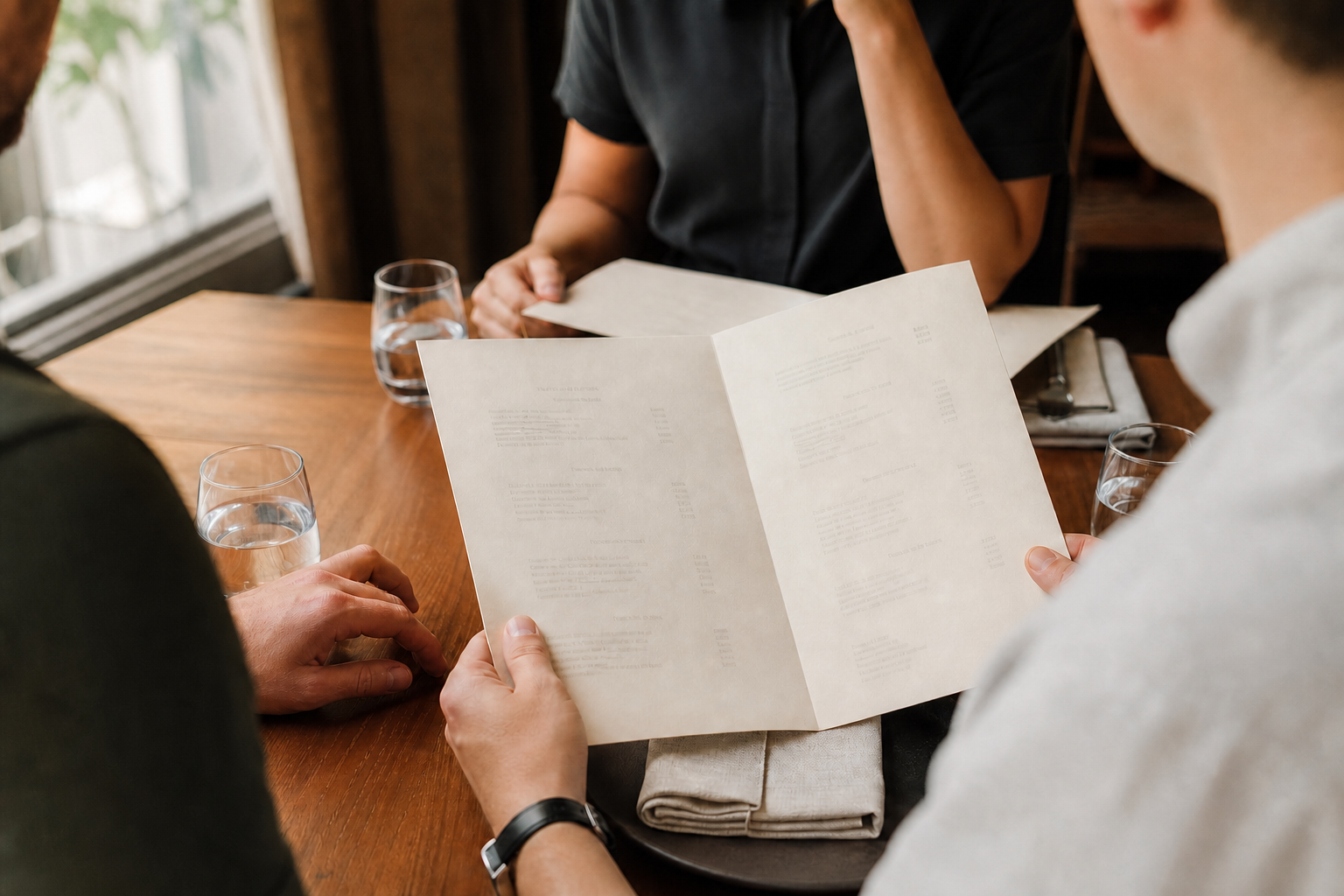
The server has given the table a few more minutes.
Everybody looks down again.
The menu is not very long, but it contains several words one diner does not recognise. The dishes are divided into sections whose sizes are unclear. Some prices appear manageable; others require a quiet calculation about what the rest of the table may order. A companion has already said that everything sounds wonderful.
The diner agrees, although nothing yet sounds like a decision.
This is a small and familiar form of restaurant anxiety: the fear not simply of choosing a dish one will dislike, but of choosing in a way that reveals too much. Ask what a word means and appear inexperienced. Mention the price and interrupt the mood. Order too little and misunderstand the format. Order too much and seem careless. Select the safe dish and waste the opportunity of eating somewhere new.
A menu should help convert appetite into choice. Sometimes it turns that choice into a public test.
Menu anxiety begins when curiosity becomes self-consciousness
Menu anxiety does not begin with unfamiliar food alone.
It can be the reason people enter a restaurant. A diner may want to encounter an ingredient they have never tasted, a regional preparation they cannot make at home or a style of eating they have only heard about. Not knowing can feel spacious and pleasurable when there is permission to explore.
Anxiety begins when uncertainty acquires social consequences.
The diner is no longer asking only, “What might I enjoy?” They are asking, “What will my uncertainty say about me?” The menu becomes connected to class, travel, education, language and the ability to move comfortably through particular rooms. A word that is merely unfamiliar on a cookbook page can feel exposing when a server is waiting and other diners are ready.
Restaurants do not invent all of this pressure. People bring earlier experiences with them: being corrected at a formal table, laughed at for mispronouncing a name, surprised by a bill or made to feel that a question was inconvenient. The menu may touch these memories without knowing they are present.
But restaurants influence whether the pressure increases or loosens. Clear structure, readable prices and an ordinary welcome to questions can keep unfamiliarity attached to curiosity. Ambiguity combined with impatience turns it into self-surveillance.
The difference is not whether the diner knows everything. It is whether not knowing feels safe.
Menu jargon can describe and divide
Menu jargon and specialised words have legitimate work to do.
The name of a technique may describe a result more accurately than a long substitute. A regional word can carry history, sound and cultural recognition that an English approximation would erase. Producers, varieties and cuts distinguish ingredients that genuinely taste or behave differently. A menu should not be required to rename its food until every dish sounds familiar to every reader.
The problem is not the existence of precise language. It is the use of precision without a path into meaning.
A menu may list a preparation, place name and ingredient variety while withholding the basic information a diner needs to imagine the dish. Is it hot or cold? Is it a small plate or the centre of the meal? Is the unfamiliar word a fish, a sauce, a grain or a method? A diner may recognise that the language is meaningful while still being unable to act on it.
At that point, vocabulary begins to sort the room. People who already know can proceed without friction. People who do not must announce the gap, conceal it or opt out of the dish.
A short explanation can preserve the original word while giving it somewhere to land. The explanation does not need to be a dictionary definition. Often a few practical cues are enough: grilled flatbread, fermented chilli, chilled almond soup, slow-cooked shoulder. The diner gains a shape, temperature or texture without the dish surrendering its name.
Good explanation does not reduce culinary identity. It makes that identity available to encounter.
Menu pronunciation happens in public
Menu pronunciation changes when an unfamiliar name moves from private reading to a public order.
On the page, the diner may feel curious. When the server arrives, the same word becomes a performance of memory, accent and confidence. The diner rehearses it silently, changes their mind or points while saying, “This one.”
Pointing is a perfectly functional way to order. It can also carry a small feeling of defeat when the diner wanted to learn the name.
Servers often understand this moment immediately. A generous response is simple: say the word naturally, confirm the order and continue without turning the exchange into a lesson unless the diner invites one. The pronunciation becomes available without the mistake becoming an event.
Less generous responses can make the whole table attentive to the correction. A server repeats the word with exaggerated precision, looks confused until the diner points or jokes that nobody says it correctly. The intention may be harmless. The result is that one person’s uncertainty becomes part of the entertainment.
Names deserve care, especially when careless renaming has historically detached foods from the people and languages that made them. Care, however, is not the same as humiliation. A restaurant can honour pronunciation while helping guests approach it.
The aim is not to protect diners from ever being corrected. It is to make correction feel like receiving knowledge rather than failing an entrance examination.
Menu prices carry a second question
Menu prices can create anxiety that is presented as confusion about dishes but is actually uncertainty about cost.
“How many plates should we order?” may mean, “What will a complete meal cost?” “Is this enough to share?” may mean, “Will choosing one of these make everybody else spend more?” The diner asks about format because asking directly about money feels more exposing.
Restaurants sometimes encourage the idea that thinking about price spoils the experience. Currency symbols disappear. Numbers are set in faint type. Market price replaces an amount. Supplements emerge in conversation after the diner has expressed interest. The design implies that the ideal guest chooses through desire alone.
Many real guests cannot and do not want to do this.
They may be celebrating within a careful budget, paying for other people or trying to understand whether drinks and service will change the total substantially. They may have enough money for the meal while still wishing to know what it costs. Financial attention is not evidence that a diner lacks generosity, sophistication or pleasure.
Anxiety grows when people must coordinate private limits in public. One person suggests several shared dishes. Another scans for the least expensive option without saying why. A third assumes the bill will be divided equally. The menu’s unclear structure enters a negotiation the table may not yet know how to have.
Transparent prices and portion guidance cannot resolve every difference in means or expectation. They give the table reliable information with which to begin. Clarity lets diners discuss their choices rather than decode the restaurant at the same time.
Readable menu design reduces uncertainty
Readable menu design is part of hospitality because a diner cannot choose from information they cannot comfortably use.
Small pale type may look restrained in a bright design studio and become unreadable in a dim dining room. Glare from a laminated page can hide a whole column. Dense spacing makes it difficult to keep one dish aligned with its description or price. These problems affect many diners, including people with low vision, dyslexia, fatigue or limited familiarity with the menu’s language.
A digital menu is not automatically more accessible. It can help when text enlarges cleanly, contrast remains strong and screen readers can follow the structure. It creates another barrier when the menu is a fixed image or PDF that demands repeated pinching and sideways movement. A QR-only system may also assume a charged phone, a data connection and comfort with the device.
No single format has to solve every need. A restaurant can keep a clear printed menu, offer an accessible digital version, provide larger print when practical and let staff read or explain information without requiring a guest to justify the request. The alternative should be available as ordinary service, not improvised as a favour.
Allergen information needs the same clarity. Tiny symbols without a readable key can turn safety into another decoding task. Written information and staff guidance should support one another, with uncertain details checked rather than guessed.
When readable menu design is treated as part of the meal, diners can spend less attention proving that they can access the information and more attention deciding what they want.
Shared ordering raises the stakes
Shared ordering makes the decision visible and collective. A person ordering only for themselves can accept a private disappointment.
Somebody must suggest how many dishes to choose. Somebody may take the lead because they know the cuisine, have visited before or are simply quickest to speak. Their confidence can be helpful. It can also quietly become control over everyone else’s appetite and budget.
The nervous diner faces several calculations at once. Should they admit that a proposed ingredient worries them? Will asking for a familiar dish make the meal less adventurous? Is it acceptable to mention an allergy again? Can they oppose an expensive choice without explaining their finances? If the group orders too little, will their hunger appear greedy later?
Menus built around sharing often describe the format as convivial, but conviviality is not produced by putting plates in the centre. It depends on whether the people at the table can express preference, refusal and appetite without embarrassment.
The restaurant can support this through practical information. Indicating approximate portions helps diners distribute food. Asking about allergies before recommendations protects someone from having to interrupt an enthusiastic order. A server can address the whole table rather than allowing the most confident voice to become its sole representative.
Shared food becomes generous when shared decision-making is possible too.
Restaurant servers can lower or raise the temperature
Restaurant servers can change the emotional temperature of the entire menu through one calm first exchange.
The server might say that the sections move from smaller to larger dishes, that most tables choose two plates each or that they are happy to explain any unfamiliar ingredient. None of this requires a speech. A few sentences remove questions the diner may have been reluctant to ask.
Tone matters as much as information.
“Do you know how our menu works?” can be offered warmly, but it can also sound like a test with a correct answer. “Have you dined with us before?” gives the restaurant a reason to explain without asking the guest to declare competence. “Would a quick guide be useful?” makes assistance an option rather than a remedial exercise.
Knowledge should be available without condescension. This requires attention because diners need different amounts of guidance. One person wants the origin of every ingredient. Another wants only to know whether the dish contains nuts. A third has understood the menu and needs time, not another explanation.
The skilled server notices these differences without dividing the table into experts and novices. They answer the question asked, offer one useful next detail and leave room for the diner to decide.
Hospitality is not the performance of knowing everything about the guest. It is the practice of making help easy to receive.
Familiar menu choices are not failed choices
Restaurant culture often celebrates adventurous ordering and treats familiar menu choices as less successful.
The unusual dish is praised as brave. The familiar one is described as safe. A diner may internalise the idea that a successful visit requires choosing what sounds most challenging, even when another dish is what they actually want.
Curiosity is valuable, but it cannot be forced without becoming another form of conformity.
A familiar dish may give someone a point of stability in an otherwise unfamiliar meal. It may accommodate a sensory preference, dietary need or difficult day. It may simply be the dish they love. Choosing it does not mean they have misunderstood the restaurant.
Nor does an adventurous choice prove openness. People can order the rarest ingredient at the table while remaining inattentive to its history, preparation or the companions sharing it.
The meaningful choice is the one a diner can make with enough information and without avoidable pressure. Sometimes that choice expands a boundary. Sometimes it respects one.
A generous menu offers discovery without turning every order into evidence of character.
A menu should not require a disguise
People adopt small disguises when they feel uncertain in restaurants.
They pretend to have decided so the table will not wait. They say they are not very hungry when the prices are higher than expected. They allow the most confident diner to order. They avoid the word they cannot pronounce. They choose what they already recognise, not from desire, but because recognition protects them from being seen hesitating.
These strategies help a person move through the meal. They also narrow what the restaurant and diner can offer each other.
The solution is not a menu emptied of specialised language, surprise or ambition. It is a menu that distinguishes between complexity in the food and difficulty in accessing it. Clear descriptions, visible prices, portion guidance and respectful service do not make a restaurant less interesting. They let more people meet its interest directly.
There will always be risk in choosing. A dish may not please us. A new flavour may remain strange. We may order too much, wish we had selected what our companion chose or discover that the familiar word meant something different here.
That ordinary uncertainty belongs to eating.
The additional fear—that a question, pronunciation, budget or preference will expose us as the wrong kind of diner—does not have to belong with it.
The server returns to the table.
This time, somebody asks what a word means. The answer is brief and unremarkable. Another person asks how many plates will be enough. A price is clarified. The table begins to order.
Nothing about the food has become less unfamiliar. But the diners no longer have to pretend that it is familiar before they are allowed to want it.