When the Kitchen Runs Out
A missing dish need not break trust when the change is explained clearly and the alternatives feel genuinely considered.
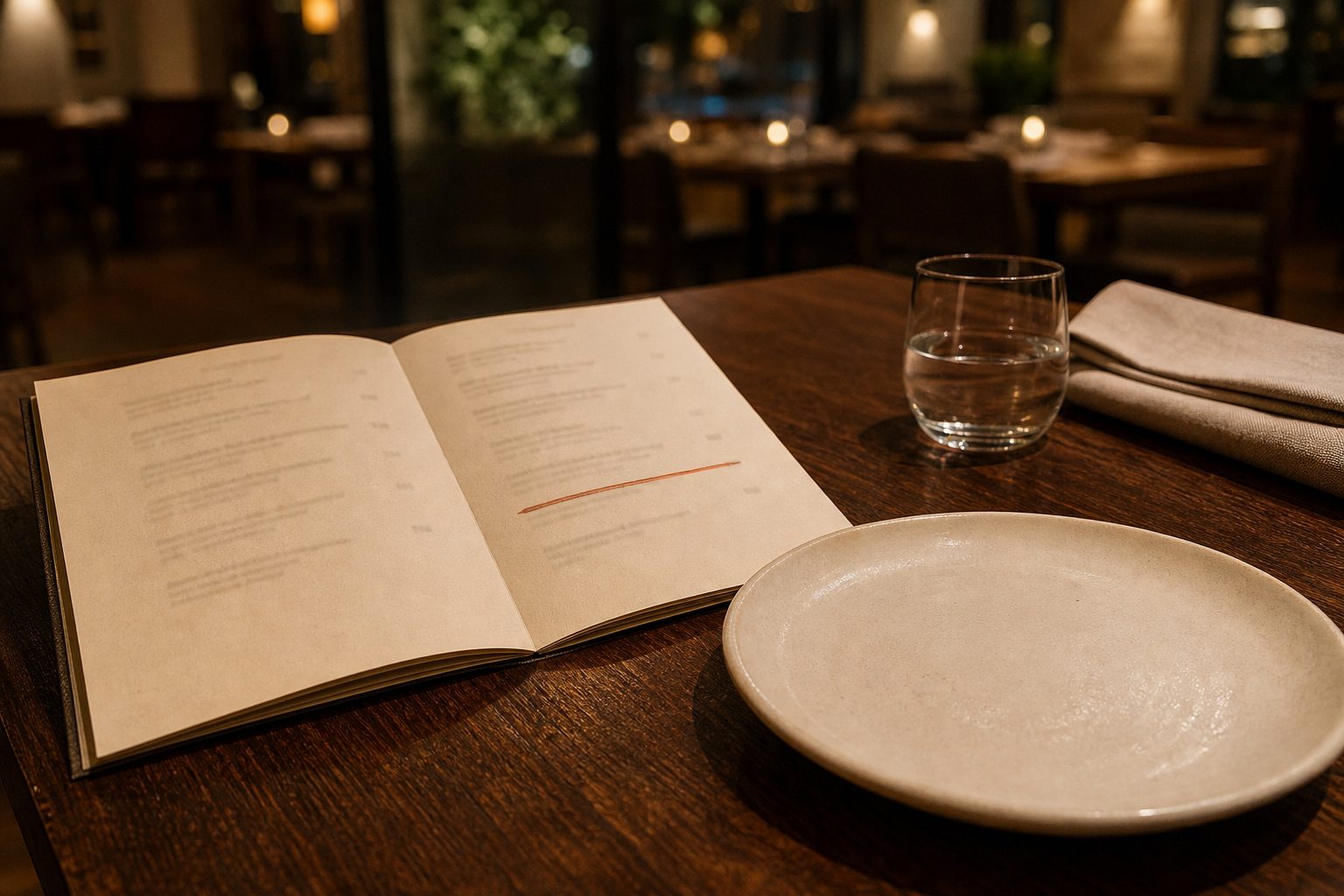
The diner closes the menu with one finger still marking the page.
They have chosen.
Perhaps it is the dish they noticed before making the reservation, the one a friend recommended or the only dish clearly suited to what they can eat. Perhaps it simply answered the appetite they brought into the room: something warm, crisp, familiar, light or generous enough to end a long day.
“I’m sorry, but we have just sold out.”
Nothing serious has happened. There are other dishes. The kitchen is still cooking, the table is still set and the evening can continue.
Yet the menu has changed after the diner finished reading it.
The diner has to reopen the menu while everyone else has stopped reading. Choice begins again under observation. The server is waiting. Other people may already be ready to order. The person who suggested the restaurant may feel responsible. A dish that existed a moment ago has left a small gap in the meal before the meal has properly begun.
Restaurants run out of things.
Ingredients arrive in finite quantities. A delivery can fail, a fish can be smaller than expected, a sauce can break, a batch can be judged unfit to serve or an ordinary dish can become unexpectedly popular. Refusing to sell what is no longer available—or no longer good enough—is often evidence of attention rather than failure.
But the diner does not encounter the stock sheet, the delivery or the decision at the pass.
They encounter an absence.
How that absence is communicated determines whether it feels like an ordinary limit of fresh cooking or a promise withdrawn too late. The missing dish becomes part of service because somebody must translate what the kitchen can no longer provide into a new possibility the table can trust.
Menu item unavailability breaks a small promise
A menu is not a guarantee that every dish will remain available throughout every service. It is still a collection of promises.
It says that these are the choices the restaurant is prepared to offer, at these prices and in these forms. Diners use those promises before they arrive. They compare menus, consider budgets, check dietary information and imagine what kind of meal will be possible. By the time they sit down, some choices already carry more weight than the few seconds it takes to say them aloud.
This is why two words—“sold out”—can carry more disappointment than the practical change seems to explain.
The diner has not lost food that belonged to them. They have lost a possibility the menu invited them to count on.
For a casual visit, the disappointment may pass quickly. For a birthday dinner built around a favourite dish, it may alter the meaning of the evening. For someone with allergies or religious restrictions, one unavailable item may remove the only clearly suitable option. For a guest who studied the menu to manage anxiety in an unfamiliar setting, beginning again is not a trivial inconvenience.
Service does not need to dramatise these possibilities. It needs to leave room for them.
A quick apology can acknowledge the change without assuming the diner’s reaction. “I’m sorry; the sea bass is no longer available this evening” is direct and proportionate. It does not insist that the diner should be deeply upset, but it also does not treat the original choice as interchangeable with anything else on the page.
Phrases such as “Unfortunately, everyone wanted that tonight” may be intended lightly. They can also make the diner feel late to a decision they had no reason to make earlier. “You should try something else” moves too quickly past the preference that has just been expressed.
The first task is not to produce enthusiasm.
It is to recognise that the menu the diner read and the menu the kitchen can now serve are no longer the same.
That recognition creates a clean starting point. The restaurant can then help with the more useful question: what did the diner want from the missing dish?
Early sold-out communication changes its meaning
There is a difference between learning that a dish is unavailable when the menu arrives and learning it after ordering.
In the first case, the restaurant has changed the field of choice. In the second, it has interrupted a choice already made.
The practical information is identical. The emotional work is not.
A server who knows that an item has sold out can mention it before diners begin reading: “Just so you know, the lamb is no longer available this evening.” The sentence takes a few seconds and prevents the menu from creating an expectation the kitchen cannot meet.
The notice should be clear without becoming the opening theme of the meal. Diners do not need a recital of every operational difficulty before they have taken off their coats. They need the changes that materially affect what they are about to consider.
Printed inserts, boards and digital menus can help, but only if they are updated with the same urgency as the kitchen’s information. A crossed-out dish on a board is clearer than a polished description left in place after the final portion has gone. A QR menu’s capacity to change instantly is useful only when responsibility for updating it is equally immediate.
Timing becomes more delicate when a dish runs out between taking the order and preparing it.
Perhaps two servers entered the last portion at nearly the same moment. Perhaps the kitchen discovered that an ingredient could not be served. Perhaps a count was wrong. The diner may have stopped choosing entirely; conversation has moved on, drinks have arrived and other dishes may already be underway.
The restaurant now has more to repair.
The server should return promptly, explain that the order cannot be fulfilled and give the diner enough time to reconsider. Standing at the table with a replacement already selected can make speed feel more important than consent. Disappearing for fifteen minutes while the rest of the order advances makes the diner absorb the kitchen’s delay.
Where timing has become uneven, the restaurant should name it.
“The other main courses have already started. We can prepare the mushroom dish quickly enough to arrive with them, or hold the other dishes while you decide” gives the group information it can use. The solution will depend on the kitchen, but the diner should not discover the consequence only when plates arrive without theirs.
Early information preserves choice.
Late information requires care with time as well as food.
A sold-out explanation should clarify, not seek acquittal
When something is unavailable, diners often want to know why.
Usually, they do not need the entire story.
“We received fewer portions of the fish than expected.” “The tomatoes for that dish were not good enough to serve today.” “The kitchen has withdrawn the dish because the latest batch of sauce did not meet its standard.” Each explanation offers a reason that is specific enough to make the absence intelligible.
Clarity can strengthen trust, especially when the reason reflects a standard the diner would want the restaurant to keep. Choosing not to serve an ingredient that falls below the restaurant’s standard is easier to accept than a vague impression that the kitchen has lost control.
But explanations can become defensive.
A long account of a supplier’s mistake may ask the diner to sympathise with a relationship they cannot evaluate. Blaming the previous table, a new member of staff or an unusually busy room moves internal frustration into the guest’s care. The details may be true and still be unhelpful.
The restaurant is not in court.
It does not need to prove that no employee could have prevented the problem. It needs to tell the diner what has changed, take responsibility for communicating it and make the next decision easier.
Tone matters here.
“The delivery didn’t come, so there’s nothing we can do” closes the exchange while technically supplying a reason. “Our delivery did not arrive, so we cannot prepare that dish today. I’m sorry we did not tell you before you chose” explains the limit without pretending that communication was beyond the restaurant’s control.
Honesty also means distinguishing a dish that has sold out from one the kitchen has chosen to stop.
“Sold out” can sound like success. Sometimes the final portion is still present but no longer meets the restaurant’s standard. Sometimes a key component is missing and the dish could be assembled only by quietly changing it. Presenting every absence as proof of popularity conceals decisions that might otherwise demonstrate care.
A concise explanation should leave the diner with greater understanding, not with a duty to reassure the restaurant.
Restaurant alternatives begin with the original choice
The quickest substitute is not always the most useful one.
If a diner orders a delicate grilled fish, a richer and more expensive main course may not answer the same appetite. If they chose a vegetable dish because it was dairy-free, another vegetarian plate finished with butter is not an alternative. If the unavailable item was the least costly main course, recommending something significantly more expensive without mentioning the difference can turn help into pressure.
The restaurant first has to understand what mattered.
Was it the main ingredient, the cooking method, the portion, the price, the dietary suitability or the role the dish would play within a shared order?
A single question can reveal enough: “Was it the fish itself that appealed to you, or were you looking for something light?” The answer gives the recommendation a direction.
Good alternatives are comparative rather than declarative.
“The trout has a similar lightness, though it is served with a richer sauce.” “The kitchen can prepare the aubergine without the yoghurt, and it remains in the same price range.” “If you wanted something to share, the beans and flatbread together would give the table a similar amount of food.”
These descriptions preserve the diner’s agency. They show both the resemblance and the difference instead of presenting the replacement as though nothing had been lost.
Sometimes there is no honest equivalent.
The only gluten-free main may be gone. The remaining dishes may take much longer, cost considerably more or belong to a different part of the meal. In that case, clarity is more hospitable than forced optimism.
“We do not have another main course that meets those requirements tonight” is disappointing information, but it allows the diner to decide what to do. The kitchen may be able to adapt another dish safely; the restaurant may suggest two starters, alter the structure of the order or, in a serious mismatch, help the guest leave without embarrassment.
An improvised plate should not be offered casually when allergies are involved. Suitability must be confirmed by the kitchen, not inferred from a server’s memory or from the absence of an ingredient in the menu description.
The purpose of an alternative is not to close the problem quickly.
It is to help the diner make a second choice with as much confidence as the first one deserved.
An unavailable dish can rearrange a shared table
An individual order rarely belongs only to one person when the table is choosing together.
The missing dish may have been the centre of a sharing plan. It may have balanced richer plates, provided the only food one guest could eat or made the total price of the order feel manageable. Removing it can change the logic of everything around it.
This is especially visible with menus designed for the table.
Four people may have chosen five dishes with different weights and flavours. If the substantial vegetable plate is unavailable, replacing it with a small salad does not preserve the meal. If the only mild dish disappears, a guest who avoids heat may be left tasting little while everyone else continues.
The server can help by looking at the order as a whole.
“Without the rice dish, what you have chosen will be lighter than you intended. The kitchen can prepare a larger portion of the beans, or I can suggest another main plate. Which would work better for the table?” This does more than name a substitute. It explains what the absence changes.
Price should remain visible during this adjustment.
A table may agree readily to a replacement without noticing that two suggested dishes cost much more than the one they replace. The server should name that difference before the table agrees. Otherwise, the discomfort arrives with the bill, when the original absence is remembered as the moment the meal became more expensive.
Clear recommendations protect the social balance as well. The person whose choice is missing should not be made responsible for redesigning the entire order while everyone waits. Nor should the most confident diner automatically take control by selecting a replacement for the table.
A useful pause can be generous: “I’ll give you a moment to reconsider these together, and I’ll come back.”
The kitchen has run out of a dish.
The table should not also be made to run out of time.
Restaurant sell-outs can signal attention or poor forecasting
Restaurants often describe a sold-out dish as good news.
It was popular. Demand exceeded expectation. The kitchen prepared a limited quantity and guests responded. For food that depends on a small catch, a short season or a process that cannot be expanded instantly, selling the final portion can represent sensible limits.
Abundance is not always the standard of good service.
A restaurant that promises unlimited availability may waste food, compromise quality or detach its menu from what suppliers can responsibly provide. “When it’s gone, it’s gone” can be an honest expression of scale.
But scarcity does not excuse every pattern.
If the same core dish disappears early every evening, the issue may no longer be unpredictability. The restaurant has learned something about demand and has either chosen not to respond or failed to do so. The effect falls repeatedly on diners who arrive later, work different hours or cannot book the first sitting.
The question is not whether the kitchen should always prepare more.
It is whether the restaurant understands the consequences of the quantity it prepares.
Increasing production may be impossible without changing quality or labour. The better response might be to describe the dish as limited, reserve portions across sittings, remove it from later menus or create a dependable alternative. What matters is that scarcity becomes part of the design rather than a surprise repeated by habit.
Patterns of waste and shortage belong together.
Preparing too much carries environmental and financial costs. Preparing too little can shift costs into lost trust, rushed substitutions and unequal access. Careful forecasting will never remove uncertainty, but it can reduce the number of times the same uncertainty is passed to the dining room as though it were new.
A sold-out dish is data as well as an event.
The restaurant can record when it happened, which alternatives diners chose, whether adequate dietary options remained and how often staff had to repair the same disappointment. The aim is not perfect prediction. It is informed limitation.
Fresh cooking accepts finitude.
Responsible service learns from where that finitude repeatedly appears.
Front-of-house staff inherit the disappointment
The person saying “we have run out” is rarely the person who decided how much to order or prepare.
Servers carry the news from the kitchen into the room. They receive the sigh, the question and sometimes the anger. They may have recommended the dish ten minutes earlier because nobody told them the final portions had gone.
This position requires more than personal charm.
Staff need accurate, current information and permission to respond within clear boundaries. They should know when an item is low, when it is finished, which alternatives the kitchen can support and what gestures they may offer when the unavailability is discovered after an order has been accepted.
Without that support, every table becomes an improvisation.
One server may promise a free dessert. Another may apologise repeatedly without offering time to choose. Another may avoid mentioning that the dish is nearly gone because they hope the order will reach the kitchen first. Inconsistency makes the restaurant appear arbitrary even when each person is trying to help.
A brief update can prevent much of this.
“Two portions of the chicken remain; confirm with the kitchen before offering them.” “The lentil dish is unavailable, and the kitchen can adapt the cauliflower as the vegan main.” “Table twelve ordered the last sole; please tell new tables when presenting the menu.”
The system should also allow information to travel back.
If guests repeatedly reject the proposed alternative because it is more expensive, management needs to know. If a missing dish leaves no suitable option for common dietary needs, the kitchen should hear that consequence. If the wording of the explanation creates confusion, the service team can help refine it.
Support matters when a guest’s frustration becomes directed at the person delivering the news, too.
Disappointment does not justify insulting staff. A restaurant can acknowledge frustration while protecting the person delivering the message. Managers should step in when the exchange moves beyond what a server should be expected to absorb.
The staff member at the table represents the restaurant.
They should not be left alone with a problem the restaurant produced collectively.
Service recovery should match what was lost
Not every unavailable dish requires compensation.
If diners are told before reading the menu and several suitable choices remain, a clear notice and a brief apology may be enough. Offering a free item automatically can make an ordinary limit feel like a major failure and distract from the meal that is still possible.
Other situations require more.
The dish may become unavailable after the order has been accepted. One guest’s replacement may arrive long after everyone else has eaten. A carefully confirmed dietary option may turn out not to exist. The restaurant may have encouraged a reservation around an item it knew was uncertain.
Repair should respond to the actual inconvenience.
That might mean prioritising the replacement, holding the other main courses, removing an unsuitable substitute from the bill or offering something while the diner waits. A manager may need to explain what happened and ensure that any item offered solely to manage the delay is not added to the bill.
The gesture matters less than its fit.
A complimentary dessert does not repair a delayed main course if the diner cannot eat the dessert—or did not want one. A discount offered without explanation can feel procedural. An elaborate apology may make a diner who was only mildly disappointed feel responsible for restoring the mood.
The most convincing repair often combines three things: a truthful account, a practical response and evidence that the consequence has been noticed.
“We accepted your order before realising the final portion was no longer available. The replacement will take twelve minutes. We can hold the other mains, or serve them now and bring you a small starter while you wait. We will remove that starter from the bill.”
The diner can understand what happened, choose how the table proceeds and see that the restaurant is carrying part of the inconvenience.
Hospitality is not measured by whether nothing goes wrong.
It becomes visible in how accurately the response matches what did.
A finite kitchen can still make a dependable promise
By the end of service, absence is everywhere.
The last portion has gone. A board has been wiped. Prep containers are empty, the bread basket is lighter and tomorrow’s deliveries have not yet arrived. A restaurant closes each night partly because its resources are not endless.
Diners do not need the illusion of an infinite kitchen.
They need a dependable relationship between what is offered and what can be served.
That relationship allows for uncertainty. A menu can say that certain dishes are limited. Staff can explain changes before choices settle. Boards and digital menus can be updated, while printed menus can be supplemented with a clear notice. Alternatives can be recommended with the diner’s original preference in mind rather than from the restaurant’s desire to move the order along.
Most importantly, a missing dish can remain a practical fact.
It does not have to become a performance of scarcity, an excuse, a test of flexibility or a hidden increase in the cost of the meal. The restaurant can acknowledge the disappointment without enlarging it and offer help without pretending that every plate is equivalent.
Running out may even reveal a standard worth trusting.
The kitchen withdrew a dish because an ingredient was not good enough. It prepared only what could be handled carefully. It refused to disguise a missing component or serve the final portion after its quality had declined.
Those decisions protect the diner, but their meaning is not self-evident in the dining room.
Service gives them language.
The sentence “we have run out” closes one path through the menu. What follows determines whether the table is left at a dead end or guided towards another choice.
A restaurant cannot keep every dish available.
It can keep faith with the person who came prepared to choose it.