Keeping a Fast Together
A communal fast coordinates bodies, clocks and attention before any food is shared. Its solidarity depends on care, exemptions and what the waiting asks people to notice.
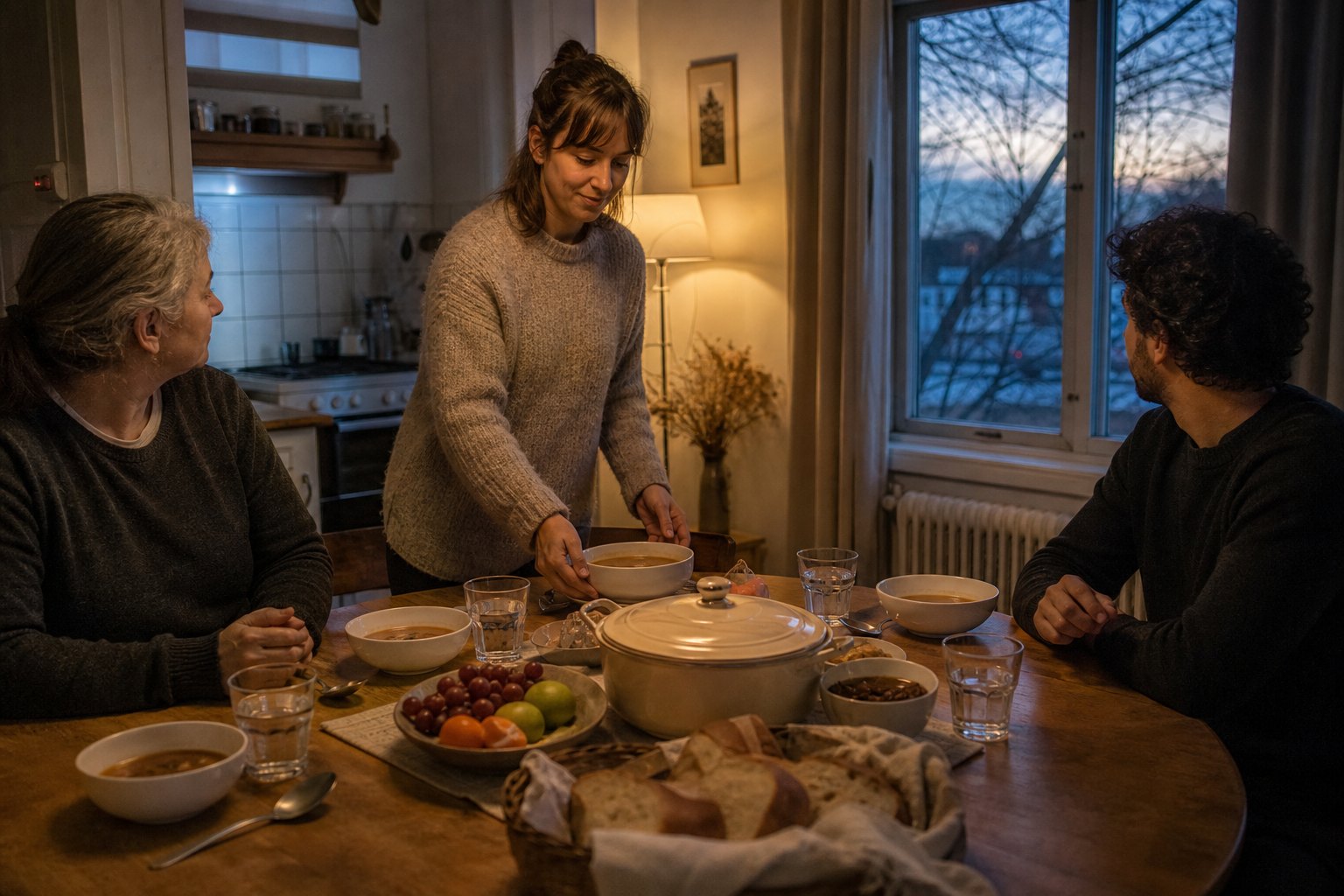
The last bowl of soup is being placed on the table.
Water catches the last light from the window. Bread has been cut, the pot is covered and every person at the table knows that the meal is ready.
One person looks outside. Another rests a hand beside a spoon that will not yet be used. Nobody reaches for the food.
The waiting has narrowed to minutes, but it began hours earlier—in a dark kitchen, perhaps, or with a decision made the previous night.
From outside, fasting can look like an empty space where eating should be.
From inside a shared fast, the space may be crowded with structure.
There are times to begin and end, foods to avoid, intentions to renew, people to remember and practical tasks that continue even when eating does not. The absence of food becomes a way of organising the day.
Fasting practices differ profoundly. Some involve no food or drink during specified hours. Others restrict particular ingredients, reduce the number or size of meals or place abstention on certain days. A fast may express devotion, mourning, repentance, purification, discipline, solidarity, petition or a promise known only to the person keeping it.
It is therefore misleading to speak of “the religious fast” as one universal experience. The comparison that follows is about shared social questions, not interchangeable beliefs or rules.
Yet communal fasts share an important social possibility. People who are physically apart can direct attention toward the same boundary in time. They notice appetite, routine and the approach of an ending together.
The meal that follows will be significant, but its meaning is being made now.
It is being made in the hours when people do not eat.
A fast is not simply a missing meal
A skipped lunch can be accidental.
A fast is usually interpreted.
The person knows why they are not eating, what period or restriction applies and how the act relates to a wider practice. Even when hunger feels ordinary, it has been placed within a moral, spiritual or communal frame.
This frame changes attention.
The hour at which coffee is normally made becomes visible. The smell of a bakery occupies more space than usual. A colleague’s snack reveals how often eating happens without a decision.
The fast turns habit into an encounter.
For some practitioners, this encounter is meant to discipline desire. For others, it creates time for prayer, reflection, mourning or acts of generosity. It may mark membership in a community whose people are observing the same rule across many households.
The physical act alone does not determine its meaning.
Two people can abstain for the same number of hours while participating in different traditions. One may experience the fast as obligation, another as chosen devotion, another as a family rhythm they are still learning how to inhabit.
This matters because outside observers often reduce fasting to willpower.
They ask whether someone “managed” not to eat, as though the purpose were a test of individual control. Communal fasting is not only a private contest against appetite. Its timing, language and support are shared.
The missing meal is only the most visible part.
Traditions restrict food in different ways
Not every fast means complete abstention.
Some practices prohibit food and drink between defined hours. Others permit water, a small meal or foods within a particular category. Some avoid animal products, rich foods or ingredients associated with pleasure. Some fasts last part of a day; others recur over a season or are kept on selected dates.
Even within one religious tradition, observance can vary by community, authority, age, health, life stage and personal commitment.
These differences should not be flattened into a scale from strict to easy.
A long period of ingredient restriction can reorganise a kitchen as thoroughly as a day without food. Shopping changes. Restaurants become harder to navigate. Shared meals require attention to what counts as permitted.
The form of restraint expresses a particular understanding of the body and its relationship to devotion, memory or community. Rules can emphasise timing, substance, quantity, simplicity or the act of giving something up.
They also change historically.
Foods become available, work patterns shift and communities interpret older obligations in new circumstances. What one generation regards as normal observance another may experience as unusually demanding.
The most respectful approach is specific.
Ask what this fast means to these practitioners. Do not assume that knowledge of one calendar, one meal or one household explains all others.
Shared restraint creates community partly through common rules. It also requires room for the ways people live those rules differently. That tension—common time without identical experience—is the thread running through the rest of the fast.
The body joins a calendar
Calendars are often understood as systems of dates.
A fast makes the calendar bodily.
The day is no longer divided only by meetings, transport and work. It is measured through thirst, energy, concentration, smell and the awareness of when food will return.
This bodily timing can connect an individual to people they cannot see.
A person working alone knows that relatives in another neighbourhood are also checking the light or the clock. A student in a classroom shares the day with a community spread across a city. Someone in diaspora observes a calendar that links them to places where the public rhythm is very different.
The experience is not identical.
Daylight-based fasts vary with season and latitude. Work can be physical or sedentary. One person has a quiet afternoon; another cares for children beside a kitchen in constant use. Shared timing does not erase unequal circumstances.
Still, the boundary is collective enough to alter expectation.
People send messages as the end approaches. Shops and community spaces change their hours. Recipes circulate. Even those who are not fasting may adjust plans so that others can keep the practice.
The calendar enters bodies, and bodies make the calendar visible.
This is one reason a fast can survive far from the place where someone learned it. The surrounding society may not pause, but the practitioner’s day carries another rhythm inside it.
Coordination turns restraint into a social act
Fasting together requires organisation.
Someone confirms the time. Someone plans the early or late meal. A workplace break is moved. A host checks which guests are observing and which are not.
The act may be spiritual, but its continuity depends on logistics.
Communities create infrastructure around restraint. Houses of worship, charities, schools, neighbours and family networks distribute information and food. People cook for those who will arrive close to the ending time. Rides are arranged. Portions are sent to workers who cannot gather.
This coordination transforms private hunger into shared practice.
It also reveals who has reliable support.
A person living with others who observe may wake, wait and eat within a complete social rhythm. Someone keeping the same fast alone must generate every cue themselves. A new practitioner may know the rule but not the practical knowledge that makes the day manageable.
Small acts can make a large difference.
A colleague avoids scheduling a long food-centred meeting. A friend asks when an evening plan should begin. A family prepares one component for a relative who works late. None of these acts requires sharing the fast physically.
They share responsibility for making it possible.
The community is therefore larger than the group abstaining. It includes people who cook, accommodate, remind, transport and welcome.
Keeping a fast together is not only doing the same thing.
It is making space for others to do it.
A bounded fast is not involuntary hunger
A religious or communal fast and food insecurity can both involve an empty stomach.
They are not the same experience.
A fast usually has a recognised purpose, rules and an expected ending. The practitioner may know that food is available but temporarily withheld. Involuntary hunger is shaped by uncertainty, lack of control and unequal access. It may not end at a known hour.
Confusing the two can sentimentalise deprivation.
Statements that fasting automatically allows a person to “know what hunger is like” should be treated carefully. Temporary abstention may sharpen awareness, but it does not reproduce the anxiety of not knowing whether food will be affordable tomorrow.
The difference does not make solidarity impossible.
Many fasting traditions connect restraint with charity, hospitality or responsibility toward people in need. The fast can interrupt complacency and redirect resources.
But empathy is not guaranteed by sensation.
A hungry person can become reflective, impatient, inward-looking or generous. The social meaning of fasting depends on the practices built around it: giving, learning, changing behaviour and listening to people whose hunger is not voluntary.
The most important question is not whether the fasting person briefly felt an empty stomach.
It is what that experience asks them to do when food returns.
Foodwork does not stop during a fast
Fasting can make food more present, not less.
Ingredients must be bought. Meals for children, non-fasting relatives or later hours still need preparation. A gathering at the end of the day may require more cooking than an ordinary dinner.
Someone performs this work while not eating.
The cook measures seasoning without tasting, stands near heat and handles food whose readiness must be judged through smell, texture and memory. They may spend the final hours of the fast making the meal possible for everyone else.
This labour is easily hidden by the drama of the shared ending.
People remember the table filling and the first sip. They may not notice who was washing herbs, carrying groceries or cleaning while tired.
As in other forms of domestic foodwork, responsibility can fall unevenly. Women, older relatives or one especially competent cook may be expected to preserve the entire tradition. The language of devotion can make it difficult to name exhaustion.
Shared fasting should invite shared preparation.
Tasks can be distributed before energy is low. One person shops, another cooks and another cleans. Purchased food can supplement homemade dishes. Simplicity can be treated as consistent with restraint rather than as a failure of hospitality.
The fast does not become more meaningful because one person is overwhelmed.
If the community is formed through shared discipline, the work surrounding that discipline should also be visible.
Exemption is part of the practice
Not every person can or should fast in the same way.
Health conditions, pregnancy, breastfeeding, medication, age, disability, travel and physically demanding work can change what is safe or required. Traditions contain different rules, dispensations and alternative forms of participation; those provisions are part of the practice, not awkward exceptions to it.
Medical questions need individual advice. A cultural essay cannot determine whether fasting is appropriate for a particular body, and general health guidance cannot replace a clinician who knows that person’s circumstances.
What it can observe is that exemption does not necessarily mean exclusion.
A person who is not fasting may prepare food, attend prayers, give to others, join the gathering or keep another form of restraint recognised within their tradition. Children can learn the rhythm without carrying an adult obligation.
Communities communicate their values through the way they treat these differences.
If a person must disclose private medical details to avoid suspicion, the shared fast has become a public test. If someone is pressured to endanger their health to prove belonging, solidarity has reversed into surveillance.
Careful communities make room without demanding performance.
They do not turn another person’s plate into evidence. They recognise that observance can include knowing when a rule does not apply or when guidance must be sought.
The strength of a collective practice is not measured by the absence of visible exceptions.
It is measured partly by whether people whose bodies require another path can remain fully present.
Children learn waiting gradually
A child notices fasting before they understand it.
Adults wake at different hours. The kitchen changes. A parent declines food. Evening acquires unusual importance.
Children may want to imitate.
Their participation needs to be shaped by age, health, family teaching and the guidance of the relevant tradition. The desire to belong should not turn adult discipline into an unsafe childhood test.
Many forms of learning do not require a complete fast.
A child can help prepare the table, practise waiting briefly, give food, learn why others are observing or take responsibility for one part of the later meal. They can see that restraint is connected to behaviour, generosity and attention rather than being a competition over endurance.
Adults also model how to speak about difficulty.
If tiredness is denied, children may learn that honest bodily limits are shameful. If every complaint is treated as failure, they may confuse spiritual seriousness with secrecy.
The fast can teach patience without glorifying suffering.
It can also teach that people participate differently. A younger sibling eats. An older relative rests. Someone takes medicine. The community remains one table even when its members have not kept identical hours.
Belonging grows through understanding the practice, not merely reproducing its hardest form as early as possible.
Diaspora keeps two kinds of time
In a place where many people fast, public life may acknowledge the altered day.
Elsewhere, the schedule continues without reference to it.
Lunch meetings proceed. School celebrations centre on snacks. Commuters arrive home shortly before the fast ends. The practitioner moves through one public clock while keeping another communal clock.
This can make fasting feel isolating.
It can also intensify connection. Messages travel between relatives across countries. People compare the hour at which darkness arrives. A meal is prepared from substituted ingredients while following a familiar temporal sequence.
Time zones complicate togetherness.
One household is already eating while another has hours to wait. A video call cannot gather everyone at the same physical moment. Families choose whether to speak before, during or after their local ending.
The fast creates simultaneity of intention rather than identical experience.
Diaspora communities often build local structures: communal meals, adjusted programmes, food deliveries and interfaith invitations. These practices make the calendar visible in a society that may not otherwise recognise it.
They also change the tradition.
Work hours, climate, food availability and the diversity within the community produce new arrangements. The shared fast becomes a way of creating home while admitting that the surrounding day is different.
Institutions can support or obstruct
A fast does not occur outside employment, education or public life.
Its difficulty is shaped by whether institutions recognise predictable needs.
Reasonable scheduling, access to a quiet space, flexibility around breaks and avoiding unnecessary food-centred obligations can help practitioners participate without special spectacle.
Accommodation begins with listening.
Not every person wants the same adjustment. One worker may prefer an earlier shift; another may not. A student may want privacy rather than public praise for fasting. Asking is more respectful than treating a community as uniform.
Support also means avoiding assumptions about performance.
Fasting does not make everyone unable to work, nor does commitment make fatigue irrelevant. People should not have to choose between being seen as weak and being denied practical flexibility.
Food events require particular thought.
A compulsory team lunch can turn non-eating into a visible declaration. An event can provide takeaway portions, schedule substantive participation away from the meal or make attendance genuinely optional.
These changes do not require an institution to interpret the fast’s theology.
They recognise that a recurring practice organises time and that inclusion may require more than placing a vegetarian option on a table.
The discipline extends beyond food
Practitioners often describe fasting as more than an empty stomach.
Attention may turn toward speech, anger, consumption, prayer, generosity or conduct. Food restraint is one part of a wider effort to live differently for a defined period.
This broader discipline matters socially.
A person who abstains from food while becoming harsher toward everyone around them has kept the visible rule but may feel they have missed its purpose. Hunger is not permission to transfer discomfort to other people.
Communities help by giving restraint a positive direction.
Time usually spent eating can be used for reflection or service. Money not spent on a meal can be given. Conversation can move toward shared commitments.
Yet the ideal should not become another instrument of judgement.
Fasting people remain tired, distracted and imperfect. A collective practice needs room for apology and repair, not constant ranking of whose behaviour appears most disciplined.
The fast becomes socially meaningful when it changes relationships, not when it produces an image of flawless self-control.
Charity must be more than symbolism
Shared restraint often carries a language of generosity.
Food is distributed. Community tables welcome strangers. Donations increase. Volunteers prepare meals for people they may never meet.
These acts can turn a private discipline outward.
They can also become temporary.
If concern for hunger lasts only as long as the fast, the experience has been contained within the ritual calendar. Food insecurity does not end when the communal meal begins.
Sustained solidarity asks what continues.
Can a seasonal food drive become regular support? Can the community learn from organisations led by people experiencing poverty? Can a generous public meal avoid waste while preserving welcome?
Giving should also respect dignity.
People receiving food are not props through which others demonstrate virtue. They have preferences, dietary needs and knowledge about what support is useful.
The fast may create a powerful opening for generosity. The ethical work lies in allowing that opening to change ordinary habits.
Restraint becomes communal not only because many people refrain at once.
It becomes communal when resources, attention and responsibility move between them.
Shared practice can become social pressure
Collective rituals create belonging partly because they are visible.
Visibility can also become surveillance.
People notice who is eating, who leaves early and who appears energetic. Questions meant as interest can become demands for explanation. A private medical decision is interpreted as weak commitment.
Pressure is especially difficult for someone managing an eating disorder, chronic illness or complicated relationship with food. The language of discipline and praise may reinforce harmful behaviour.
Communities need ways to protect privacy.
No person should be required to disclose a diagnosis to make their plate acceptable. Leaders and families can speak clearly that safety, exemptions and professional guidance matter. Alternative participation should be described as legitimate before anyone needs it.
The same care applies to people whose observance is less strict, newly adopted or uncertain.
A shared fast is not strengthened by humiliation.
It can hold common expectations while refusing to turn those expectations into public policing.
Belonging built through coercion is fragile. People may perform the rule while withdrawing from the community that enforced it.
The most durable solidarity leaves room for conscience, interpretation and bodies that cannot be made identical.
Food becomes unusually noticeable
During a fast, food can occupy the mind.
People plan the later meal, exchange recipes and imagine the first taste. Shops display seasonal foods. Social media fills with preparations.
This attention is not necessarily a contradiction.
Abstention can heighten appreciation and make ordinary flavours vivid. Cooking can be part of hospitality and anticipation.
But abundance can overtake restraint.
The meal grows elaborate. Shopping expands. The hours without food become organised around producing excess for the hours with it. Waste increases, and the burden on cooks intensifies.
Practitioners often negotiate this tension.
How can the later table feel generous without turning the fast into a daily food festival? How can traditional dishes remain present while simplicity keeps its meaning?
There is no universal answer.
One household reduces the number of dishes. Another shares preparation across several families. Community organisers plan portions carefully and arrange for safe distribution of what remains.
The goal is not austerity for its own sake.
It is alignment between the values named during the fast and the material practices surrounding it.
Those who do not fast can still belong
At the table may be someone who has eaten during the day.
They are too young, medically exempt, travelling, not part of the tradition or participating in another way.
Their presence tests whether solidarity depends on identical bodily experience.
It does not have to.
A non-fasting person can protect the rhythm, prepare food and wait respectfully for others. They can join the gathering without pretending to have kept a fast they did not keep.
In interfaith and mixed households, such participation can be especially important. The fast becomes understandable through practical care rather than abstract explanation.
Care should move both directions.
The fasting person need not demand that everyone hide food all day. The non-fasting person need not centre meals in shared spaces if that makes observance harder. Households negotiate based on age, need and relationship.
This negotiation is itself a form of community.
It demonstrates that people can support a discipline without claiming it, and can differ without making the difference a threat.
The final minutes gather the day
As the ending approaches, dispersed experiences converge.
The office worker travels home. The cook covers the pot. A message confirms the time. People take their places.
The body’s attention narrows.
Water is close. Food is visible. The rule is almost complete, but “almost” remains part of the practice.
These minutes reveal why timing matters.
If fasting were only private deprivation, each person could stop when they wished. Waiting for the shared boundary places individual appetite within a collective order.
The order is not valuable because discomfort is valuable by itself.
It is valuable when it creates attention: to intention, to other people, to unequal access to food and to the possibility of acting with greater care.
The fast has not been kept together merely because everyone avoided eating.
It has been kept together if people made room for weakness, shared labour, respected exemptions, adjusted institutions and allowed restraint to become generosity rather than judgement.
At the table, hands remain still for another moment.
The first bite belongs to the next part of the story.
The community has already been formed in the waiting.