The Recipe Written in the Margin
Corrections, substitutions and names in the margins reveal the lives through which a recipe has travelled.
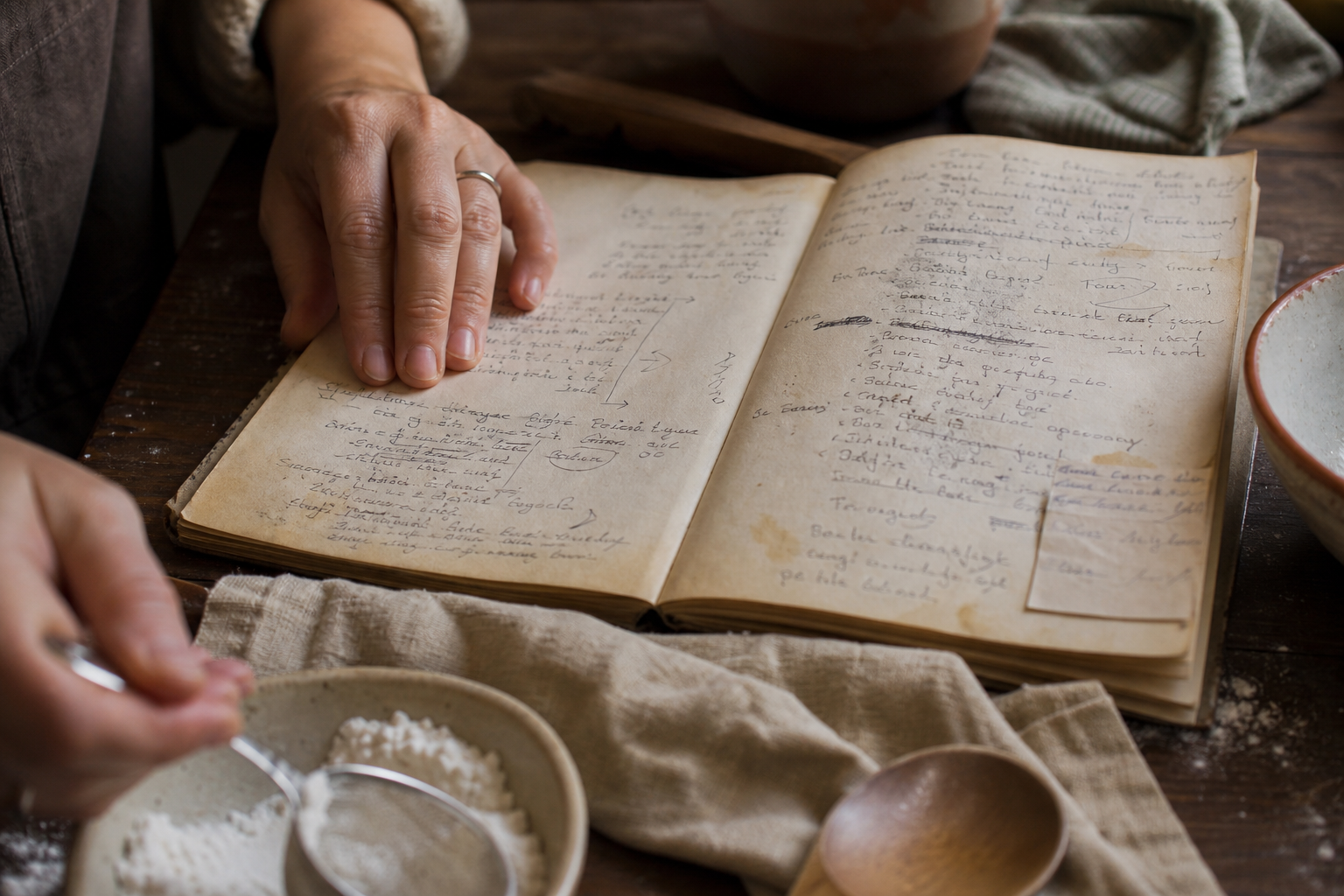
The recipe begins in the centre of the page.
Its ingredients are aligned. Its method proceeds in numbered steps. The type is even, the measurements certain and the cooking time precise. Everything about the printed recipe suggests that the dish has already been settled.
Around it, another recipe has begun.
In one margin, a hand has crossed out the amount of sugar. Near the oven temperature, somebody has written, “lower shelf.” An arrow carries an ingredient from the method back to the list. There is a date beside a substitution and a person’s name beside a warning: ask her which flour she used. A later hand disagrees with an earlier one. The page contains not a single correction but a small conversation conducted across several meals.
The official recipe says how the dish is supposed to work. The margins remember how it worked here: in this kitchen, with this oven, for these people, using what could be found and what somebody had learned not to forget.
That surrounding knowledge may appear secondary because it occupies the edge of the page. In practice, it is often what makes the recipe cookable.
It also changes what kind of document we think we are holding. A recipe is usually read as an instruction addressed to the future: do this and a dish will follow. A marked recipe also faces backward. It records decisions, constraints, disagreements and acts of care that the clean version could not anticipate. The centre tells us what was intended. The edges show what people actually had to do.
Family recipes contain two recipes on the same page
A printed or carefully copied recipe presents a useful fiction: begin with these ingredients, follow these actions and arrive at this result.
The fiction is useful because it allows knowledge to travel. A person who never watched the original cook can still attempt the dish. Quantities give shape to instructions that might otherwise depend on memory. A sequence creates confidence. The recipe in the centre offers a route into an unfamiliar kitchen.
But no written method can contain every condition under which food is made.
Flour absorbs differently. An onion is not a standard size. A “medium heat” belongs to a particular stove. The pan named in the instructions may not exist in the household using them. A dough that needed ten minutes yesterday may need twelve today. Experience enters where precision runs out.
This is the second recipe: the one assembled through use.
Its instructions may be written in the margin, spoken across the kitchen or demonstrated by a hand lifting a spoon. Add water only if it resists. Stop when the smell changes. Make more sauce when your uncle is coming. These are not necessarily improvements to a defective original. They are evidence that recipes become reliable through a relationship between text, cook and circumstance.
The page gives the dish a structure. Repetition teaches the cook where that structure can bend.
Kitchen measurements become local knowledge
Recipes often become more precise as they move away from the kitchen that produced them.
A cook who works by touch may be asked for grams. A relative who says “until it feels right” is pressed to name a quantity. This translation matters. It gives somebody elsewhere a genuine chance to begin, especially when they have never seen the dish made.
But measurement does not eliminate judgement. It relocates it.
Two hundred grams of flour can still behave differently according to its protein, age, storage and the humidity of the room. A cup may be levelled, heaped or simply the cup that has always lived beside the sack. An oven dial may say 180 degrees while the back corner runs hotter than the front. The written number is stable; the material it meets is not.
Family recipe notes often connect those two kinds of knowledge. “One cup” becomes “a little less with this flour.” “Bake for thirty minutes” becomes “turn the pan after twenty.” The annotation does not reject precision. It explains where precision stops being sufficient.
This is why apparently vague instructions can be dense with experience. “Enough water” may mean that the writer knows the dough will reveal the answer through resistance. “Cook until done” may conceal years of looking, smelling and listening. Such phrases are frustrating when the signs have not been taught. They become useful when somebody names what to notice.
The best margin does more than provide a replacement number. It helps the next cook learn how to judge.
Recipe notes usually begin with a problem
Recipe notes rarely record everything that went as expected.
Nobody writes, “The salt was correct.” They write, “Half this next time.” A successful forty-minute bake leaves no trace; a scorched edge produces a new temperature in dark pencil. The note appears because the written promise and the lived result separated.
This makes the margin a record of attention rather than failure.
The cook has noticed what happened, formed a theory and left help for a future attempt. Sometimes the future cook is the same person a week later. Sometimes it is a child who will open the book years afterward and encounter an instruction whose original problem nobody remembers.
The most useful notes include their reasons. “Use less” is fragile knowledge. Less than what, and why? “Reduce the salt if using the preserved lemons” lets another cook understand the relationship and make a new decision when the ingredients change again.
Dates help too. A substitution made during a shortage means something different from a substitution repeated because everybody preferred it. A name can return credit to the person who solved the problem. “Marta’s method” or “the way Grandfather mixed it” acknowledges that the recipe has more than one author, even if only one name appears on its cover.
Handwritten recipes carry inheritance
In handwritten recipes, a familiar hand changes how the instructions are read.
The pressure of the pen, a hurried abbreviation or an unusually careful capital can bring a person into the room more immediately than a photograph. The note does not need to be profound. “Needs longer” may be enough. Ordinary handwriting carries the physical fact that somebody stood over this page and decided the next cook should know.
Yet it is easy to make such pages more sentimental than the lives around them were.
Not every marked cookbook is a treasured family archive. Some were used by people who disliked cooking. Some notes record disagreement, constraint or work performed without recognition. A recipe may preserve the handwriting of the person allowed to own the book while omitting the knowledge of the person who did most of the cooking. The neatest record is not always the fullest account.
Many essential instructions were never written. They travelled through watching, repetition and correction: the movement that folds without deflating, the sound of properly heated oil, the firmness understood by pressing with a thumb. Literacy, time, language and access to the page all influence whose knowledge enters the margin.
So the handwriting deserves attention, but also questions. Who wrote this? Who taught them? Who else was present? Whose contribution was treated as too obvious, too domestic or too difficult to put into words?
An inherited recipe is not only a message from the person holding the pen. It may be the visible edge of knowledge made by several people.
The missing handwriting matters too
Some of the most important cooks leave no mark on the page.
They may have dictated while somebody else wrote. They may have demonstrated a method so often that nobody thought it needed recording. They may have prepared the dish as paid work in another household, as unpaid work in their own or as part of a shared routine in which authorship was never discussed.
The recipe book can therefore reproduce the household’s hierarchy. The person who owned the notebook appears to be the author. The person who cleaned, chopped, watched the fire or corrected the seasoning disappears into the passive voice: mix well, bake slowly, serve hot.
This absence does not mean the page is useless. It means the page should not be asked to tell the whole story by itself.
Questions can reopen the record. Who usually made this dish? Who taught the person whose name is written here? Who was called in when the texture went wrong? Who prepared the ingredients before the celebrated cook entered the kitchen? The answers may be uncertain or contradictory. Recording that uncertainty is more honest than assigning every insight to the clearest signature.
Sometimes the next annotation should not alter the method at all. It should add a name, a relationship or a sentence about the work that made the recipe possible.
Ingredient substitutions show where family recipes travel
An ingredient substitution in a family recipe is sometimes described as a compromise: the proper item was unavailable, so an imperfect replacement entered the dish.
That may be true for one meal. Over time, however, substitution can become part of the dish’s history.
People move between regions and countries. Shops change. Gardens succeed and fail. Ingredients become expensive, restricted, newly abundant or known by another name. Religious practice, allergies, health, climate and the preferences of new family members reshape what a household can and wishes to cook.
The margin records these negotiations in practical language. This cheese works if soaked first. Use the local beans, but cook them less. The new oven dries the top. Add the herb at the table because one person cannot eat it.
Such changes should not be automatically celebrated as innovation or condemned as loss. Either judgement can flatten the conditions that produced them. A replacement might preserve a cherished dish under difficult circumstances. It might also show what could not be carried forward. The cook may feel pride, relief, indifference or grief about the same altered ingredient.
Tradition survives not because every detail remains fixed, but because people decide which relationships matter enough to remake: a taste associated with a holiday, a method performed together, a shape recognised on the table or the act of serving the dish to particular people.
The substitution in the margin tells us that continuity required work.
Scarcity is not a romantic ingredient
Later generations can be tempted to admire resourcefulness without remembering why it was required.
A note that replaces an ingredient may come from curiosity or preference. It may also come from rationing, poverty, forced movement, exclusion from particular shops or the simple fact that a household could not afford the version described in print. Calling every substitution inventive can turn constraint into a charming family trait.
The cook may indeed have been inventive. The condition should still be named when it is known.
“Use water instead of milk” means something different if it was a chosen variation, a response to an allergy or the only possible way to make the dish that week. “Leave out the nuts” may describe taste, safety, expense or availability. The result on the table can be loved in every case, but the history carried by the change is not the same.
Context protects the recipe from easy nostalgia. A date, place or brief explanation allows descendants to honour skill without pretending hardship was picturesque. It also prevents a temporary emergency measure from becoming an unexplained command.
The margin can hold pride and difficulty together. It can say that somebody made a satisfying dish from limited means without suggesting that the limitation was desirable.
Recipe corrections become the family version
After enough repetition, the note at the edge may become more authoritative than the recipe in the centre.
Nobody in the household uses the printed quantity anymore. The changed spice, different filling or extra resting time is simply “how we make it.” A younger cook may be surprised to discover that the family version began as a pencilled alteration to a recipe from a newspaper, a neighbour or the back of a packet.
This does not make the tradition false.
Family recipes often acquire legitimacy through repetition rather than origin. A dish becomes ours because it appears when people gather, because certain hands are expected to make it and because its absence would be noticed. The source matters, but so does the life built around it.
Problems arise when adaptation is followed by forgetting. A household may claim a recipe as entirely its own while losing the name of the person, community or publication from which it came. Affection does not remove the responsibility to remember sources where they are known.
A generous recipe record can hold both truths: this method entered our home from somewhere, and this is what happened after it arrived.
Keeping the original attribution beside later changes does not weaken the family story. It gives the story a longer table.
Attribution keeps the recipe’s longer story
Recipes move so easily that their sources are often lost through affection rather than deliberate theft.
A neighbour writes a method on a scrap of paper. A dish enters the family rotation. The scrap is copied into a notebook, then typed for a wedding gift. Two generations later, the recipe carries the family name because that is the name everybody remembers.
The household’s history with the dish is real. It is simply not the whole history.
Where a source is known, keeping it visible makes the record richer. Note the person who shared the recipe, the publication it came from, the restaurant or community event where it was first encountered. If the source is uncertain, say so. “Copied from a newspaper, probably in the 1980s” is more useful than silence and more honest than false precision.
Attribution also clarifies what the family contributed. The original recipe may explain the structure; later notes show the different spice, the reduced sweetness, the local ingredient and the occasion that made the adapted version matter. Credit does not take ownership away from the household. It shows the relationship through which the recipe arrived.
A recipe can belong in a family without being said to have begun there.
Family recipe margins have moved beyond paper
Many family recipes now travel without a physical page.
A photograph of a handwritten card is enlarged on a phone. Corrections collect beneath a shared document. A relative sends a voice message because the crucial texture cannot be expressed in teaspoons. Somebody types, “Ignore step four—I’ll explain,” into a family chat. A video captures the speed of a movement that writing had reduced to the word “stir.”
These are margins too: knowledge gathering around an instruction as people try to make it usable.
Digital abundance can preserve more voices, languages and demonstrations than one cookbook could hold. It can also make knowledge strangely fragile. The useful correction may be buried beneath years of messages. A voice note may remain on an old device. A platform disappears, a link breaks or nobody remembers which photograph shows the final version.
Preservation does not require turning every recipe into a formal archive. A few deliberate choices help. Keep the person’s name with their instruction. Add a date and a sentence about why the change was made. Save the voice as well as a transcription when tone or pronunciation matters. Photograph the whole page, including stains, inserts and edges, rather than cropping it into a clean rectangle of ingredients.
Most importantly, do not wait until nobody can answer the obvious questions.
Preserve a living recipe without freezing it
Preservation often begins with fear that the original object will be lost.
The ink is fading. The card is stained. A notebook’s binding has failed. Scanning or photographing the material is sensible, but a clean transcription alone can remove the evidence that made the object meaningful: arrows, crossings-out, pressure marks, scraps tucked between pages and the order in which different hands arrived.
Keep more than one layer when possible.
Photograph the whole page in steady light. Preserve the front and back of loose cards. Record a transcription for searching and cooking, but do not treat it as a replacement for the image. Identify the writers when they are known, and mark guesses as guesses. Add the date of the copy so future readers can distinguish an old note from a recent explanation.
Then record use. Ask somebody to make the dish while another person observes. Note where the written instructions fail to answer a question. Capture the sound, texture or gesture that carries the missing information. A short voice recording may preserve pronunciation and rhythm; a video may preserve the angle of a hand. The aim is not a polished documentary. It is enough evidence for another cook to continue.
Access matters as much as capture. A perfect archive on one person’s device is not a family resource. Store copies where the intended people can find them, name files plainly and keep context beside the recipe rather than in a separate message that will soon be buried.
Preserving a living recipe means protecting both the record and its capacity to change.
Leave room for the next cook
There is a temptation to produce a final family recipe: to test every quantity, resolve every contradiction and type the result into a document clean enough to outlast the stained page.
Clarity is valuable. It helps a new cook begin. But a recipe can become so polished that it conceals the choices through which it became dependable.
The crossed-out number shows that somebody paid attention. Two conflicting notes show that different kitchens needed different answers. An unexplained name invites a conversation. The page is useful not despite these complications, but partly because of them.
The next cook should not be required to obey every annotation. They may live somewhere else, use a different pan or cook for people with other needs. Their responsibility is not to freeze the dish at the moment they received it. It is to understand what earlier cooks were trying to protect, then make their own changes with similar care.
Perhaps they will write in the remaining space.
Use less water in this flour. She preferred it with orange peel. We made this together the winter the oven broke. Ask him about the folding method.
The recipe still begins in the centre of the page. But the life of it gathers at the edges, where one cook leaves enough knowledge—and enough room—for another to continue.