When Service Feels Scripted
A service script can protect accuracy and fairness, but hospitality weakens when the sequence becomes more important than the person sitting at the table.
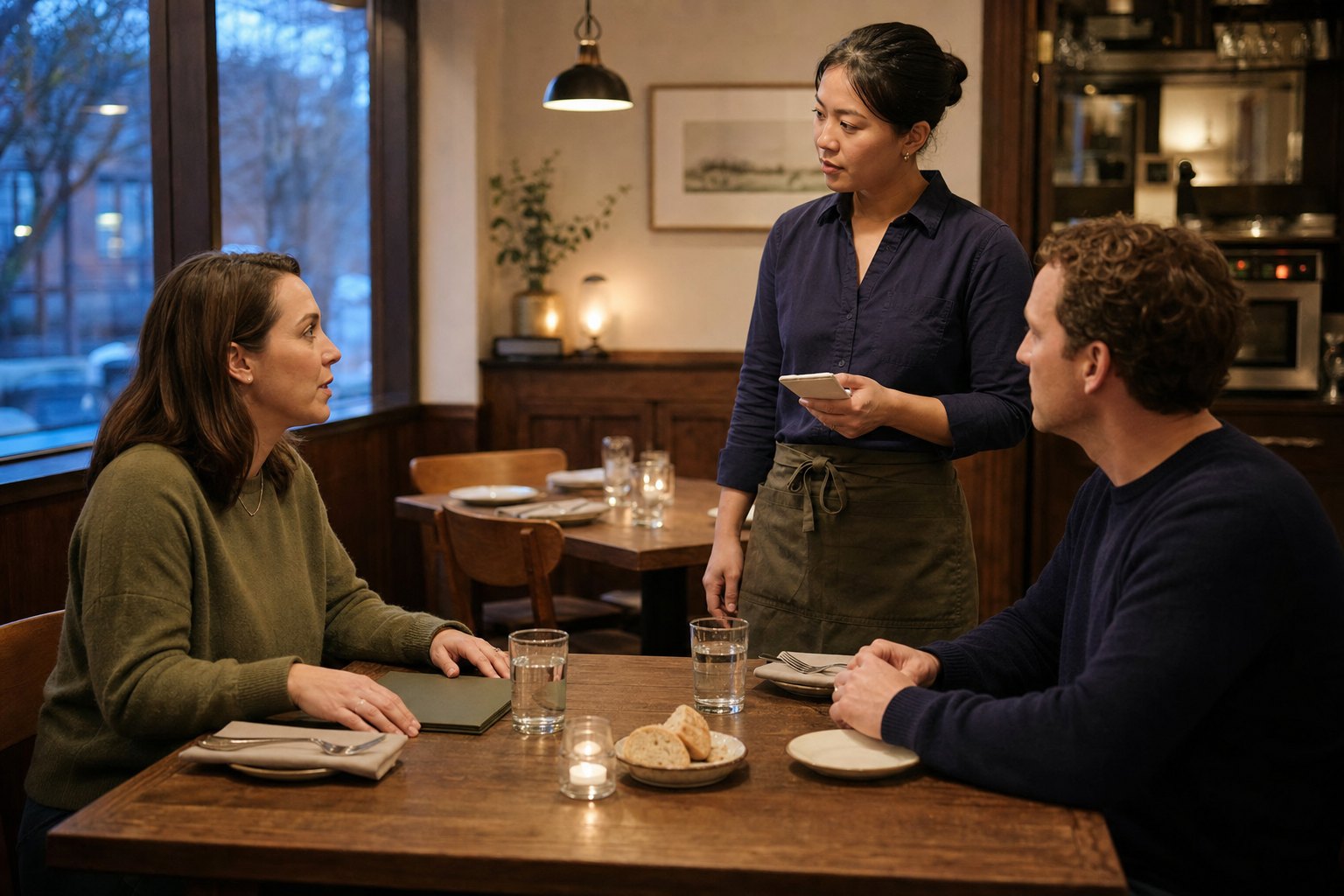
The first sentence arrives before the guests have fully settled.
“Have you dined with us before?”
It is a sensible question. The answer may determine how much explanation follows. It can spare regulars a speech and help newcomers understand the menu. Yet sometimes the server asks while one guest is still removing a coat, another is moving a chair, and nobody is ready to listen. The words are correct. The moment is not.
That small mismatch is what makes service feel scripted. It is rarely the sentence itself. Most useful hospitality language has been said many times before: welcome, may I explain, are there allergies, may I clear this, would you like anything else? Repetition is unavoidable in work built from recurring encounters.
The difference lies in whether the phrase responds to the table or simply arrives at its assigned place in the sequence.
A restaurant needs patterns. Guests should not have to wonder whether their allergy will be taken seriously depending on who serves them. Staff need shared ways to handle reservations, orders, payments and emergencies. Consistency can be a form of care.
But a pattern becomes a script in the troubling sense when completing it matters more than perceiving the person in front of it. The service still moves. Nothing obviously fails. Yet the guest begins to feel less welcomed than processed.
Why restaurant service scripts exist
Restaurant service scripts exist because memory and goodwill are not enough to run a restaurant.
A server may be responsible for several tables, each moving at a different pace. The kitchen needs orders in a consistent format. Allergies require precise questions and clear communication. A bill must reach the right guest with the right items. During a busy service, a reliable sequence reduces the chance that essential steps disappear.
This is not bureaucratic fuss. It is infrastructure.
The best scripts make an invisible promise: no guest should lose basic care because the room is full, the server is tired or the manager happens to be elsewhere. A greeting, a water offer, a dietary-needs check and a clear explanation of delays can distribute attention more fairly.
Shared language can also protect staff. A new employee does not have to invent every encounter under pressure. A standard response to harassment, intoxication or an unsafe request gives the worker a boundary backed by the restaurant. A clear procedure for mistakes can prevent one person from absorbing blame alone.
In these cases, consistency is not the enemy of hospitality. It is what allows hospitality to survive conditions in which improvisation would favour only the most experienced, confident or socially fluent worker.
The question is not whether a restaurant has scripts. It is which outcomes must remain consistent, what those standards are protecting, and where staff need discretion.
Restaurant service consistency needs two standards
Restaurant service consistency depends on separating the moments that need precise language from those that need judgement.
Confirming a reservation name, repeating an allergy, checking the temperature of a dish, identifying the person responsible for payment—these tasks are safer when the steps are explicit. Warmth cannot compensate for getting them wrong.
Other parts depend less on precision than on treatment.
Explaining an unfamiliar menu, responding to hesitation, recognising that a celebration wants more time, or noticing that a solo diner does not wish to chat cannot be solved by one perfect sentence. The appropriate response changes with the person and the moment.
Hospitality research on scripting makes a similar distinction. Guests tend to value scripts when they ensure that a task is completed, but react more negatively when scripted treatment feels insincere. Strict scripts suit some functional encounters; complex and relational ones need more freedom.
A restaurant can therefore divide its standards into two layers.
The first is non-negotiable: the allergy is recorded, the order is confirmed, the delay is communicated, the bill is accurate.
The second is adaptive: the wording, pace, amount of detail, distance and tone change according to what the server observes.
This does not weaken the standard. It locates the standard where it belongs. Consistency secures a fair floor of care; human attention shapes how that care reaches a particular guest. The task remains dependable. The treatment remains human.
When scripted service becomes audible
Guests often recognise a script even when they have never worked in hospitality.
They hear the identical phrase delivered at three neighbouring tables. They notice the question asked without waiting for an answer. They sense when a joke has been inserted because a manual recommends lightness, or when an enthusiastic description continues after everyone has clearly decided.
The machinery becomes audible.
Sometimes this is harmless. Familiar phrases can be reassuring. A regular sequence tells a guest what will happen next. In a place where the cuisine or customs are unfamiliar, structure can reduce anxiety.
The discomfort begins when the script asks the guest to perform too.
“Are we celebrating anything special?” can open a generous conversation. It can also demand a cheerful explanation from people who came after a funeral, during a difficult negotiation or simply because they needed to eat. “How is everything tasting?” invites useful feedback, but not when asked while every mouth is full and the server has already begun to turn away.
The guest learns that the expected answer is brief and positive. The question was not entirely a question.
Once that happens, even genuine warmth can be mistaken for procedure. The script has not only standardised the employee’s words. It has narrowed the space in which the guest can answer honestly.
Service timing is part of the sentence
Service timing cannot be separated from hospitality language.
“Take your time” means little if the server returns every ninety seconds. “No rush” sounds different when the dining room is empty and when people are waiting at the door. An explanation that feels generous before ordering can feel intrusive after a guest has closed the menu.
The same words can welcome or pressure depending on when they arrive.
This is why attentiveness is not simply politeness. It is perception. The server must read unfinished gestures: menus still open, a conversation reaching a delicate point, coats kept on, a child close to losing patience, a hearing aid being adjusted, an empty water glass that matters more than another description.
No script can list every cue. A branching decision tree may help, but the table will always produce situations the tree did not predict.
Timing also reveals whether staff have enough capacity to notice. A server responsible for too many tables may know that a guest needs a pause and still be forced to deliver the next step before disappearing. What looks like personal insensitivity can be a staffing decision made elsewhere.
Restaurants sometimes train employees to sound natural without giving them time to observe. The result is polished speed: fluent words moving past unread faces.
Human attention requires seconds that cannot always be recovered through better phrasing.
Emotional labour and the performance of sincerity
Service work asks people to display emotion as part of the job.
The employee may be worried, exhausted or angry and still expected to appear calm. That expectation is not unique to restaurants, but the dining room makes it especially visible. Guests are not only buying completed tasks. They are interpreting tone, expression and presence.
Training often responds by defining the display: smile, use the guest’s name, make eye contact, sound enthusiastic. These instructions can help a nervous new employee. They can also turn sincerity into another compliance measure.
A smile held for the required duration does not necessarily feel warm. Repeating a guest’s name can feel personal once and strangely possessive the fourth time. Enthusiasm for every dish produces a room in which no preference seems believable.
Research distinguishes between merely producing the outward expression and engaging more genuinely with the purpose of the interaction. Guests are particularly sensitive to the first—going through the motions—when treatment matters.
But asking employees to become genuinely delighted on command creates another burden. A restaurant cannot demand inner feeling as a uniform.
The more ethical aim is not constant sincerity of emotion. It is honesty of attention. A server need not adore every guest or dish. They can listen accurately, speak without contempt and act with care. Professional warmth can be real without becoming compulsory intimacy.
Guest names are not the same as recognition
Many service systems collect details in order to personalise the encounter.
A reservation note records a birthday. A guest profile remembers a preferred table, a disliked ingredient or a bottle ordered last time. Used carefully, this memory can make a person feel recognised. Used automatically, it can feel like surveillance with good manners.
The distinction is subtle.
Recognition says: we remembered something that may help you.
Performance says: we possess information about you and will demonstrate it whether or not the moment invites it.
A returning guest may appreciate being offered the quiet table requested before. They may not want the server to announce a previous celebration in front of new companions. Someone who once mentioned an allergy needs continuity. Someone who once ordered a particular cocktail may simply have wanted it that evening.
Personalisation becomes scripted when data replaces observation. The profile says “likes conversation,” so the server chats despite the guest’s closed posture. The note says “anniversary,” so dessert arrives after the relationship has changed.
Good memory remains provisional. It offers rather than declares.
“Would you still prefer the table near the window?” leaves room for a new answer. It treats the record as support, not destiny.
To know a guest is not to freeze them in the last version the restaurant happened to see.
How service scripts can protect fairness
Service scripts can protect fairness because discretion is not automatically fair.
When every server is told to “read the room” without shared standards, some guests receive abundant attention and others become invisible. Staff may spend more time with people who resemble them, tip generously, speak confidently or signal status. Guests with accents, disabilities, dietary needs or unfamiliarity with restaurant customs may be judged as difficult when they simply need clearer information.
A script can interrupt these biases.
Offering the same dietary-needs question to every table prevents the server from guessing who “looks” likely to have an allergy. Explaining accessibility options as a normal part of welcome reduces the burden on a guest to request special treatment. A standard method for handling complaints can stop generosity from depending on how forcefully someone speaks.
Fairness, however, does not require identical treatment.
The same welcome may need to be spoken more slowly, written down or translated. The same pacing rule may not suit a guest who tires easily. Equal concern can produce different actions.
The useful standard is therefore not “say this sentence to everyone.” It is “make sure everyone receives this protection, information or choice.”
That shift connects consistency, fairness and human attention. Consistency guarantees the protection; attention adapts its delivery without lowering it. Fairness is measured in whether the guest receives the care, not whether every employee uses identical words.
The words may vary. The dignity should not.
The guest brings a service script too
Restaurants are not the only ones carrying expectations.
Guests arrive with scripts of their own. They know, or think they know, when to sit, how to order, whether bread is included, how long a course should take, who pays and how much conversation with staff is normal.
These expectations come from culture, class, experience and the kinds of restaurants a person has been able to enter. What feels obvious to one guest can be opaque to another.
When the restaurant’s script and the guest’s script match, service seems effortless. Each side anticipates the next move. When they differ, the encounter can be misread as incompetence or rudeness.
A guest waits to be invited to order while the server waits for closed menus. A server clears an empty plate as efficient care; the guest experiences the gesture as rushing the remaining diners. A visitor expects the bill to arrive automatically; the restaurant waits because presenting it unasked would imply departure.
Rigid service turns these differences into faults. Attentive service makes the local script visible without humiliating anyone for not knowing it.
“Whenever you are ready, you can ask any of us for the bill” gives information and agency. It does not require the guest to confess unfamiliarity.
Hospitality is partly the art of explaining a system without making the person feel outside it.
Scripted upselling erodes trust
Scripted upselling becomes audible quickly.
Would you like sparkling water, an extra side, the premium pour, another course? Each offer may be relevant. Restaurants have narrow margins, and servers are often expected to guide guests toward a fuller meal.
The problem is not commerce. A menu is already an invitation to spend.
The problem arises when recommendation and obligation become difficult to distinguish. A server praises the same supplement at every table, describes the most expensive option as the natural choice, or continues after the guest has declined. The interaction still uses the language of care, but its direction has been predetermined by a sales target.
Trust weakens because the guest can no longer tell whether the advice responds to appetite or instruction.
A useful recommendation contains a reason connected to the table: the portion is small, the sauce works well with bread, the wine is unusual, the side will make the meal more substantial. It also leaves refusal intact.
“No, thank you” should complete the exchange.
The more a restaurant relies on staff to sell, the more important it becomes to distinguish guidance from pressure. A server who is permitted to say “you have ordered plenty” earns credibility that may outlast the value of one additional dish.
Sometimes the best service interrupts the sales script.
Service recovery cannot be recited
Service recovery often begins with the most carefully prepared language.
“I’m sorry you feel that way.”
“That is not the experience we aim to provide.”
“Thank you for bringing this to our attention.”
These phrases exist because difficult moments make improvisation risky. A defensive response can deepen harm. Staff need a safe opening that acknowledges the guest without making promises they cannot keep.
But recovery fails when the opening becomes the whole response.
The guest describes a cold dish, a long wait or a dismissive remark. The manager delivers an immaculate apology that does not identify what happened, what will change or what the guest needs now. The words are polished enough to move the complaint away.
Real recovery requires diagnosis.
Is the person asking to be heard, to have the dish replaced, to leave quickly, to protect another guest, or to know that a discriminatory act will be investigated? Compensation may matter, but it cannot substitute for understanding the failure.
A good recovery script should therefore create space rather than close it. It can begin with acknowledgement, clarify the immediate need, define who has authority to act and make sure the issue reaches the right person.
The final language should belong to the event.
An apology becomes credible when it contains evidence of listening.
Staff know where service scripts fail
The people delivering service encounter the edges of the script first.
They know which question confuses guests, which explanation is too long, which policy creates conflict and which promised gesture the kitchen cannot reliably support. They see the table that does not fit the reservation system and the dietary request that the standard form has no place to record.
Yet scripts are often designed away from the dining room and handed down as finished language.
This wastes operational knowledge. It also makes buy-in unlikely. Employees are asked to perform words that may contradict what they know will happen.
Staff participation can change the design. Instead of asking, “Did you follow the script?” managers can ask, “Where did the script stop helping?” A pre-service briefing can identify the steps that must remain fixed and the situations likely to require judgement. After service, a short account of exceptions can improve the next version.
The script then becomes a shared tool rather than evidence used against the employee.
This matters because flexibility without authority is fictional. A server may recognise the appropriate response but be unable to adjust a course, move a table, remove a charge or slow the pacing. Training someone to notice without allowing them to act produces frustration for both sides.
Human attention needs a route to decision.
The hidden labour of natural service
“Just be yourself” is not simple guidance when the self is working.
Service staff must translate personality into a narrow professional range. Too quiet can be read as cold, too energetic as false, too formal as distant, too familiar as intrusive. The acceptable range shifts by restaurant, guest and manager.
Workers whose accents, expressions, age, gender or cultural styles differ from the establishment’s imagined host may be judged more harshly. The script can give them useful clarity, but it can also define one social manner as naturally hospitable and everything else as deviation.
This is why training should separate necessary behaviours from aesthetic preferences.
Listening, accurate information, consent before touching personal items, respectful distance and clear recovery are behaviours. A particular smile, joke, accent or degree of eye contact is culturally loaded style.
Restaurants often say they want individuality while rewarding only employees who improvise in familiar ways. Genuine flexibility requires accepting more than one credible voice.
A server can be warm without being effusive. Another can be concise without being indifferent. A third can explain with humour if the table welcomes it. The shared standard is not identical personality. It is reliable care.
The goal should be to make professionalism spacious enough that employees do not have to disappear inside it.
Design service scripts with exits
A good service script has exits built into it.
It identifies what must happen, but also the cues that mean the normal sequence should pause or change. If menus remain open, wait. If a guest mentions an allergy, stop the regular description and follow the safety process. If the table is in serious conversation, offer a discreet way to signal readiness. If an answer contradicts the reservation note, trust the answer.
These are not endless exceptions. They are recognition points.
Training can practise them through scenarios rather than memorised speeches. One table wants detailed guidance; another wants speed. One guest enjoys celebration; another asks for no public attention. One complaint needs a replacement; another needs a manager and documentation.
The employee learns not only what to say, but what to notice before speaking.
Managers can also examine the service sequence from the guest’s side. How many questions arrive in the first three minutes? How often must a diner decline something? Does every course generate a check-in? Are names repeated because it helps the guest or because the system records compliance?
Removing unnecessary language can make the essential language more credible.
The strongest script may be a short one: protect safety, explain clearly, observe, ask permission, and know when to stop.
Service consistency at the level of care
Restaurants often fear that flexibility will produce chaos.
If every server uses different words and adjusts the sequence, how can the establishment maintain its identity? How can it train, evaluate and improve?
The answer is to standardise protections and outcomes more firmly than wording or performance.
Every guest should understand what they are ordering. Every dietary concern should reach the kitchen accurately. Every delay should be acknowledged. Every person should have a way to ask for help. No one should be pressured into conversation, disclosure or additional spending.
Within those commitments, variation is not failure. It is evidence that someone was paying attention.
Evaluation can follow the same logic. Instead of scoring whether the server delivered an exact phrase, ask whether the guest received the information, whether the timing respected the table and whether the worker used available authority appropriately. Review exceptions for learning, not only compliance.
Consistency then becomes deeper. It is not a restaurant in which every table hears the same words. It is a restaurant in which different people can rely on the same seriousness of care.
That standard is harder to photograph, count or mystery-shop. It requires trust in staff and patience with context.
It is also closer to what hospitality promises.
A service sentence that can still change
A restaurant service has a shape. Guests arrive, settle, choose, eat, pay and leave. Staff repeat that shape night after night because repetition is how the room becomes possible.
There is no shame in the sequence.
The trouble begins when repetition dulls perception—when a question is asked because its turn has come, when a name is used because the database provided it, when an apology is delivered to finish rather than understand.
Human attention does not require abandoning standards. It requires knowing what the standards are for.
The allergy question protects a body. The menu explanation reduces uncertainty. The check-in creates a chance to correct. The farewell closes the encounter with dignity. Once the purpose is clear, the words can adapt without losing their responsibility.
The best service may still contain familiar sentences. What changes is their relation to the moment. The server waits until the guest is ready. The recommendation responds to what was asked. The routine pauses when a closed expression, unfinished conversation or unexpected need says that the next step should not yet arrive.
A script tells a worker what usually comes next.
Hospitality gives them permission to look up and see whether it should.