“This Is How We Make It”
“This is how we make it” can pass on a standard, a memory or a hard-won skill. It can also decide whose questions and improvements a kitchen is prepared to hear.
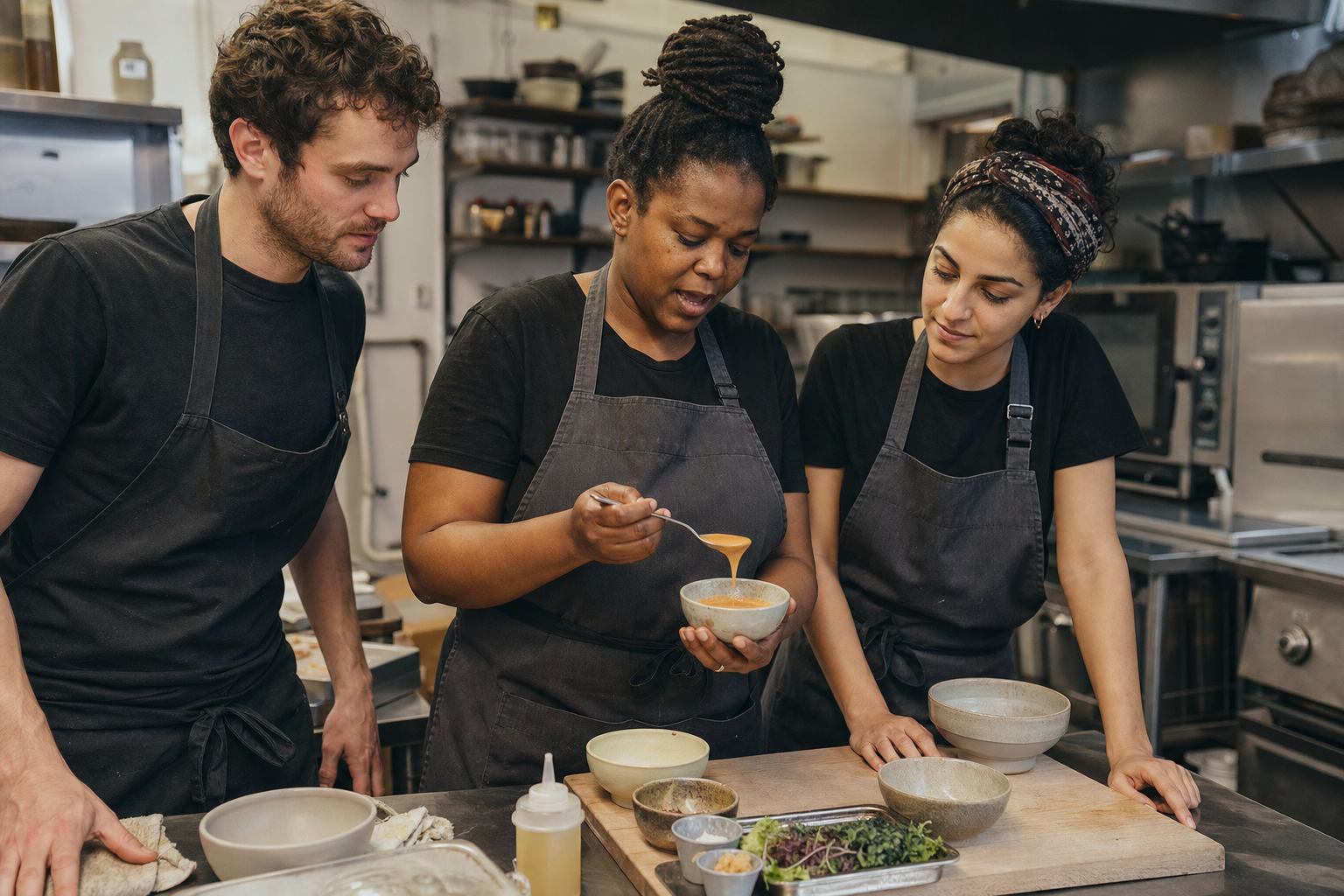
The new cook reaches for the salt.
The sauce has been simmering for several minutes. He has tasted it once, frowned slightly and moved his hand towards the container beside the stove. The cook working next to him stops him.
“Not yet,” she says. “Taste it with the preserved lemon.”
He does.
Then she adds the sentence heard in family kitchens, bakeries, cafés, hotel prep rooms and restaurant lines across the world:
“This is how we make it.”
The words are ordinary. Their meaning is not.
They may say: there is a reason for the sequence, even if you cannot see it yet. They may mean: people come here expecting this taste, and we have promised to reproduce it. They may carry the memory of the person who taught the speaker. They may protect a food-safety step, a cost, a texture or the timing on which the whole service depends.
They may also mean: stop asking.
A kitchen needs methods. Food cannot be prepared collectively if every cook treats every instruction as a suggestion. Yet kitchens also need learning, judgment and the ability to notice when a familiar method no longer works. The sentence “This is how we make it” stands between those needs.
It can be a door into knowledge.
It can be the sound of that door closing.
“We” is the largest word in the sentence
The sentence does not say, “This is how I make it.”
It says “we”.
That small word gathers a group around the method. In a household, “we” may mean the people in this family, the relatives from this region or the generations who have repeated a dish. In a restaurant, it may mean this kitchen, this shift, this company or the version guests know by the restaurant’s name.
The word gives the instruction more authority than personal preference. A cook is not merely choosing to prepare the onions in a particular way. The method belongs to a collective.
But collectives are rarely as simple as the grammar suggests.
Who developed the method? Who performs it each day? Who is included in the “we” but not allowed to change anything? Does the dishwasher who notices a recurring problem belong to it? Does a new cook join after one shift, one year or never?
“We” can create belonging. It can also hide the people whose labour and knowledge made the method possible.
Before asking whether the technique is correct, it is worth asking who the sentence allows to speak for the kitchen.
Standards need reasons, not only repetition
Restaurant guests do not usually experience consistency as a management system. They experience it as recognition.
The bread has the crust they remember. The soup carries the same balance of heat and acidity. A dish recommended to a friend resembles the one that inspired the recommendation. For a guest with a declared dietary requirement, consistency can also be part of trust: the preparation described on one visit should not become casually different on the next.
Behind that recognition are repeated decisions.
Standardised recipes can record ingredients, quantities, yields, equipment, cooking times, temperatures and presentation. They support purchasing, costing, nutrition information, training and the ability to produce a dish across different shifts. Their value is not bureaucratic neatness. It is that a restaurant’s promise should not depend entirely on which individual happens to be working.
“This is how we make it” can therefore protect the guest from arbitrary variation and the cook from being expected to invent the dish during service.
A good standard turns collective intention into something repeatable.
A new instruction can look irrational when only the current step is visible.
Why leave the sauce underseasoned now? Because the reduced stock added later is salty. Why cut the vegetables larger than seems elegant? Because they must survive holding and reheating without collapsing. Why cool the rice so quickly? Because the step protects safety, not style. Why portion the dough before resting it? Because the service schedule depends on it.
Experienced cooks often see the entire process while a learner sees the task directly in front of them.
This is one legitimate source of authority. The person correcting the step may understand consequences that will appear twenty minutes, six hours or one busy service later.
The explanation does not always need to become a lecture. During pressure, “not yet” may be enough. But when time permits, naming the later consequence turns obedience into understanding.
The learner can then carry the method into a slightly different situation instead of repeating the movement without knowing what it protects.
Tacit knowledge becomes generous through demonstration
A recipe can specify that a sauce should coat the back of a spoon. It cannot make every reader feel the correct resistance.
It can give a proofing time without knowing the temperature of today’s room. It can instruct a cook to brown onions without reproducing the smell at the moment sweetness overtakes sharpness. It can state the weight of flour while saying little about how a particular batch absorbs water.
Researchers describe much of this as tacit knowledge: practical knowledge acquired through attention, repetition and experience that is difficult to communicate completely in words. Cooking contains it everywhere.
This is why watching an experienced cook matters. The learner sees the angle of the pan, hears the change in frying, notices how often the cook tastes and observes the small adjustments absent from the written method.
“This is how we make it” is most useful when followed by something that can be sensed: look at this texture, listen for this sound, feel how the dough returns.
The sentence should lead attention towards the work, not merely towards the speaker’s status.
Knowledge becomes easier to receive when it is shown without humiliation.
A cook lifts the spoon and lets the sauce fall. They place two cuts beside one another so the difference is visible. They ask the learner to taste before and after an adjustment. They repeat the movement slowly once, then return the tool.
The action says: you are expected to learn this, and I am prepared to help you learn it.
This is different from performing expertise. A demonstration is not improved by making the learner feel clumsy. The aim is not to prove that the experienced cook can do what the newcomer cannot. It is to reduce the distance between them.
In a good teaching moment, authority remains present. One person knows more about this preparation. But the knowledge is treated as something the kitchen needs to circulate, not something the expert must hoard to remain important.
The method becomes stronger when more than one person can recognise and reproduce it.
Tone decides whether questions have a future
The same words can carry patience, pride, fatigue or threat.
Said while making space at the bench, “This is how we make it” can welcome someone into a practice. Said sharply after a reasonable question, it can announce that curiosity is dangerous. Said with affection in a family kitchen, it may connect a child to someone they never met. Said during an argument, it may use the dead, the absent or the powerful as authorities who cannot be questioned.
Listeners understand more than the literal instruction. They notice whether the speaker expects them to remember, imitate, agree or disappear.
This matters because learning requires exposure. To ask why is to admit not knowing. To raise a possible problem is to risk implying that the experienced person has missed something. Research in health-professions education describes this dilemma: learners can improve through questions and feedback, but moment-by-moment judgements about psychological safety shape whether they expose uncertainty. A restaurant kitchen is a different workplace, so the finding is used here as a limited analogy rather than proof about cooks.
Tone tells the learner whether the kitchen considers such exposure part of learning or evidence of disloyalty.
“Why do we do it this way?” can be asked in many spirits.
It can express genuine curiosity. It can be an attempt to connect a new method with previous experience. It can identify missing information. It can also be passive resistance from someone who has already decided their own way is better.
Experienced cooks learn to hear the difference, but they can mishear it—especially when tired, rushed or accustomed to defending their position.
Treating every question as disrespect carries a cost. The kitchen loses opportunities to explain the method, discover gaps in documentation and hear observations from people encountering the process with fresh attention.
Treating every instruction as negotiable carries a cost too. Service slows, inconsistency grows and the team repeatedly reopens decisions that have already been tested.
A useful kitchen distinguishes between the moment to follow and the moment to discuss. “Do it this way for tonight; we’ll taste both versions after service” protects the work without declaring the conversation permanently closed.
The new cook arrives with knowledge too
Nobody enters a kitchen empty.
A new employee may have worked with different equipment, ingredients or service volumes. They may know another regional version of the dish. They may bring techniques from a hotel, a street stall, a school, a family business or a home kitchen where written recipes were rarely used.
Not all of that knowledge fits the new operation. A method that worked for ten portions may fail at one hundred. A shortcut acceptable elsewhere may conflict with safety procedures. A beautiful finishing step may be impossible within the price or service time.
Still, difference is not the same as ignorance.
When “this is how we make it” is used to erase everything learned before arrival, the kitchen wastes experience it has already hired. A stronger approach teaches the local reason first, then remains curious about what the newcomer can contribute once they understand the context.
Joining a standard should not require pretending one had no culinary life before it.
Family standards can carry affection and power
At home, consistency is rarely managed through recipe specifications, costing sheets or formal training. It can nevertheless be fiercely protected.
One person chops the herbs finely because that is how their father did it. Another insists the dough must be mixed by hand. A relative who measures an ingredient is told that the correct quantity is something the cook should feel.
Here “this is how we make it” may carry affection more visibly. Repeating the method can keep a person, place or period of life present. Alteration feels larger than a technical choice because the dish helps the family recognise itself.
The sentence can also conceal uneven power. The person who performs most of the cooking may be expected to preserve a tradition defined by someone else. A newcomer through marriage may be corrected for making a familiar food from their own background differently. A younger relative may be invited to help but not to interpret.
The domestic and professional kitchen are not the same. Yet both reveal how easily a method becomes a rule about belonging.
Many cooking rules began as sensible responses to particular conditions.
An ingredient was unavailable. An oven ran hot. A cook needed to stretch an expensive component. A customer preferred a preparation, and it became popular. The workaround succeeded, was repeated and eventually lost its explanation.
Later cooks inherit the action as though no alternative ever existed.
This does not make the rule foolish. A preference repeated over years may create the flavour people value. But it changes the kind of claim being made. “This is the only way the dish works” is different from “This is the version our guests know” or “This is the taste our family wants to preserve.”
Clear reasons make standards more honest. They also make them easier to review.
When circumstances change, the kitchen can ask whether the method still serves its purpose. If nobody remembers the purpose, the rule may survive mainly because authority dislikes admitting that it has forgotten.
Safety is firm; consistency still requires judgement
Some methods should remain firm even when the explanation feels unromantic.
Handwashing, temperature control, cooling, storage, allergen procedures, labelling and prevention of cross-contact are not personal signatures. They protect people who may never see the work. A cook does not honour creativity by casually changing them.
In these cases, “this is how we make it” is not enough on its own. The kitchen should name the requirement and train it clearly. Staff need to know which steps are critical, what records are required, who can verify ingredients and what to do when the normal procedure fails.
The distinction between a safety rule and a flavour preference matters.
If both are enforced through the same unexplained authority, workers may not recognise which variation is inconvenient and which is dangerous. They may also hide mistakes because every deviation receives the same punishment.
A disciplined kitchen does not make all rules equally mysterious. It explains what cannot be compromised and why.
Ingredients change with seasons, suppliers and storage. Humidity affects dough. Produce varies in sweetness and water content. A pan responds differently when crowded. The same written quantity of spice can behave differently after months on a shelf.
Producing a consistent result therefore requires judgment, not merely exact repetition.
The paradox is important. A cook may need to change the action in order to preserve the intended outcome. More water today produces the texture achieved with less water yesterday. A shorter cooking time protects vegetables that arrived more tender. A smaller final seasoning adjustment follows a saltier cheese.
This is where tacit knowledge and standardisation meet.
The recipe defines the target and important controls. Skilled cooks interpret changing conditions while staying accountable to that target. “This is how we make it” should teach both the fixed elements and the range within which judgment is expected.
Uniform gestures do not guarantee consistent food.
The guest can hear the sentence without entering the kitchen
A guest asks whether a familiar dish can be changed. The server replies, “That is how the kitchen makes it.”
Sometimes this is useful honesty. A preparation may be made in advance, depend on a balanced combination or become unsafe if an ingredient is simply removed. The restaurant should not promise modifications it cannot execute well.
But the phrase can also become a shield against ordinary questions. It offers no distinction between impossible, undesirable and merely inconvenient.
A more informative answer protects both the guest and the kitchen: “The sauce is prepared with dairy before service, so we cannot remove it,” or “The chef can leave off the garnish, but the stock itself contains celery.”
The explanation need not reveal a secret recipe. It should give the guest enough truth to make a decision.
When front-of-house staff understand why a method is fixed, they can communicate boundaries without making the kitchen sound hostile to the person asking.
Correction becomes culture when others are watching
Mistakes must be corrected in kitchens. Food, time and safety do not permit every error to wait for a private meeting.
Yet the manner of correction teaches more people than the person being corrected.
A calm interruption—“Stop there; this tray needs to cool differently”—protects the work. A public humiliation adds a second message: uncertainty will be punished and status can be performed through embarrassment.
The observing team then adapts. People ask fewer questions. They conceal errors until they can fix them alone. They repeat instructions they do not understand because appearing compliant feels safer than exposing confusion.
This may create a quiet kitchen, but quiet is not the same as controlled.
Leaders can be direct without making contempt part of the method. Name the problem, give the next action and return later to the explanation. Correction should restore the process, not enlarge the corrector.
The phrase “this is how we make it” gains credibility when the way people are taught also deserves to be repeated.
Documents should distribute knowledge, not freeze it
Documentation matters.
A useful recipe can preserve ratios, yields, temperatures, equipment, holding limits, allergen information, plating references and the order of work. It reduces dependence on memory and gives new staff something to revisit without repeatedly interrupting colleagues.
But a document can become another version of unexplained authority.
If the written method is outdated, experienced staff quietly work around it while new cooks are blamed for following it. If quantities are correct only at one batch size, scaling produces failure. If the photograph shows an ideal plate that cannot be assembled during real service, the standard teaches appearance without feasibility.
The strongest recipe systems remain connected to practice. Cooks can report ambiguity. Changes are dated. The reason for a critical step is recorded where it helps. Training includes tasting and demonstration rather than handing someone a folder and calling the knowledge transferred.
The page should support the people who make the food, not compete with what they know.
Sometimes a cook is the only person who knows.
They hold a ratio in memory, recognise the correct texture or manage a preparation nobody else has been taught. The exclusivity may give them pride and security. It may also have developed because the operation never gave them time to document or teach the work.
The restaurant benefits from their expertise while becoming dependent on their presence.
When knowledge is hoarded deliberately, “this is how we make it” can mean “this is how I remain necessary.” When knowledge is trapped through neglect, the result is similar: illness, leave or departure creates a crisis.
Sharing knowledge does not diminish the person who developed it. Proper credit, responsibility and advancement can recognise expertise without making secrecy its only protection.
A resilient kitchen knows more than any one shift. It also remembers who taught it what it knows.
The sentence can erase a source
A method may enter a restaurant through a cook, supplier, neighbour, former employee or family member. After enough repetition, the kitchen begins to speak as though the knowledge originated there.
“This is how we make it” replaces “this is what she showed us.”
Not every movement requires a public genealogy. Kitchens cannot recite a full history each time they prepare a sauce. But habitual erasure matters, especially when a restaurant markets cultural depth while the people who carried that knowledge remain unnamed or poorly rewarded.
Internal memory is one place to begin. Recipe notes can identify contributors. Training can acknowledge where a technique came from. Menu language can avoid turning a specific inheritance into the chef-owner’s solitary invention.
Credit is not only ceremonial. It changes who is understood to possess knowledge and who may be consulted when the method develops.
The collective “we” becomes more truthful when it remembers how the knowledge entered the room.
Standards earn authority by receiving evidence
A cook notices that one batch repeatedly splits during service. A supplier’s product has changed. Guests return the same component. The written yield no longer matches what the kitchen produces.
If the only response is “this is how we make it,” the standard stops functioning as a tool and becomes a defence.
A reliable operation creates a route for observations to travel. The team may compare batches, taste after service, record waste, review tickets or test one controlled adjustment. Not every suggestion will improve the dish. The point is that evidence receives examination rather than automatic dismissal.
This protects standards from random change while protecting the kitchen from loyalty to a failing method.
The person closest to a repeated task often sees problems early. Position does not guarantee that their proposed solution is correct, but lower status does not make the observation irrelevant.
A standard earns authority by surviving attention, not by avoiding it.
Changing a dish well requires understanding what people recognise in it.
The defining quality may not be the obvious ingredient. It may be the order in which aromas appear, the contrast between a crisp edge and soft centre, the way the food is shared or the memory attached to its colour.
A new cook who changes the method immediately may remove the very feature that gave it meaning. An experienced cook who refuses every experiment may preserve procedures after their purpose has disappeared.
The phrase “this is how we make it” should therefore begin a more precise question: what, exactly, are we trying to keep?
Once that is known, adaptation becomes more intelligent. A safer process can replace a risky custom. A seasonal ingredient can vary while the balance remains. A new tool can reduce labour without destroying texture. A dietary version can be developed as a real preparation rather than an improvised absence.
Innovation does not have to insult inheritance. It can be inheritance paying attention to new conditions.
Leadership appears in the explanation
Kitchen leadership is often most visible during urgency, but it is built during quieter moments.
Before service, a leader can explain why one detail matters. After service, they can ask what failed. During training, they can demonstrate the target, observe the learner’s attempt and correct without converting every difference into a character judgment.
These actions take time in a workplace that rarely feels rich in time.
Yet unexplained authority creates its own expenses: repeated mistakes, dependence on a few people, staff turnover, hidden problems and standards followed only while the supervisor is present.
An explanation is not a vote on every decision. The person responsible for the kitchen still decides. The explanation makes the decision teachable and gives the team a way to recognise whether the intended result is being achieved.
“Because I said so” can produce immediate movement. It cannot produce shared judgment.
The learner will one day repeat the sentence
Knowledge travels by becoming ordinary.
The new cook who once had to be shown the sauce begins to recognise its texture. Later, another person reaches for the salt too early. The former learner stops them.
“Not yet,” they say.
At that moment, the kitchen discovers what was transmitted.
If the learner repeats only the prohibition, authority has travelled without understanding. If they can show the texture, explain the preserved lemon and listen to a question, the method has become part of a living practice.
Every teaching culture reproduces itself this way. People do not pass on only recipes. They pass on how questions were received, how mistakes were corrected, who received credit and whether knowledge was offered generously or guarded through fear.
The sentence survives, but so does the tone.
“This is how we make it—for now”
A kitchen needs the confidence to say, “This is how we make it.”
Without that confidence, collective work dissolves into personal versions. Guests cannot know what will arrive. Training becomes guesswork. Safety depends on individual memory, and every service begins by renegotiating the food.
A kitchen also needs the humility to hear an unspoken ending:
This is how we make it with these ingredients, this equipment, these people and what we currently understand.
Some parts of the method are protected because they define the dish. Some protect safety, honesty or the guest’s trust. Some carry memory worth preserving. Others are habits awaiting a reason.
The strongest “we” is neither fragile nor absolute. It can explain what it knows, name what it inherited and examine what experience brings to its attention.
Then the sentence does more than enforce a recipe.
It tells a person: this knowledge belongs to the kitchen, and the kitchen is prepared to teach you how to carry it.