“Save Room”
“Save room” does more than announce dessert. It places a future dish inside the present meal, changing how people choose, pace themselves and imagine the ending.
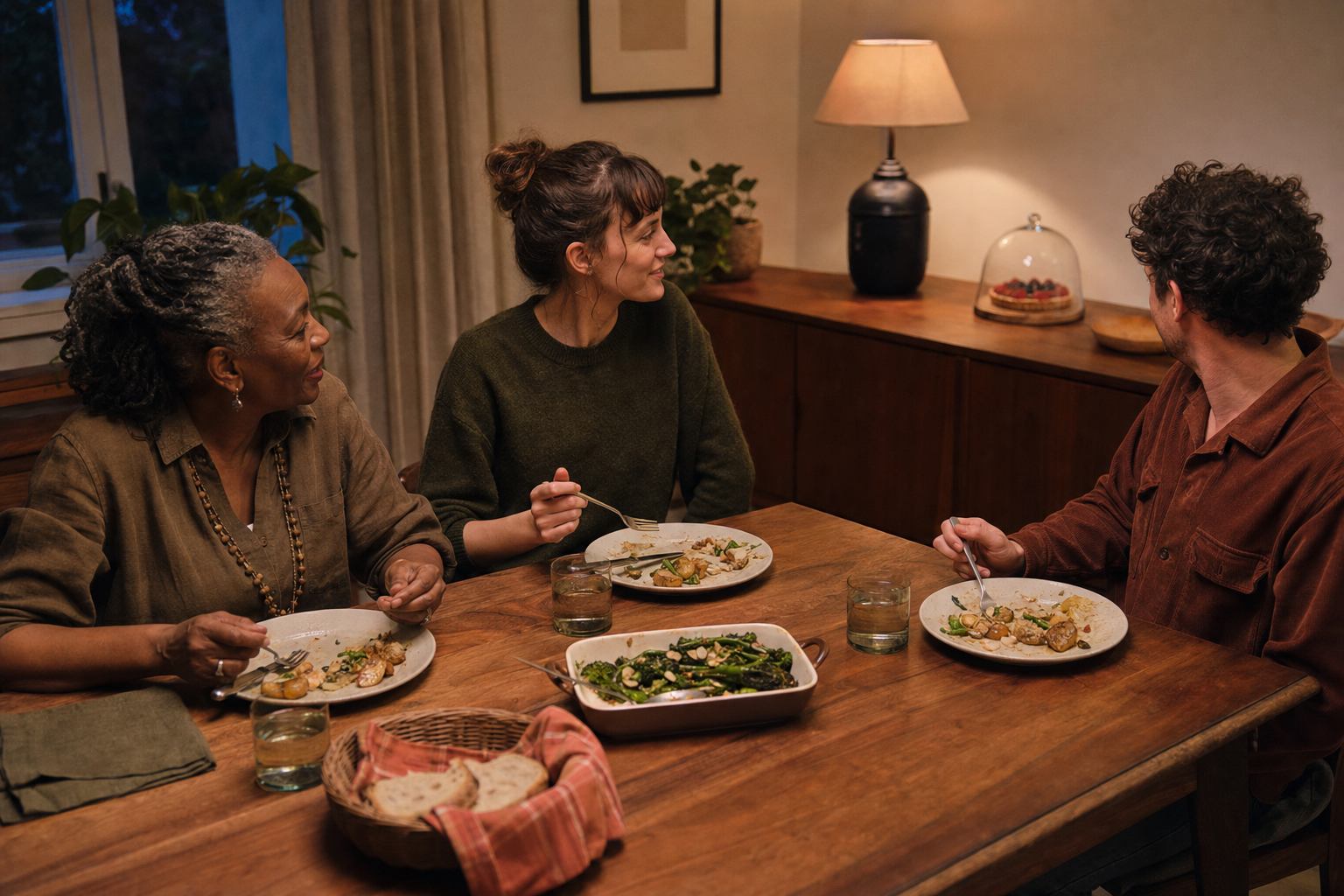
The tart is not on the table.
It waits on a sideboard beneath a glass dome, far enough from the plates to belong to later. The savoury dishes are still being passed. Someone is finishing a story. Bread remains in the basket.
Then the host says, almost in passing, “Save room.”
Nothing edible has changed. No plate has been removed, no portion divided, no sweetness tasted. Yet the meal is no longer quite the same.
One diner takes less from the serving dish. Another looks briefly toward the sideboard. A third continues exactly as before but now knows what the evening is expected to contain. The tart has entered the meal before it has entered anyone’s mouth.
“Save room” sounds like practical advice about capacity. It is also a small act of storytelling. It places a future event inside the present, turns appetite toward something absent and gives the meal an anticipated ending.
The words can carry affection, excitement, warning, persuasion or pressure. They can make a later dish feel generous before it arrives. They can also make a diner feel that eating freely now would be a failure of planning.
To hear the phrase carefully is to notice that appetite is never only a response to the food directly in front of us. It is shaped by memory, expectation, sequence, company and the belief that something else is still to come.
A future dish enters the present
The simplest meaning of “save room” is literal: do not become too full because more food will follow.
But the phrase acts before fullness can be measured. It gives the listener information and asks them to use it. The current plate becomes one part of a larger imagined whole.
That new whole may include dessert, fruit, cheese, a birthday cake, a ceremonial dish, a special bottle or a course that has taken hours to prepare. Whatever it is, the later food begins to compete for attention with food already served.
The competition is not necessarily unpleasant. Anticipation can lend brightness to the middle of a meal. The waiting dish becomes a small point of shared knowledge: we are here now, and there is something else ahead.
This is why an unseen course can influence behaviour. People do not need to taste it to make decisions around it. They need only believe that it is coming.
A future dish, once named, becomes part of the present arrangement.
“Save room” is rarely issued in the tone of a formal command.
At home it may be said with a smile while dishes are being carried in. It can mean, “I made something for you,” or “The part I am most excited about has not appeared yet.” Sometimes it is the cook’s first request for recognition.
The phrase may also contain a little secrecy. A person who knows what waits in the kitchen briefly possesses more of the evening than everyone else. Their warning offers a glimpse without giving the surprise away.
That is why “save room” can feel warm even when nobody changes what they eat. The words announce care as much as food. They reveal that someone has planned beyond the visible plate.
In another voice, however, the same words can sound supervisory. They may imply that the speaker is watching portions, expecting participation or deciding how appetite should be allocated.
Meaning depends on relationship and delivery. Affection cannot be assumed simply because the phrase is familiar.
The words are small. The social position from which they are spoken is not.
Appetite is planned as well as felt
The image behind the phrase is architectural. Somewhere inside the body, it suggests, there is a room that can be filled, reserved or accidentally occupied.
Real appetite is less tidy.
People begin meals with expectations about what will satisfy them. Familiar foods carry learned ideas about heaviness, duration and portion. The amount selected at the start may reflect not only present hunger but what a person thinks the food will do later.
Researchers distinguish between sensations that develop while eating and the expectations that help organise a meal beforehand. Those expectations are not perfect calculations. They are practical knowledge built from repetition: how sustaining this soup usually is, how much bread feels right before a main course, whether a rich dish leaves interest in anything else.
“Save room” adds another piece of information to that planning.
It does not reveal a hidden second stomach. It changes the imagined boundaries of the meal. What first looked like the whole becomes an opening or middle.
The body still matters. So do the words that tell the body’s owner what kind of event they are in.
Consider two dinners with exactly the same first course.
At one, diners believe that the dish in front of them is all that will be served. At the other, they know several courses will follow.
The food has not changed, but its role has. A bowl that might be a complete meal becomes a beginning. A generous helping may look appropriate in the first setting and strangely final in the second.
This is one reason menus, invitations and course announcements matter. They help people place each dish within a sequence. When that information is missing, diners plan from incomplete evidence.
Studies of expected satiety suggest that people often make meaningful portion decisions before eating, drawing on what they believe a food will provide. Research on dessert presentation similarly shows that placing an indulgent option earlier in a sequence can alter choices made around the rest of the meal.
These findings do not produce one universal rule for eating. They show something more useful: later food can affect earlier decisions because a meal is mentally assembled as well as physically consumed.
Anticipation is not added after appetite. It participates in appetite from the beginning.
A meal is a sequence, not an inventory
Not every culture or household divides food into the same ordered courses.
Some meals place many dishes on the table at once. Others move from small plates to a central dish, from savoury to sweet, from food to fruit, or from a formal service to tea and something brought out much later. The boundaries may be sharp or almost invisible.
Still, diners learn local ideas about what counts as a beginning, what belongs in the middle and what signals completion.
A meal is therefore more than a collection of foods. It has syntax. Dishes acquire meaning partly from position.
Soup after cake would not be nutritionally impossible, but in many settings it would feel like a disrupted sentence. Coffee may mean “the evening can continue” in one home and “we are approaching the bill” in another.
“Save room” draws attention to this grammar. It says that the visible course cannot yet be read as an ending.
The phrase gives the meal a direction of travel.
Once people expect a special ending, the middle of the meal can feel different.
Some diners slow down, making the evening last long enough for appetite to change. Others decline another helping. Someone who had been considering bread may decide to wait. Conversation may acquire an easy suspense.
The effect is not always a reduction in eating. Anticipation can heighten attention to food generally. A person excited by dessert may experience the entire meal as more festive, not merely smaller.
What changes most reliably is interpretation. The present course is understood in relation to what follows.
This is how stories work. An announced ending reorganises the scenes before it. A promised dish does something similar. The meal becomes a set of chapters rather than a single continuous act.
That structure can be especially strong when the later food carries ritual importance. A birthday cake is not simply another sweet item. It gathers singing, candles, photographs and the public marking of a person’s year. To leave before it arrives is to miss more than dessert.
The future course may hold the meaning of the occasion.
A different taste can renew attention
People sometimes joke that they are completely full until dessert appears.
The joke recognises a real distinction without needing to turn it into a biological myth.
As a particular food is eaten, its immediate appeal can decline while interest in foods with different sensory qualities remains. Research calls this sensory-specific satiety. In everyday terms, a diner may lose interest in another bite of the same savoury dish while still finding a contrasting sweet, cool or crisp food attractive.
This does not mean fullness has vanished. Nor does it prove that dessert occupies a separate compartment. It means that appetite has qualities as well as quantity.
Variety can renew attention. A change of flavour, texture, temperature or aroma may feel like a new invitation.
“Save room” anticipates that invitation. It asks diners to imagine not only more food but different food.
The distinction matters because the phrase is often heard as arithmetic: less now equals space later. Experience is subtler. The later course may appeal because it interrupts repetition, marks a transition and offers a new sensory beginning.
Dessert is an ending we have learned
In many contemporary restaurant settings, dessert appears near the end so consistently that it carries the feeling of an ending even before it is ordered.
The expectation is cultural, not inevitable.
Sweet foods can appear at breakfast, with tea, beside savoury dishes or at moments unrelated to the close of a meal. Fruit, cheese, coffee, digestifs and small confections occupy different positions in different traditions. Some meals have no separate sweet course at all.
Yet where dessert functions as a finale, it gathers the emotional work of closure. It can be shared when the main dishes were individual. It may arrive with a candle, a message, extra spoons or a reason to remain seated.
The dessert question often changes the room. Plates have been cleared. The urgent hunger that opened the meal has passed. Diners decide whether the gathering should extend.
To “save room” in this setting is partly to save time for the ending.
The course is not only consumed. It closes, prolongs or transforms the social occasion.
The promised ending is not always sweet. The phrase belongs to any food whose arrival has been deliberately delayed.
A host may warn guests about dumplings still steaming, bread finishing in the oven, a rice dish resting, a cheese brought from a journey or a late-night bowl of soup prepared for after the celebration.
At a feast, the most symbolically important food may appear after diners have already encountered abundance. Its lateness creates rank. It is not merely another option among many; it receives its own moment.
Restaurants use sequence in similar ways. A chef may hold back a signature course, an off-menu preparation or a tableside finish. A tasting menu may reveal little in advance so that each arrival can revise the diner’s understanding of the meal.
In these cases “save room” means “do not mistake plenty for completion.”
The phrase protects a place for something whose importance depends on being encountered separately.
Sweetness is one way to create contrast. Ceremony, rarity and timing can do the same.
Anticipation can be part of the pleasure
Pleasure does not begin only when food reaches the tongue.
It can begin while a recipe is described, while a smell travels from the kitchen, while a covered dish is carried past or while someone says, “Wait until you see what comes next.”
Anticipation stretches the experience across time. It allows people to imagine before they evaluate.
This can be especially generous when the promised food has a story: the first strawberries of the season, a family cake made once a year, a dessert recreated from a remembered restaurant. The waiting helps the dish gather meaning.
But anticipation works best when it remains connected to reality. An exaggerated promise can make a modest dish carry an impossible burden. Repeated hints can turn curiosity into impatience.
Good anticipation has proportion. It opens attention without demanding amazement.
The tart on the sideboard does not need an advertising campaign. Its quiet presence is enough to bend the meal toward it.
A promise can also become pressure
The warmest version of “save room” assumes that everyone will want what is coming.
That assumption may be wrong.
A guest may dislike sweet food, avoid an ingredient, be tired, feel full, need to leave or simply not want another course. None of these choices cancels the host’s effort.
Yet when a later dish has been presented as the climax of the evening, declining it can feel like refusing the occasion itself. The diner may accept a portion to protect the cook’s feelings rather than to satisfy appetite.
Pressure grows when the warning has been repeated: “I told you to save room.” What sounded playful earlier can become evidence in a small prosecution. The diner ate too much, planned badly or failed to value what was prepared.
Hospitality becomes narrower when pleasure is compulsory.
A promised dish should create possibility, not debt. The maker’s pride and the eater’s autonomy can occupy the same table if refusal is allowed to remain ordinary.
Hosts often enjoy surprise. Guests often appreciate enough information to make comfortable choices.
These interests can conflict.
If a substantial later course is completely concealed, a guest may eat the visible meal as though it were complete. The surprise then arrives as an obligation they were given no chance to anticipate.
“Save room” solves part of this problem without revealing everything. It communicates scale while preserving mystery.
More useful versions may be slightly more specific: “There is a small dessert later,” “We still have the special rice dish,” or “Cake will come after we clear.”
The amount of information needed depends on the meal. A long tasting menu requires a different map from tea with an optional biscuit.
The principle is simple: people make better decisions when they know the shape of what is being offered.
Surprise can concern flavour, appearance or story. It does not always need to concern whether another full course exists.
Anticipation belongs not only to diners.
The person who made the later dish may have been carrying it through the entire meal. They know when it was mixed, whether it set, how the fruit looked, whether the crust held and where it is waiting.
“Save room” may be the first moment that private labour enters public conversation.
This helps explain the emotional charge behind the phrase. The cook is not simply managing other people’s capacity. They are protecting an encounter they have already imagined.
Perhaps they pictured the dish being uncovered, cut and shared. Perhaps its recipe belongs to someone absent. Perhaps its success matters because the rest of the meal felt uncertain.
Recognising that hope can make diners more attentive. It should not make them captive.
The gentlest response to labour is not forced appetite. It is honest interest: a small portion, a question, admiration for the craft, or a clear thank-you even when the body says no.
Children hear a rule about deserving
For children, “save room” can become tangled with another familiar sentence: “If you are too full for dinner, you are too full for dessert.”
Adults may use this rule to create consistency or discourage bargaining. Children may hear a moral hierarchy in which the savoury meal proves virtue and sweetness is the reward.
The result can make internal sensations difficult to name. A child who says “full” during the main course but wants cake later may be accused of dishonesty, even though interest can change when a different food appears.
This does not require adults to provide every requested sweet. It asks them to separate household decisions from claims about what a child must be feeling.
Clear structure is possible without courtroom logic: dessert is part of tonight’s meal; everyone may have some; nobody has to finish everything first.
Such language keeps the adult responsible for the offering while allowing the child’s appetite to remain information rather than evidence of character.
“Save room” can teach anticipation. It need not teach suspicion of the body.
Scarcity and abundance change the promise
The phrase sounds different at a table where food is secure than at one shaped by scarcity.
When there is plenty, saving room can be playful allocation within abundance. When future food is uncertain, declining what is available now may feel unwise.
People carry histories of shortage, rationing, migration, unstable income and unequal access into present meals. A guest who eats fully when food appears may not be failing to understand sequence. They may be responding to a different knowledge of time.
Even within one household, generations can hear the phrase differently. One person trusts that the promised dish will arrive. Another has learned not to organise present hunger around future assurances.
Hospitality rarely needs this history explained aloud. It benefits from not treating one pattern of appetite as universal.
The ability to “save room” assumes confidence in the later course.
That confidence is social as well as physical.
Large meals can become confusing precisely because they are generous.
When dishes arrive continuously, diners may not know which foods are central, which are accompaniments and how much remains. Every new plate creates a fresh decision.
A host who says, “There are two more savoury dishes and then fruit,” offers orientation rather than control. The information lets guests participate in the meal’s design.
Restaurants provide similar maps through course numbers, set menus and staff explanations. A guest ordering from a tasting menu knows to interpret early portions differently from someone ordering a single main dish.
Maps do not remove spontaneity. They make abundance legible.
This matters because generosity can otherwise become a test of endurance. More food is not always experienced as more care when the end remains invisible.
To announce what is still coming can be an act of hospitality in itself.
A menu lets the future be seen
A restaurant menu is partly a document about the present: these are the dishes available now.
It is also a map of possible futures.
The dessert section can influence a guest before any order is placed. A tasting-menu description establishes length. A note about cheese, shared plates or a final course helps diners imagine the whole experience.
This does not mean every guest reads from beginning to end. Some discover dessert only when a server returns with a menu. Others decide on it before choosing a main course.
The restaurant cannot control every sequence of attention. It can make the sequence understandable.
Descriptions, portion cues and staff explanations should agree. A “small plate” that eats like a main, or a surprise supplement presented as essential, disrupts the diner’s planning.
The educational lesson is quiet: information about later courses is not merely sales material. It participates in the comfort and pacing of the meal.
In a restaurant, “Save room for our chocolate tart” can sound enthusiastic. It can also sound like a sales instruction delivered before the guest has chosen dinner.
The difference lies in timing, tone and freedom.
A server may notice genuine interest and mention a dessert that takes time to prepare. They may explain that a set menu includes several more courses. They may answer, honestly, whether portions are designed for sharing.
These comments help guests plan.
Pressure begins when every recommendation assumes purchase, when declining is met with disbelief or when dessert is framed as the only proper ending. “You cannot leave without trying it” is praise of the kitchen expressed as a restriction on the guest.
Better language keeps the door open: “If you would like dessert later, the soufflé needs twenty minutes,” or “We can bring the menu when you are ready.”
The dish may be special. The choice remains the guest’s.
Timing turns information into trust
An invitation to think about dessert can arrive too early or too late.
Mentioned before the main order, it may help someone plan for a signature dish. Repeated during the meal, it may feel as though the table is being steered toward a higher bill.
Offered immediately after the last savoury bite, it can make diners feel hurried. Delayed without acknowledgement, it can make the meal lose shape.
Research on restaurant pacing shows that excessive speed can reduce satisfaction, especially in fine dining, while quicker check settlement may be welcome. The correct tempo is not one fixed number of minutes. It is a relationship between expectation, context and experience.
A simple cue can protect that relationship. “Take your time; I’ll return in a few minutes,” gives the pause a name. “The next course will be about ten minutes,” turns waiting into anticipation rather than uncertainty.
Service timing is language made visible.
A tasting menu asks diners to surrender many individual choices in exchange for sequence.
The kitchen decides the arc: opening bites, transitions, richer courses, pauses, pre-desserts and endings. The guest consents to an experience whose meaning lies partly in not receiving everything at once.
Here, saving room is built into portioning and pace. Diners trust that early courses have been designed with later ones in mind.
That trust can be strained when supplements, bread service or unexpected extras make the total unclear. It can also be strengthened by a brief orientation at the start: how many courses, approximate duration, and whether dietary adaptations change the sequence.
The finest surprise is not the discovery that the meal is twice as long as expected. It is the way one course prepares attention for another.
Anticipation becomes structural when the restaurant carries some of the planning on the guest’s behalf.
Once a later dish has been promised, its delay acquires meaning.
At home, the cake may need to cool. In a restaurant, a soufflé, pastry or tableside preparation may require time. Waiting can heighten pleasure when diners understand what is happening.
Silence changes the same interval. A table that does not know whether an order was forgotten cannot enjoy anticipation in the same way.
The promised course therefore creates a small contract. It need not arrive instantly, but the people waiting should be able to trust the sequence.
This is especially important when the dish has been used to influence earlier choices. If guests were encouraged to plan around it, disappearance feels larger than a missing item.
Good hospitality does not eliminate delay. It makes delay intelligible and responds candidly when plans change.
Anticipation survives uncertainty only when communication does.
Groups do not save room together
A table may receive one announcement, but it contains several appetites.
One person wants dessert. Another prefers coffee. A third would share two bites but not order a full portion. Someone else is finished and ready to leave.
The phrase “Shall we save room?” can make these differences seem like a group decision that needs one answer.
Shared desserts offer a practical compromise, but they can also blur consent. Extra spoons do not guarantee equal desire. The person who wanted only a taste may end up managing everyone else’s expectation.
Groups negotiate time as well as food. Ordering dessert may extend the evening; declining may close it sooner than one diner hoped.
Servers and hosts can help by allowing mixed endings to coexist. Coffee can arrive while someone eats cake. A portion can be divided without requiring everyone to participate. The bill need not become a signal that pleasure must stop immediately.
A shared table does not require a shared level of hunger.
A promised later course can create exclusion if only some diners can eat it.
When “everyone” is told to save room for a dessert containing an allergen, alcohol or an ingredient someone avoids, the future of the meal splits. Some receive anticipation; another receives advance notice of absence.
Thoughtful planning does not require identical dishes. It requires an ending in which each person has been considered.
At home, that may mean fruit, a separate preparation or the freedom to enjoy tea without being treated as unfortunate. In a restaurant, staff should know whether the alternative is genuinely comparable, merely available or not possible that day.
The language matters. “We have something for you as well” creates a different expectation from “You can just skip dessert.”
An alternative should not be promised beyond what the kitchen can safely deliver. Clear limits are more hospitable than improvised reassurance around dietary risk.
Saving room is meaningful only when there will be a place for the diner in what comes next.
Not everyone wants a meal narrated in advance.
Some diners enjoy responding course by course. They do not wish to budget appetite, compare imagined pleasures or turn eating into a strategy.
For them, “save room” may introduce calculation where there had been ease.
This preference deserves as much respect as the desire for a map. Information can be offered without requiring a particular response. “There will be dessert later” is enough. What the listener does with that knowledge remains private.
The phrase becomes burdensome when followed by observation: how much someone takes, whether they finish, whether they have complied.
Anticipation should enlarge the experience, not install a supervisor inside it.
There are many ways to meet a later course. One can prepare for it, be surprised by it, take a small taste or decide that the meal is already complete.
The ending changes what is remembered
Meals are often remembered through a few concentrated moments rather than a complete record of every bite.
An ending has special power because it is the last part carried away.
A beautiful dessert cannot repair humiliation or poor care earlier in the meal. But a calm, well-timed ending can gather the experience. It gives people a final shared object, a last question, a reason to linger or a clear way to leave.
The promised course may therefore shape memory before it arrives. Diners anticipate not only flavour but completion: this is how the evening will resolve.
When the ending disappoints, the problem is not always the recipe. It may be that expectation was built too high, the wait went unexplained or the course arrived after the table’s attention had already dispersed.
A satisfying ending feels proportionate to the meal that led to it.
Room can mean time, attention and welcome
The room in “save room” is not only inside the body.
It is room in the schedule for one more course, room in the conversation for a pause, room on the table after plates are cleared and room in the evening for something not yet visible.
It is also room for difference.
One diner can be eager while another is finished. A cook can be proud without demanding appetite. A restaurant can recommend a final dish without treating refusal as a lost argument.
The phrase is most hospitable when it names possibility and then releases control.
“There is a tart later.”
The information enters the meal. People adjust or do not. The savoury dishes continue to be passed. The story at the table reaches its end.
The tart waits beneath its glass dome, already part of the evening and not yet asking to be eaten.