A Menu Without Jargon
Restaurants can explain unfamiliar dishes without stripping away their names, histories or the pleasure of discovery.
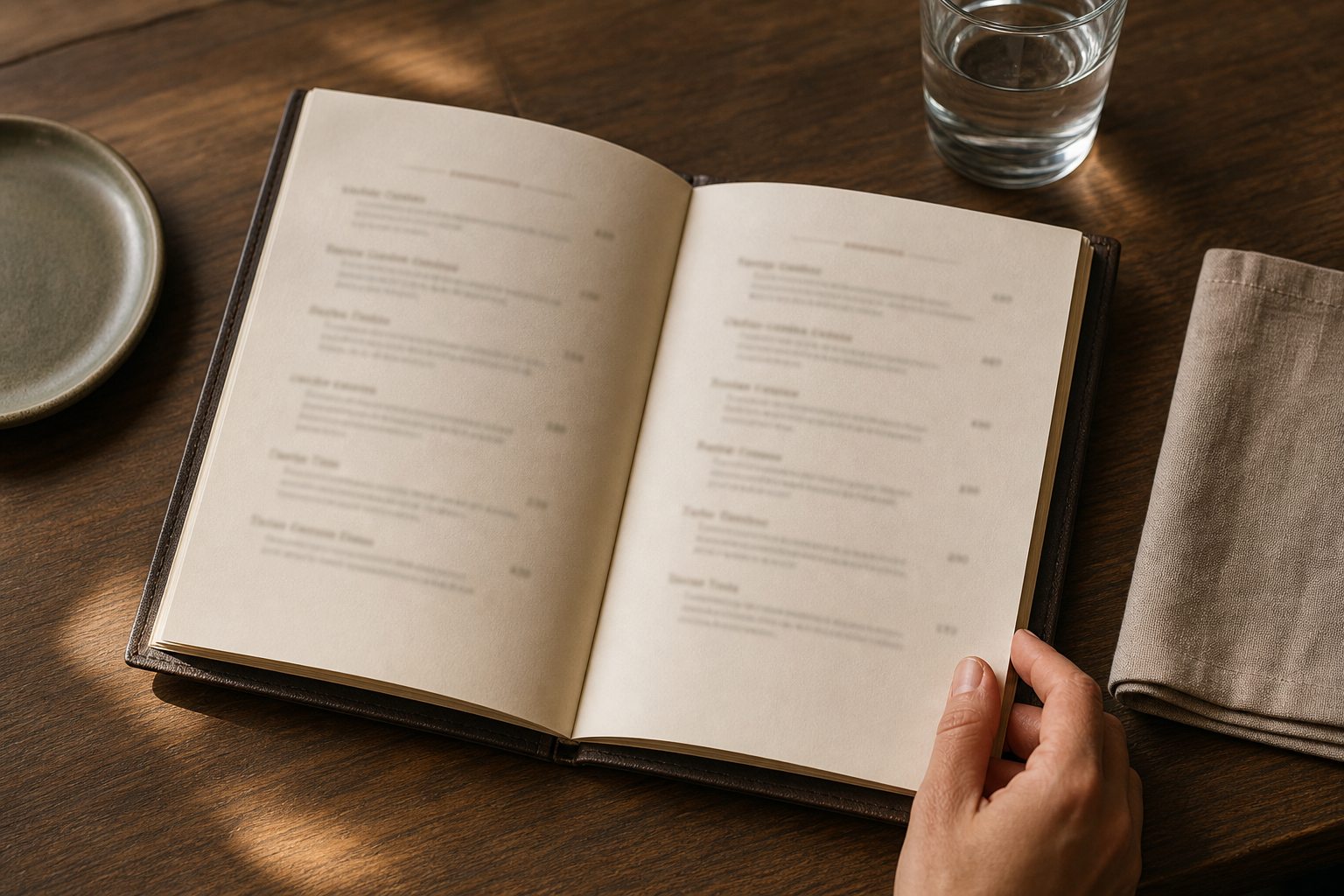
The dish has a name the table does not know how to pronounce.
It appears in the middle of the menu without a clue to its form. Beneath it is a short line containing three ingredients, one of which is equally unfamiliar. The description is elegant. It is also too compressed to reveal whether the dish is a soup, a pastry, a plate to share or something eaten in two bites.
One diner reads the name silently.
Another tries it aloud, then stops halfway through.
A third points to the line and says, “What is this one?”
The question sounds simple. It may contain several others.
What will arrive? Is it meant to be shared, and how much should we order? Is it mild or intense? Does it contain something I cannot eat? Will I embarrass myself by saying the name incorrectly? Am I expected to know?
An unfamiliar word can create appetite. It can carry the sound of another language, the memory of a place and the promise that the meal will offer something the diner could not have named before entering. The menu should not remove that possibility.
But unfamiliarity becomes exclusion when the restaurant treats knowledge as an entry requirement.
Menus often move between two unsatisfying extremes. One assumes that the diner already understands every culinary term, regional reference and house convention. The other translates so aggressively that distinctive dishes become vague combinations of protein, starch and sauce. In the first, the guest is left outside the language. In the second, the food loses part of its identity before it reaches the table.
A clearer menu does not have to choose between these outcomes.
It can keep a dish’s name and offer a way into it.
The distinction begins with what jargon actually is. Jargon is not simply any word from a language unfamiliar to the diner. Nor is every specialised term automatically a problem. Some words are the most accurate names available for a method, ingredient or dish. Replacing them can reduce rather than improve understanding.
A word becomes jargon in practice when it functions as proof of belonging rather than a path to meaning.
It tells experienced diners that they are at home while leaving everyone else to perform confidence, search privately or ask for help in public. Its purpose may be precision, but its effect is to divide the table into people who know and people who do not.
This can happen with a regional dish name.
It can also happen with familiar-looking restaurant language: crudo, confit, jus, natural, market, for the table, chef’s selection. A diner may recognise every word and still not know what quantity, preparation or commitment the menu is describing.
The problem is therefore not foreignness.
It is unsupported knowledge.
Clarity is not the same as simplification.
Dish names carry cultural meaning
A dish name carries cultural meaning that no short translated description can fully replace.
It may identify a town, a technique, a festival, a community or the person from whom the recipe was learned. It may distinguish one preparation from another that uses nearly identical ingredients. For diners who know it, the name may create an expectation of texture, temperature and occasion before the description begins.
Removing that name in favour of a generic label can make the menu easier to scan while making the dish less truthful.
“Spiced rice,” “stuffed pastry” or “slow-cooked meat” may tell a new diner something useful. None necessarily says enough to stand in for the dish itself. The translation describes a category. The name locates the food within a particular history.
The two can appear together.
A menu can lead with the dish’s own name, followed by a concise description of what the diner most needs in order to imagine it. This does not demote the original language. It gives the name room to remain visible without asking it to carry the entire burden of explanation.
The order matters.
When the generic description replaces the name, cultural specificity becomes optional background. When the name remains and the description accompanies it, context becomes an invitation to learn.
This is especially important in restaurants serving food that has often been translated for outsiders. Familiarity may have been purchased through years of renaming, shortening and adapting dishes until they seem detached from the communities that made them. A menu can resist that loss without turning authenticity into a test.
Respect does not require the diner to arrive already educated.
It requires the restaurant to present the food accurately and to share enough knowledge for the diner to approach it with confidence.
Pronunciation belongs to this question, but not in the way restaurants sometimes imagine.
A phonetic guide can be generous when it is simple, accurate and developed with speakers of the language. It can help a diner say a name they want to remember. Audio on a digital menu can offer the sound without crowding the printed page.
Yet pronunciation should never become another examination.
A guest who points, describes the dish or attempts the word imperfectly has communicated what they want. Correction may be welcome when it is offered gently and relevantly. Requiring a performance of linguistic confidence before accepting an order turns the name back into a gate.
The aim is not to make every diner pronounce the name perfectly.
It is to let the dish keep its name while making recognition possible.
Ingredient lists do not explain every dish
Many contemporary ingredient lists describe food through a line of nouns.
Beetroot, whey, sorrel.
Lamb, date, smoke.
Rice, lentil, onion.
The style can be clean and visually confident. It can also conceal the information that would make the dish imaginable.
Ingredients tell the diner what is present. They do not necessarily explain what those ingredients become.
Is the beetroot roasted, raw or fermented? Is the whey a sauce, a curd or a sharp liquid poured at the table? Does “smoke” describe a cooking method, an aroma or a theatrical moment under a glass cover? Are the rice and lentils separate components or part of a preparation whose identity lies in their combination?
A diner does not need a recipe.
They need a useful picture.
Texture, temperature, format and intensity often matter more than a complete inventory. “Crisp pastry filled with…” may be more helpful than a list of six spices. “Chilled soup” answers a question that tomatoes, cucumber and herbs do not. “Served whole for two” may determine the order more than any adjective describing the glaze.
The most useful detail changes with the dish.
For one, the diner needs to know that it is raw. For another, that it contains several small pieces intended for sharing. A fermented ingredient may deserve context if its flavour is central. A familiar dish with an unusual allergen requires precision rather than poetry.
Description is an editorial act.
The restaurant decides which information will help someone recognise the experience before choosing it. That decision should begin with the questions most likely to shape the choice, not only with the kitchen’s preferred vocabulary.
This does not mean reducing every description to texture, temperature and portion.
Menus can still be lyrical. They can mention a producer, a memory, a landscape or the season that shaped the dish. Evocative language becomes more generous when it rests beside practical meaning rather than replacing it.
“From the coast” may offer atmosphere.
It does not tell the diner whether the plate contains shellfish.
“A childhood favourite” may reveal personal history.
It does not indicate whether the dish is sweet, savoury or substantial.
The story and the structure can coexist.
A clear description reveals enough of the structure for the story to become interesting.
Familiar menu language can still exclude
Some of the most confusing familiar menu language does not look specialised at all.
“Small plates” can mean three bites or a modest main course.
“Snacks” may be the least expensive section or a collection of technically elaborate dishes.
“For the table” can identify something genuinely shared, something simply large or an item the restaurant hopes every group will add.
“Market fish” may refer to changing species, changing price or both.
“Chef’s choice” can promise trust and surprise while leaving portion, dietary flexibility and final cost uncertain.
These phrases are not empty. Within a restaurant, they may describe a precise service model. The kitchen and staff use them daily and understand the sequence they imply.
The diner encounters them for the first time.
What feels natural inside the operation may remain opaque at the table.
This is why clarity cannot be achieved only by translating non-English words. A menu written entirely in the diner’s first language can still depend on insider knowledge. Industry conventions become jargon when the restaurant forgets that they are conventions.
A brief note can solve much of this.
“Designed for sharing; we suggest two or three dishes per person.”
“A small opening plate.”
“Price changes with the day’s catch and will be confirmed before ordering.”
“Serves two as a main course.”
Such guidance does more than prevent mistakes. It lets the group begin negotiating appetite, budget and dietary needs with the same basic understanding.
The menu’s structure also teaches.
Sections, spacing and sequence tell diners how the restaurant imagines the meal. If snacks, starters and small plates are three different categories, their relationship should be visible. If side dishes are necessary to complete a main course, they should not appear as an afterthought on another page. If a set menu is the intended experience and individual ordering is secondary, the hierarchy should say so honestly.
Clear architecture reduces the amount of language required.
The diner can see where the meal begins, how it develops and what kinds of decisions belong together.
Without that structure, even beautiful descriptions become isolated clues.
Layered menu translation preserves clarity
Layered menu translation begins from the fact that no single line can serve every diner equally.
One person wants to know the principal ingredients. Another needs allergen information. Someone else is curious about the region, method or story. A regular recognises the dish immediately and wants the menu to remain quick to read.
Trying to place every fact beneath every title produces a document that is technically complete and emotionally exhausting.
Layering allows the menu to remain calm.
The first layer is the name.
The second offers the shortest useful description: the form of the dish, its defining ingredient or method and any characteristic a diner should understand before choosing.
A third layer can provide dietary markers, portion guidance or the meaning of a term used repeatedly across the menu.
Further context may live in a glossary, a small note, a digital extension or the conversation with staff.
The layers should not hide essential information.
Price, relevant allergen information, whether a defining ingredient is raw, and the basic scale of the dish should not require a separate website or a confident question. Additional history can be optional. Safety and the structure of the order cannot.
Digital menus can make layering easier.
A diner might open a short note about a regional preparation, hear the name spoken or view fuller allergen information without expanding every printed description. This can be valuable when it supports the table rather than pulling everyone into a phone.
On a digital menu, clarity also includes the way language is marked for technology. When a dish name or explanatory phrase changes language, correct language metadata can help screen readers pronounce it more appropriately. A definition or glossary link can make an unusual term available without removing it from the page. These are small technical decisions, but they continue the same editorial promise: diners should be able to encounter a precise word and find a usable path to its meaning.
Technology does not correct unclear writing by itself.
A QR code leading to a dense page of unexplained terms only relocates the problem. A translation generated without cultural or linguistic review may turn a precise name into an inaccurate approximation. A glossary helps only when its definitions use words clearer than the ones they explain.
Good translation requires editorial responsibility.
Someone must decide what should remain untranslated, what needs explanation and which explanation is both accurate and useful. That work is best done with people who know the language, food and context—not only with a dictionary or an assumption about what outsiders will understand.
The same care applies to diacritics, regional spelling and the way a name is rendered from one writing system into another.
Correctness matters. So does consistency. A menu that preserves original names in one section but casually renames them in English in another creates an uneven hierarchy: some cuisines remain culturally specific while others are treated as available for easy adaptation.
Layering makes room for integrity without demanding encyclopaedic detail.
The menu can be readable at a glance and rewarding under closer attention.
Dietary and allergen clarity cannot depend on confidence
For a diner with an allergy, intolerance or religious dietary requirement, unclear language is not merely awkward.
It can determine whether participation feels possible.
A poetic description may omit an ingredient because the kitchen considers it a minor component. A translated dish name may resemble a familiar preparation while containing a stock, garnish or cooking fat the diner would not expect. A symbol may indicate that a dish can be adapted without explaining what the adaptation changes.
The diner then has to ask.
Questions are often necessary and responsible. No menu can anticipate every medical or personal need. But the quality of the written information changes the kind of question required.
“Does this contain nuts?” is different from asking a server to reconstruct the entire dish at the table.
“Can the sauce be served separately?” is different from discovering after ordering that the main preparation depends on an ingredient the diner cannot eat.
Clear baseline allergen information protects both the guest and the staff member answering.
The legal requirements vary by jurisdiction, so a menu essay cannot substitute for local compliance advice. In the European Union, Regulation 1169/2011 makes information about specified allergens mandatory for non-prepacked food, while national rules can determine how that information is presented. That establishes a safety floor rather than a complete writing strategy. A restaurant still has to decide whether the information is easy to find, whether its symbols are explained and whether staff can answer consistently when a recipe or supplier changes.
Dietary markers should have defined meanings. “Vegetarian” should not shift between sections. “Gluten-free” should distinguish between a dish made without gluten-containing ingredients and a kitchen able to manage cross-contact, where that distinction matters. “Can be made vegan” should indicate that an adaptation is available, not leave the diner to wonder whether the result remains a complete dish.
This precision does not require covering the menu in warnings.
It requires a system the restaurant understands and can explain consistently.
Jargon is especially harmful here because it converts a practical need into a test of culinary literacy. A diner should not have to know that a named paste traditionally contains shellfish, that a glaze is made with meat stock or that a particular style of noodle usually includes egg.
Tradition is relevant information.
It is not a substitute for clear ingredient information.
A restaurant can respect the integrity of a dish while stating clearly what it contains and whether changes are possible.
Restaurant service continues menu explanation
Even the clearest menu leaves room for restaurant service to continue its explanation.
A server can notice when a table is reading with curiosity or hesitation. They can offer orientation without assuming ignorance: how the dishes are sized, what is usually shared, which flavours are especially intense and where the kitchen recommends beginning.
The phrasing matters.
“Would a quick sense of how the menu is structured be helpful?” leaves the diner a choice.
“You know what that is, right?” demands a performance.
“This is a chilled yoghurt-based dish with…” begins with usable meaning.
“It’s traditional” may be true while explaining almost nothing.
Good service does not recite a glossary.
It listens for the question beneath the question.
When a diner asks, “Is this good?” they may be asking whether the flavour is approachable, whether the portion is sufficient or whether their uncertainty has become visible. When they ask for the most popular dish, they may want social reassurance more than a ranking.
The server can respond without making the guest feel that they have failed to read correctly.
They can also model pronunciation naturally. Repeating a dish name as part of the answer gives the table another chance to hear it without turning correction into a lesson. If the diner points, the order remains valid. If they attempt the name, effort can be received warmly rather than evaluated.
Staff need support to do this well.
They need opportunities to taste the food where possible, accurate explanations of its methods and knowledge of which details matter to different questions. Memorising a polished sentence is less useful than being able to explain the same dish briefly, practically or historically according to what the diner wants.
The menu and the service should agree.
If the printed description calls a dish mild while staff routinely warn that it is hot, the writing is not doing its job. If the menu suggests that plates are shared but the server recommends one per person, the structure remains unclear. Repeated questions are evidence the restaurant can use in its next edit.
Conversation is a continuation of the menu.
It should deepen understanding, not repair information that was withheld for style.
Menu clarity protects discovery
Restaurants sometimes fear that menu clarity will remove a dish’s surprise.
There is a genuine pleasure in receiving something not fully imagined. A sauce may be brighter than expected. A familiar ingredient may arrive in an unfamiliar texture. The composition of the plate can reveal the kitchen’s point of view in a way no sentence could reproduce.
Clarity does not eliminate this pleasure.
It protects it from the wrong kind of surprise.
Discovering an unexpected aroma is different from discovering that the “small plate” was enough for four people after the table ordered one for each diner. Encountering a new texture is different from learning only when the dish arrives that its central ingredient is raw. A beautiful garnish can remain unannounced. A major dietary risk cannot.
The menu does not need to predict every detail of the plate.
It needs to establish a trustworthy range of expectation.
Within that range, curiosity becomes easier. The diner can choose something unfamiliar because they understand enough to take the risk willingly. They are not ordering blindly to prove openness or retreating to the one item whose vocabulary feels safe.
Clear language can therefore expand rather than narrow adventurous eating.
It gives appetite somewhere to begin.
This is also why generic adjectives offer so little help.
“Delicious,” “authentic,” “elevated,” “artisanal” and “signature” tell diners how the restaurant wants the dish valued. They rarely tell them what they might experience. Specific language—charred, chilled, sour, brothy, crisp, slow-cooked—creates a more useful anticipation.
Precision can be sensual.
The right concrete word does not flatten a dish. It lets the diner imagine heat, texture and movement. It makes the mouth attentive.
Clear restaurant menus can still have a voice
Clear restaurant menus are sometimes mistaken for neutral language.
But a menu without jargon does not have to sound administrative. It can be warm, playful, spare, scholarly or intimate. It can reveal where ingredients come from and why a dish matters. It can use rhythm and surprise.
Voice becomes a problem only when it asks diners to admire the writing instead of understanding the meal.
A long story attached to every dish can create another kind of opacity. So can jokes that conceal portion or ingredients, references understood only by regulars and descriptions written primarily for social media rather than the person making an order.
The strongest voice knows when to step forward.
An opening note may explain the restaurant’s approach to sharing. A short sentence can acknowledge the family or place behind a recipe. A section heading can set the pace of the meal. The individual descriptions can then remain precise.
Editing is an act of hospitality here.
It removes the phrase that sounds impressive but contributes no meaning. It notices when two terms are being used for the same preparation. It replaces a general claim with one sensory detail. It preserves the word that carries cultural identity and adds the phrase that helps a new diner approach it.
The result is not a menu emptied of expertise.
It is expertise made available.
Diners should not have to pretend
At the table, the unfamiliar dish is still waiting to be chosen.
Its name remains where it belongs.
Beside it, the menu now offers a form, a defining flavour and an indication of size. The diner may still ask how the word is pronounced. They may want to know more about the region or technique. The server has something meaningful to add.
But the first question no longer has to be, “What is it?”
The diner can ask, “Is it sharper than this one?” or “Would it work with what we’ve ordered?” Curiosity has moved beyond basic decoding and into the meal itself.
This is what clarity makes possible.
It does not guarantee that every diner will choose the unfamiliar dish. Nor should it. Hospitality is not measured by persuading guests to prove their adventurousness.
It is measured by whether the choice is genuinely available.
A menu without jargon does not remove difficult words.
It removes the expectation that diners must hide what they do not know.
It allows a person to read slowly, point, ask, learn or decide against a dish without feeling that the restaurant has divided the room into insiders and everyone else.
The dish keeps its name.
The diner receives a way in.